


How to Get the Best Computer Parts Scrap Prices Today
Introduction
Navigating electronics recycling can be complex, especially when trying to determine the actual value of your old hardware. Computer board scrap prices are not fixed; they are influenced by a variety of factors including precious metal markets, the specific grade of the board, and the volume of material being processed. For businesses and individuals in the Chicago area, understanding these values is the first step toward a sustainable and profitable recycling strategy.
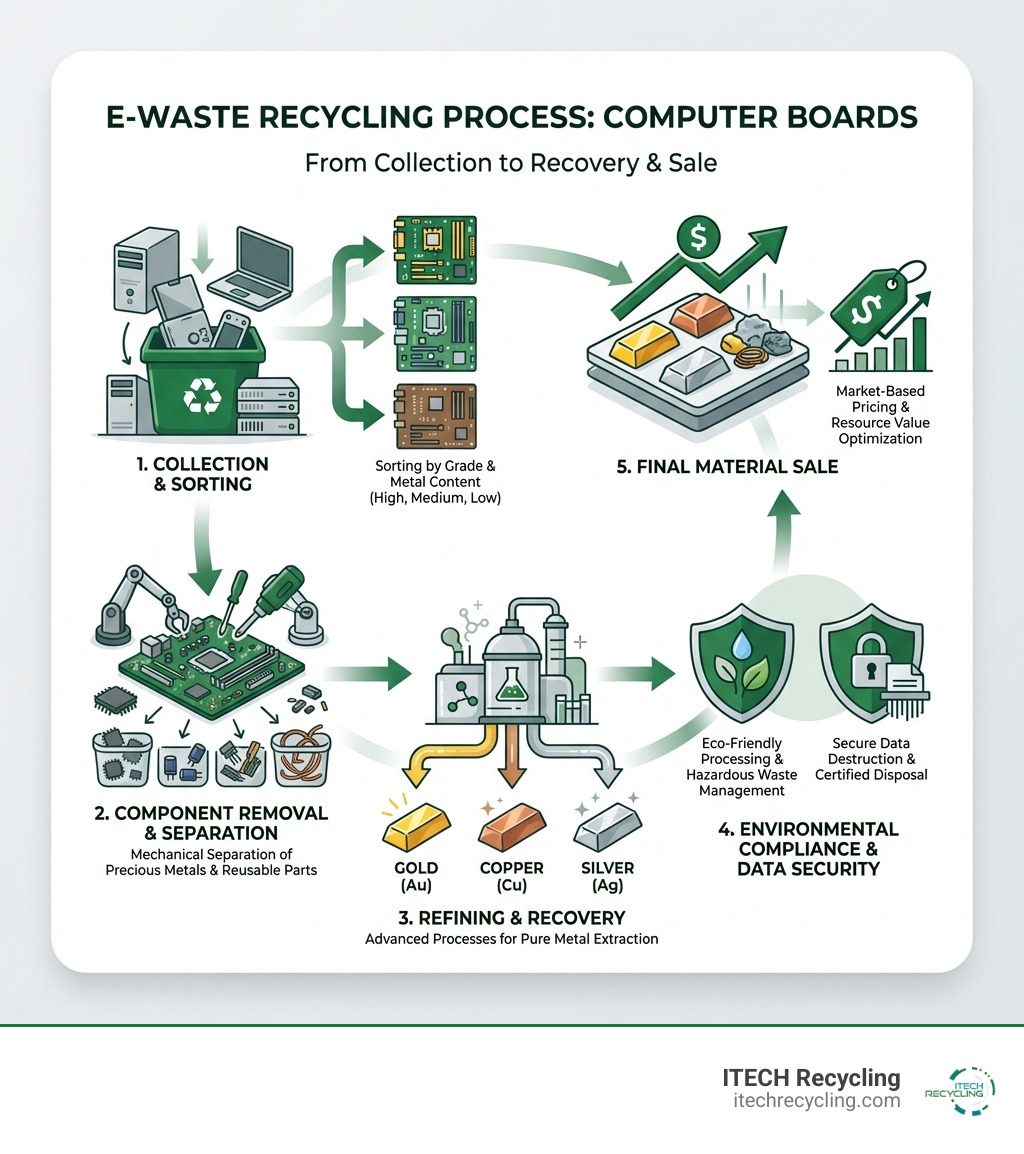
Why Understanding Computer Board Scrap Prices Matters
Computer board scrap prices vary widely based on grade, metal content, and market conditions—but knowing current rates can help you maximize value from old electronics. Here’s what you need to know right now:
Current Computer Board Scrap Price Ranges:
| Board Type | Price Range (per lb) |
|---|---|
| High-Grade Boards | $3.50 – $11.23 |
| Clean Gold Fingers | $50.00 – $60.00 |
| Motherboards (Small Socket) | $1.25 – $2.70 |
| Motherboards (Large Socket) | $3.00 – $5.90 |
| Populated Circuit Boards | $0.29 – $0.58 |
| Low-Grade Boards | $0.15 – $1.15 |
| Cell Phone Boards | $14.00 – $16.25 |
| CPU Processor Chips | $4.00 – $205.00 |
Whether you’re a business disposing of old IT equipment or an individual looking to recycle electronics, understanding computer board scrap prices helps you get fair value while ensuring responsible disposal. Prices fluctuate based on precious metal content (especially gold, silver, and copper), board quality, and whether you’re selling small quantities or truckloads.
The challenge is knowing how to identify different board types, where to sell them, and how to prepare materials for the best payout. Many scrap yards won’t accept e-waste at all, while others pay dramatically different rates for the same materials. Some boards contain enough gold to fetch $60 per pound, while others barely reach 50 cents.
Security is another critical concern. Computer boards often come from devices containing sensitive data—improper disposal can lead to data breaches, while unlicensed recyclers may not follow environmental regulations for handling hazardous materials like lead and mercury.
I’m Felix Bagr, owner of iTech Recycling in Chicago, and I’ve spent years helping businesses and individuals understand computer board scrap prices to maximize value while ensuring compliant, secure disposal. This guide will walk you through current market rates, grading systems, and best practices for getting the most from your electronic scrap.
Understanding Computer Board Scrap Prices and Market Grades
When we talk about computer board scrap prices, we aren’t just talking about one flat rate. The “board” inside a microwave is vastly different from the one inside a high-end server. In the recycling industry, we categorize these materials into “grades.” The higher the grade, the higher the concentration of precious metals like gold, silver, and palladium.
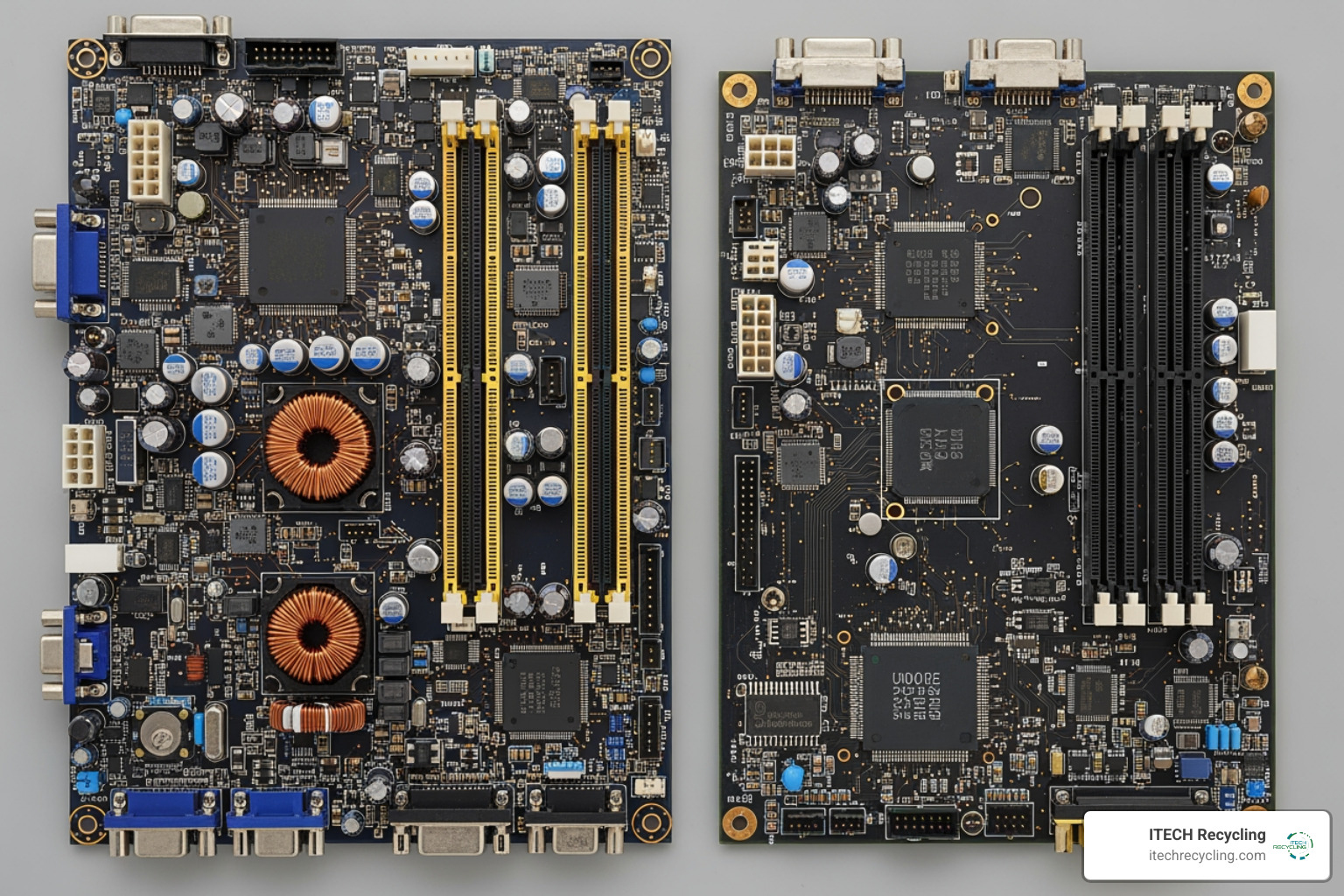
To get the best return, you must understand the difference between a “populated” board and a “stripped” one. A populated board still has its components (chips, capacitors, etc.) attached. If you shear these components off, you change the grade. For instance, populated circuit boards might fetch around $0.29/lb for small loads, but high-grade versions can jump to over $11.00/lb.
Common Market Grades and Price Ranges
| Grade | Description | Price Range (per lb) |
|---|---|---|
| High Grade | Telecom boards, server boards, hard drive boards (non-SATA). | $3.50 – $17.50 |
| Mid Grade | Peripheral cards (video/sound), networking cards, some medical equipment boards. | $1.25 – $1.50 |
| Low Grade | Power supply boards, monitor boards, printer boards (low gold content). | $0.15 – $0.50 |
| Finger Boards | Boards with gold-plated “fingers” or connectors. | $3.00 – $5.65 |
If you want to learn more about how these materials are processed, check out our guide on Electronics and Computers Recycling.
High-Grade vs. Low-Grade computer board scrap prices
The “gold standard” of the industry is the high-grade board. These are typically found in telecommunications equipment and servers. Why? Because these machines need to be incredibly reliable, and gold is the best non-corrosive conductor.
- Telecom Boards: These are the heavy hitters. High-grade telecom boards are densely packed with IC chips and gold-plated connectors. You can see an example of this in the VIDEO: High Grade Telecom.
- Peripheral Cards: These are your standard computer plug-ins, like older video cards or network interface cards. These are usually mid-grade.
- Low-Grade Boards: Think of the brown or green boards found in power supplies or remote controls. They have lots of copper and iron but very little gold, which is why they pay the least.
Comparing Motherboard and CPU Scrap Values
Motherboards are the most common item we see in our Chicago and Elgin facilities. However, not all motherboards are created equal.
- Large Socket Motherboards: These come from older units (Pentium 3 and older). They generally have more gold plating and higher-quality components, fetching up to $5.90/lb. You can see a breakdown in the VIDEO: Large Socket Motherboard.
- Small Socket Motherboards: These are P4 and newer. While still valuable, they have less precious metal than their ancestors, typically pricing between $1.25 and $2.70/lb.
- CPUs: The processor is the “brain” and the gold mine of the computer. Ceramic CPUs can fetch $12.00/lb, while rare, older chips like the Intel 386 or 486 can go for a staggering $205.00/lb!
For a deeper dive into these components, read A Complete Guide to CPU Recycling.
Key Factors That Influence computer board scrap prices
Why do prices change? If you checked the price last month, it might be different today. The computer board scrap prices you receive are influenced by several global and local factors:
- Precious Metal Markets: Since the value of a board is tied to the gold, silver, and copper it contains, the “spot price” of these metals on the stock market dictates the scrap price. If gold goes up, your high-grade boards go up.
- The Monthly Electronics Scrap Index: This index tracks the overall health of the e-waste market. Recently, the Monthly Electronics Scrap Index rose 0.39%, showing a slight increase in demand for materials like finger trimmings and high-grade boards.
- Quantity (LTL vs. TL): In the scrap world, volume is king. LTL (Less Than Truckload) prices are for smaller batches. TL (Truckload) prices are for bulk shipments, often doubling the payout per pound because the processing cost per unit is lower. For example, populated boards might pay $0.29/lb for LTL but $0.58/lb for TL.
- Contamination: If your boards have large aluminum heatsinks, heavy iron brackets, or batteries still attached, the buyer will “downgrade” the price to account for the extra weight of the “junk” material they have to remove.
How to Maximize Your Payout When Selling Scrap Boards
If you want to get the highest computer board scrap prices, you can’t just throw everything into a bin and hope for the best. Preparation is the key to moving from “mixed scrap” prices to “premium” prices.
- Strip the Heatsinks: Aluminum and copper heatsinks are worth money on their own, but if they stay on the board, they make the board “low grade” because they add non-precious weight. Remove them and sell the aluminum separately.
- Remove the Batteries: This is a big one. Many boards have CMOS batteries (coin cells). If you leave these on, some recyclers will dock your pay or refuse the load due to environmental hazards.
- Sort by Grade: Don’t mix your $5.00/lb motherboards with your $0.15/lb power supply boards. If you mix them, most yards will pay you the lowest common denominator price for the whole pile.
- Harvest the “Fingers”: If you have the tools, cutting the gold-plated “fingers” off of RAM and peripheral cards can be highly lucrative. Clean gold fingers can fetch between $50.00 and $60.00 per pound.
- Separate the RAM and CPUs: Never sell a motherboard with the RAM and CPU still attached. These components are worth significantly more per pound than the board itself. Memory chips alone can go for $6.50/lb, while the board might only be $1.75/lb.
For residents in the Chicago suburbs, we recommend checking out our guide on Computer Recycling in Melrose Park, IL: How to Prepare Your Device.
Where to Sell and Important Risks to Consider
Finding a buyer for computer board scrap prices can be tricky. Not every local scrap yard in Naperville or Aurora is equipped to handle e-waste.
Local Scrap Yards vs. Specialized E-Waste Recyclers
General scrap yards usually focus on steel, copper pipe, and aluminum cans. They might take your boards, but they often pay a “flat rate” that is much lower than what a specialized e-waste recycler like us would offer. Specialized facilities have the equipment to properly assay and grade the material.
Mail-In Programs
For those not near a major hub like Chicago, mail-in programs are an option. However, be aware of “lot minimums.” Many programs require at least $150 worth of material before they will even process your shipment. You also have to factor in the cost of shipping, which can eat into your profits.
The Major Risk: Data Security
This is the most overlooked part of scrapping. Computer boards—specifically those from hard drives or motherboards with onboard flash storage—can contain sensitive data. If you sell your scrap to a “guy with a truck,” you have no guarantee that your data is destroyed.
At iTech Recycling, we prioritize security. Whether you are in Bolingbrook, Evanston, or Schaumburg, we offer Secure Data Destruction in Chicago, IL: Protect Business Information to ensure that while you get your scrap value, you aren’t losing your privacy.
Environmental and Economic Benefits of Board Recycling
Recycling computer boards isn’t just about the cash in your pocket; it’s a vital part of the “circular economy.”
- Resource Recovery: Mining for new gold and copper is incredibly taxing on the environment. It is much more efficient to recover gold from a circuit board than to dig it out of the ground. In fact, a ton of circuit boards contains 40 to 800 times more gold than a ton of gold ore!
- Landfill Diversion: Circuit boards contain lead, mercury, and cadmium. When left in a landfill, these toxins can leach into the groundwater. By recycling, we ensure these hazardous materials are handled according to EPA standards.
- Economic Growth: The e-waste industry creates local jobs in collection, sorting, and refining. When you choose a local Chicago-area recycler, you’re supporting the local economy.
To see the full picture of how this works, read What is E-Waste Recycling and How is it Done?.
Frequently Asked Questions about Computer Board Scrap Prices
Are computer boards worth scrapping?
Absolutely. While a single board from a home PC might only be worth a few dollars, the value adds up quickly when you sort and aggregate. For businesses with hundreds of outdated workstations, the scrap value can offset the cost of new equipment. Beyond the money, the environmental necessity of keeping heavy metals out of Illinois landfills makes it a “must-do.”
Why do motherboard scrap prices vary by socket type?
It comes down to the era of manufacturing. Older “Large Socket” boards (like those for Pentium 3 or older chips) were manufactured when gold was cheaper and used more liberally in the circuitry and pins. Modern “Small Socket” boards use thinner plating and more efficient (but less valuable) alloys. You can see the visual difference in this VIDEO: Large Socket Motherboard.
How does gold content affect computer board scrap prices?
Gold is the primary driver of high-end scrap prices. It is found in three main areas:
- Gold Fingers: The connectors that plug into slots.
- Pins: The connectors on CPUs and some board headers.
- IC Chips: Many integrated circuits use microscopic gold wires to connect the silicon chip to the lead frame. The thicker the plating and the more chips on the board, the higher the price per pound.
Conclusion
Navigating computer board scrap prices doesn’t have to be a mystery. By understanding the grades—from low-grade power boards to high-value gold fingers—and taking the time to properly sort and prepare your materials, you can significantly increase your payout.
At iTech Recycling, we serve the entire Chicago area, from the North Suburbs like Glenview and Evanston down to Bloomington and Springfield. We don’t just look at the metal; we look at the big picture. We provide a secure, compliant, and sustainable way to turn your “e-junk” into recovered resources. Whether you have a single box of motherboards in Elgin or a truckload of servers in Naperville, we ensure you get a fair market price while protecting your data.
Ready to see what your boards are worth? Get a quote for Electronics and Computers Recycling from us today and let’s keep Illinois green together!
 Prev
Prev