

Hard Disk Disposal Service: Ultimate 2026 Security
Why Secure Hard Disk Disposal Service Matters for Your Data and the Planet
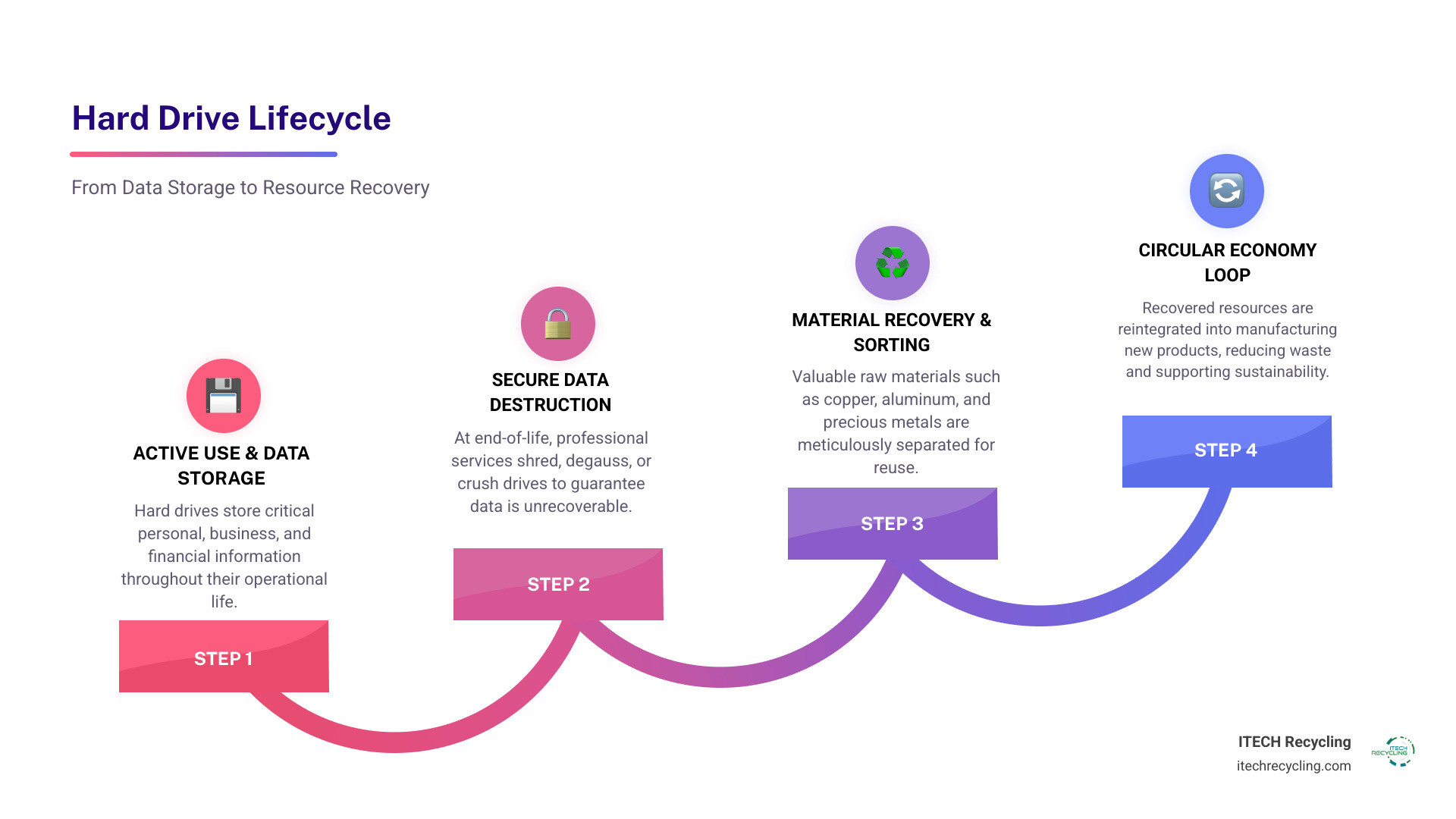
A hard disk disposal service protects your sensitive information while keeping toxic e-waste out of landfills. Here’s what you need to know:
Quick Answer: How to Properly Dispose of Hard Drives
- Physical Destruction – Industrial shredding reduces drives to 2mm particles (most secure)
- Degaussing – Strong magnetic fields erase data permanently
- Crushing/Punching – Physical damage to platters prevents data recovery
- Professional Service – Certified providers follow chain-of-custody protocols
- Certificate of Destruction – Legal proof of compliant data sanitization
Never: Simply delete files, reformat, or throw drives in regular trash
Your old hard drives contain more than just forgotten files. They hold your personal information, business records, customer data, and financial details. Even after you delete everything and reformat the drive, sophisticated software can recover that data. Meanwhile, hard drives contain hazardous materials like lead and mercury that contaminate soil and water when dumped in landfills.
The good news? Professional hard drive destruction solves both problems at once.
As Felix Bagr, owner of iTech Recycling, I’ve helped thousands of businesses and individuals safely dispose of electronic waste while recovering valuable materials like copper, aluminum, and precious metals. Our certified hard disk disposal service ensures your data stays permanently erased while keeping toxic components out of the environment.
The process is simpler than you might think. Whether you have one drive or a thousand, certified recyclers use industrial shredders, degaussers, and crushers to make your data completely unrecoverable. Then they separate the materials for responsible recycling. You get a Certificate of Destruction as proof of compliance with privacy laws like HIPAA and FACTA.
Let’s walk through everything you need to know about choosing the right hard drive disposal method for your needs.
The Hidden Risks of Improper Hard Disk Disposal Service
When you upgrade your office computers in Chicago or clear out old laptops in Naperville, it’s tempting to think that a quick “factory reset” is enough. Unfortunately, that’s a dangerous myth. Improperly handling your hardware can lead to consequences that last much longer than the life of the computer.
Identity Theft and Corporate Espionage
The information stored on hard drives is far more accessible than most people realize. Even if a drive is “dead” and won’t boot up, the magnetic platters inside still hold data. Cybercriminals and data thieves look for discarded electronics in trash bins or at uncertified recycling centers.
If your drives fall into the wrong hands, they can access:
- Social Security numbers and birth dates.
- Internal business invoices and budgetary numbers.
- Proprietary software and trade secrets.
- Private emails and customer contact lists.
This is why understanding 5 Reasons to Choose Hard Drive Shredding Services is critical for anyone handling sensitive information.
Legal Penalties and Compliance
For businesses in Illinois, data privacy isn’t just a good idea—it’s the law. If you are in the healthcare, financial, or legal sectors, you are likely governed by strict regulations:
- HIPAA (Health Insurance Portability and Accountability Act): Requires the secure destruction of patient records.
- FACTA (Fair and Accurate Credit Transactions Act): Mandates the destruction of consumer information to prevent identity theft.
- GLBA (Gramm-Leach-Bliley Act): Requires financial institutions to explain how they share and protect customer private information.
Failing to use a certified hard disk disposal service can result in massive fines, legal battles, and a devastating loss of customer trust. We’ve seen how Data Destruction in Palatine, IL: Why It Matters for Every Business helps local companies stay compliant and avoid these pitfalls.
Environmental Toxins
Beyond the digital risks, there is a physical risk to our planet. Hard drives are not just metal and plastic; they contain hazardous materials like lead, mercury, and cadmium. When electronics are tossed into a landfill, these toxins can leach into the groundwater, poisoning the local ecosystem. By choosing a responsible recycling partner, you ensure these materials are diverted from landfills and handled according to EPA standards.
Professional Methods for a Secure Hard Disk Disposal Service
To truly protect your privacy, the data must be rendered unrecoverable. We use several heavy-duty methods to ensure that even the most determined hacker can’t get a single bit of info off your old drives.
Physical Shredding
This is the “gold standard” of data security. An industrial shredder uses roughly 40,000 pounds of force to slice the hard drive into tiny pieces. At our facilities, we can shred drives into particles as small as 2mm. Once a drive has been through the shredder, the data is physically gone—it’s impossible to reconstruct. This is the primary method we use for our Service: Hard Drive Shredding and Data Destruction.
Degaussing
Degaussing uses a powerful magnetic field to scramble the data on magnetic media. It essentially “neutralizes” the magnetic particles on the platters, making the drive completely useless and the data unreadable. While very effective for traditional Hard Disk Drives (HDDs), it doesn’t work on Solid State Drives (SSDs), which store data on chips rather than magnetic platters.
Crushing and Stake Punching
Crushing applies roughly 7,500 pounds of force to punch a hole directly through the drive’s platters. This deforms the magnetic surface so severely that the drive can never spin again, and the data cannot be read. Stake punching is a similar, cost-effective alternative that physically compromises the drive’s integrity before it is sent for metal recovery.
The Standards We Follow
We don’t just guess at what’s “secure.” We follow the most rigorous federal guidelines:
- NIST Special Publication 800-88 Guidelines: The modern standard for media sanitization, which outlines how to clear, purge, and destroy data.
- DoD 5220.22-M standards: While the military has moved toward NIST standards, we still adhere to these legacy protocols for clients who require them.
| Method | Effectiveness | Best For | Physical Recovery Possible? |
|---|---|---|---|
| Software Wipe | Moderate | Reusing drives | Yes (with advanced tools) |
| Degaussing | High | HDDs, Tapes | No |
| Crushing | Very High | All Drives | No |
| Shredding | Absolute | Maximum Security | No |
On-Site vs. Off-Site Hard Disk Disposal Service
We offer flexibility depending on your security needs.
- Off-Site Destruction: We collect your equipment from your location (free for 20+ items!) and transport it securely to our facility for processing.
- On-Site Destruction: For businesses that need to witness the destruction for compliance, we can arrange for mobile units or witnessed punching. This provides the ultimate peace of mind.
Regardless of the location, we maintain a strict chain of custody. This includes GPS-tracked trucks, 24/7 video surveillance at our facilities, and barcode scanning at every touchpoint. We take Secure Data Destruction in Chicago, IL – Protect Business Information seriously, ensuring your assets never go missing.
Ensuring Compliance: Certifications and the Chain of Custody
When you hire a hard disk disposal service, you are trusting them with your most valuable asset: your reputation. That’s why certifications matter. You shouldn’t just take a company’s word for it—you should look for independent verification.
R2v3 and RIOS Certifications
We are proud to be a certified electronics recycling company. These certifications aren’t just badges; they are rigorous standards that require annual audits:
- R2v3 (Responsible Recycling) Certification: This is the premier global standard for e-waste. It focuses on data security, worker health and safety, and environmental protection.
- RIOS (Recycling Industry Operating Standard): An integrated management system that ensures quality, environmental, and health and safety performance.
The Paper Trail: Certificate of Destruction
After we destroy your media, we provide a Certificate of Destruction. This document is your “get out of jail free” card during an audit. It lists:
- The date and location of destruction.
- The method used (shredding, crushing, etc.).
- The serial numbers of the individual drives.
- Verification of the chain of custody.
This documentation is a key part of IT Asset Disposition in Chicago, IL – Secure Solutions for Technology, providing the legal proof you need for HIPAA or FACTA compliance. We also ensure that all asset tags are removed before processing, so your company’s name isn’t attached to any scrap material.
Environmental Impact and Resource Recovery
Recycling hard drives isn’t just about destroying data; it’s about mining for the future. Hard drives are concentrated “treasure chests” of valuable materials. By using a professional hard disk disposal service, you are participating in a circular economy.
Precious Metal Recovery
Did you know that recycling one million laptops can save enough energy to power 3,500 homes for a year? Hard drives contain:
- Gold and Silver: Used in circuit board connectors.
- Copper: Found in the wiring and motors.
- Aluminum: Most drive platters and casings are made of high-grade aluminum.
- Palladium: A rare metal used in electronic components.
When we shred a drive, the mixed “shred” is sent to specialized facilities that separate these metals. This reduces the need for destructive mining operations, which are a major source of global pollution.
Diverting Hazards from Illinois Landfills
By processing your e-waste in facilities that follow ISO 14001 (Environmental Management) and ISO 9001 (Quality Management) standards, we ensure that the hazardous bits—like the lead solder or mercury in older components—are handled safely. This is a core part of What is E-Waste Recycling and How is it Done?.
Whether we are performing Hard Drive Shredding in Skokie, IL – Protecting Data & Environment or serving clients in Aurora, our goal remains the same: 100% landfill diversion for all hazardous electronic components.
Frequently Asked Questions about Hard Drive Destruction
What is the average cost of a hard disk disposal service?
On average, expect to pay between $7 and $20 per hard drive. The final price depends on a few factors:
- Volume: The more drives you have, the lower the per-unit cost.
- Location: Drop-offs at a facility are usually cheaper than scheduled pickups. For example, some facilities charge a flat $20 fee for drop-offs.
- Service Level: Simple crushing is often more affordable than high-security 2mm shredding.
- Free Options: We offer FREE business recycling for 95% of companies in our service area (including Chicago, Bolingbrook, and Elgin). If you have 20+ items, we even provide free collection!
For specific details on regional services, check out our guide on Hard Drive Destruction in Aurora, IL – Ensuring Privacy Through Responsible Recycling.
What other media can be destroyed besides hard drives?
A complete hard disk disposal service should handle all types of data-bearing media. We don’t just stop at HDDs. We also destroy:
- Solid State Drives (SSDs): These require specific shredding because data is stored on small chips.
- USB Flash Drives & SD Cards: Small but packed with data.
- Backup Tapes: Old magnetic tapes can hold terabytes of sensitive archives.
- CDs, DVDs, and Floppy Disks: Legacy media still needs secure disposal.
- Cell Phones and Tablets: Modern mobile devices are essentially pocket-sized hard drives.
Our Service: Electronics and Computers Recycling covers the full spectrum of electronic devices.
Why is a Certificate of Destruction important?
Think of the Certificate of Destruction as your insurance policy. If a data breach ever occurs and investigators come knocking, you need to prove that you didn’t just throw your old servers in a dumpster.
The certificate provides:
- Legal Proof: Documentation that you followed privacy laws.
- Audit Trail: A clear record for internal or external auditors.
- Liability Protection: It transfers the responsibility of the physical media to the recycler.
Understanding the difference between Data Destruction vs. Data Disposal in Des Plaines, IL: What Every Business Needs to Know is vital for any organization that handles third-party data.
Conclusion
At ITECH Recycling, we believe that you shouldn’t have to choose between protecting your privacy and protecting the planet. Our mission is to provide the Chicago area with a hard disk disposal service that is as sustainable as it is secure.
From our headquarters in the Chicago area to our service reach in Wood Dale, Bensenville, Franklin Park, Mundelein, Deerfield, Naperville, Elgin, Springfield, Evanston, Elk Grove Village, Bloomington, Glenview, Hawthorn Woods, Vernon Hills, Bolingbrook, Aurora, and Arlington Heights, we are dedicated to responsible e-waste management.
We’ve served over 71,000 business customers and recycled more than 32 million pounds of electronics. Whether you are a small business in Evanston or a major corporation in the Loop, we ensure your data is shredded, your hazardous materials are diverted from landfills, and your valuable resources are recovered for a greener tomorrow.
Don’t leave your data to chance. Protect your data and the planet with ITECH Recycling’s hard drive shredding and data destruction services. Contact us today to schedule a pickup or find a drop-off location near you!
 Prev
Prev