

The Ultimate Guide to Free IT Equipment Disposal and Recycling
Why Free IT Equipment Disposal Is More Important Than You Think
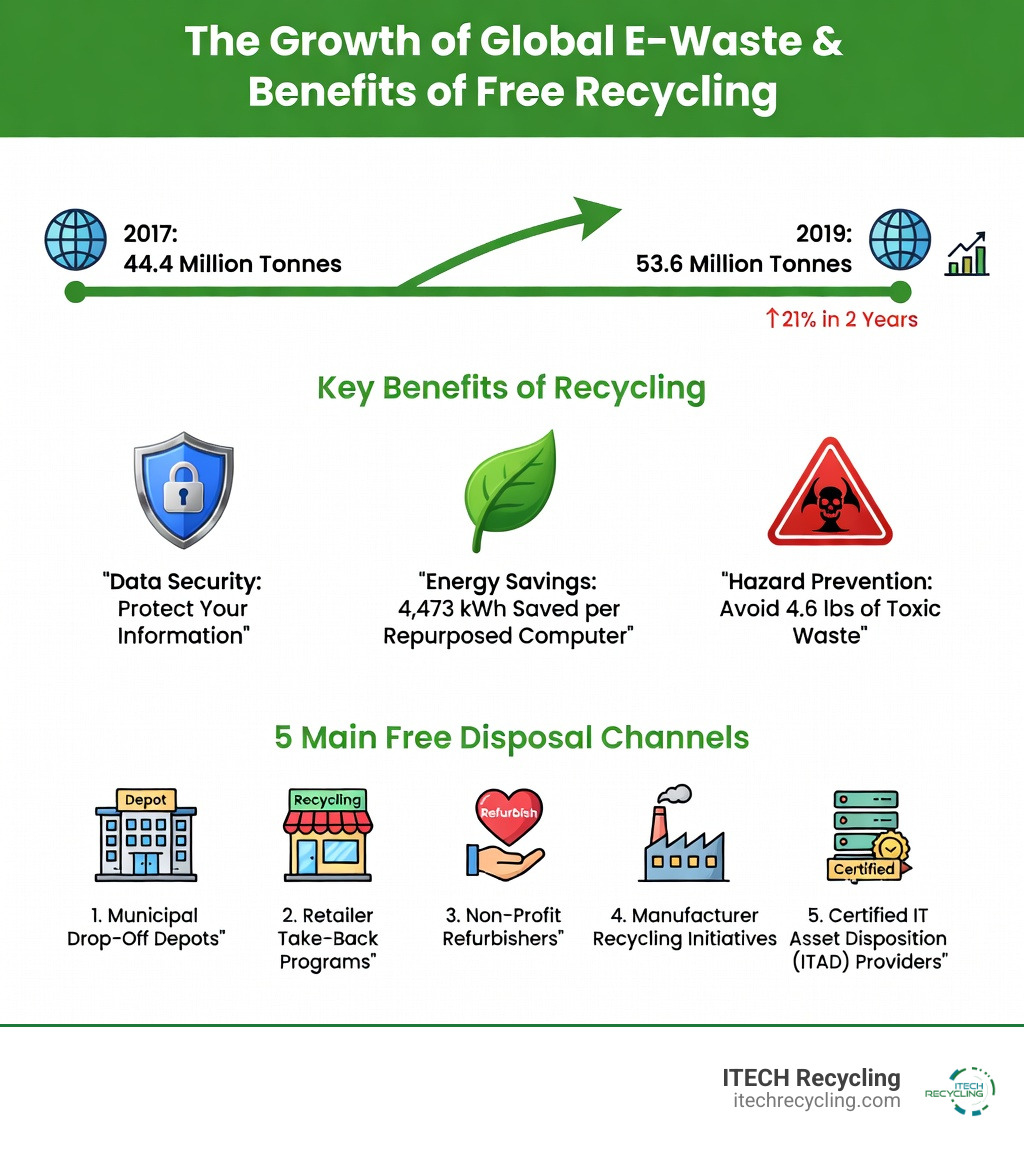
Free IT equipment disposal is available through several programs across Canada and the US — here are the fastest ways to find it:
| Option | Best For | Cost |
|---|---|---|
| Municipal drop-off depots | Residents, small volumes | Free |
| Retailer takeback programs | Common electronics | Free |
| Non-profit refurbishers | Functional devices | Free |
| Manufacturer programs | Any brand tech | Free |
| Certified ITAD companies | Businesses, bulk disposal | Often free |
The global e-waste problem is growing fast. In 2019 alone, the world generated 53.6 million tonnes of electronic waste — a 21% jump in just two years. Old computers, servers, printers, and phones pile up in offices and homes, and most people aren’t sure what to do with them.
The stakes are high. Toss old IT equipment in the trash and you risk two serious problems: a data breach from an improperly wiped hard drive, and environmental harm from toxic materials like lead, mercury, and cadmium leaching into the ground.
The good news? You don’t have to pay to solve either problem.
At ITECH Recycling, we have spent years helping businesses and individuals navigate free IT equipment disposal through secure, compliant, and sustainable programs. In this guide, we’ll walk you through exactly where to go, what to bring, and how to protect your data along the way.
Understanding Free IT Equipment Disposal: What Qualifies?
When we talk about free IT equipment disposal, it is important to understand that not every piece of “office junk” qualifies for every program. Most recycling centers and community initiatives focus on items that contain recoverable precious metals or those that pose the greatest environmental risk.
What is Accepted?
Generally, if it processes, stores, or communicates information, it is considered IT equipment. This includes the “big three”: desktops, laptops, and servers. However, it also extends to the smaller items that clutter our drawers.
| Category | Accepted for Free Disposal | Common Exclusions/Fees |
|---|---|---|
| Computing | Laptops, Desktops, Tablets, Servers | Units with leaking batteries |
| Peripherals | Keyboards, Mice, Cables, Webcams | Mixed boxes of “junk” (sometimes) |
| Printing | Desktop Printers, Scanners | Industrial-sized Plotters/Copiers |
| Displays | LCD Monitors, LED Monitors | CRT “Tube” TVs, TVs > 55″ |
| Telecom | Cell Phones, Desk Phones, Routers | Satellite Dishes |
Non-Qualifying Items
We often see people trying to drop off major appliances (microwaves, fridges) or power tools at IT recycling events. These are usually not accepted. Furthermore, hazardous materials like lead-acid batteries or items that are physically leaking chemicals are often rejected for safety reasons. If you are curious about the technical side of how these items are processed once they leave your hands, you can read more about what is E-Waste Recycling and how is it done?
Regional Variations
In our service areas—ranging from Chicago and Naperville to Elgin and Aurora—municipal rules can differ. For instance, in the City of Chicago, the Household Chemicals & Computer Recycling Facility provides a steady drop-off point, while suburbs like Vernon Hills or Deerfield may rely more on scheduled community collection days. It is vital to check your local city’s “Waste Wizard” or recycling page to see if they offer curbside pickup or if you must visit a designated depot.
Why Responsible Recycling Matters for Security and the Environment
Choosing free IT equipment disposal isn’t just about saving a few dollars; it’s about preventing a global crisis. According to the International Telecommunication Union (ITU), e-waste is the fastest-growing waste stream in the world.
Environmental Protection
Electronics are a cocktail of hazardous substances. When a computer sits in a landfill, the outer casing eventually breaks down, exposing the “guts.”
- Lead: Found in CRT glass and circuit board solder; can cause neurological damage.
- Mercury: Used in older flat-panel backlights; highly toxic to the nervous system.
- Cadmium: Present in older laptop batteries and chip resistors; a known carcinogen.
By choosing electronics and computers recycling, we ensure these materials are diverted. In fact, repurposing just one computer conserves 4,473 KWh of energy—enough to power a small home for months—and prevents 4.6 lbs of hazardous waste from entering the ecosystem.
Data Protection
For businesses and individuals alike, an old hard drive is a goldmine for identity thieves. Simply “deleting” files isn’t enough. Professional recycling programs prioritize data destruction to ensure that your private spreadsheets, photos, and passwords never see the light of day.
Essential Steps to Prepare Your Hardware
Before you head to a drop-off location or schedule a pickup, you must take ownership of your data. While we provide high-level security, the first line of defense starts with you.
- Backup Your Data: Ensure anything you need is moved to a cloud service or an external drive.
- Sign Out of Accounts: De-authorize your computer from iTunes, Microsoft 365, and Creative Cloud.
- Perform a Factory Reset: This is a basic step for Windows and Mac devices to clear user settings.
- Remove Secondary Storage: Check for SD cards in laptops and discs in DVD drives.
- Remove Batteries: If a device has a removable battery that is swollen or leaking, handle it with extreme care and place it in a separate, fire-safe container.
For a more detailed breakdown, check out our complete checklist for electronics disposal.
Data Security and Free IT Equipment Disposal
For high-security needs, we recommend looking into residential electronics recycling services that offer certified data sanitization. This often involves a “triple-pass” Department of Defense (DoD) wipe, which overwrites your data three times with random patterns, making recovery impossible even with forensic tools. For businesses, always request a Certificate of Destruction to maintain your compliance trail.
Where to Find Free Recycling Programs and Drop-Off Locations
Finding a spot for free IT equipment disposal is easier than you might think if you know where to look.
Retailer Takeback Programs
Many national retailers offer in-store recycling for many items. You can generally walk into a participating “big box” store and drop off cables, computers, and even monitors (up to a certain size). However, they do not accept large appliances or items that are leaking. Always check with your local store to confirm that electronics recycling is available before you make the trip.
Manufacturer Programs
Various manufacturer programs allow you to drop off used tech at designated locations. This is a fantastic way to ensure your old gear is handled responsibly while staying out of the landfill.
Municipal Events
Many of our local service areas, such as Naperville and Chicago, host “Community Environment Days.” These are often Saturday morning events where you can drive up and have volunteers unload your trunk for free. You can find more tips on the best computer recycling drop off spots near you to save time and fuel.
Finding a Local Partner for Free IT Equipment Disposal
If you have a large volume of equipment—perhaps you’re clearing out a small office in Bolingbrook or Arlington Heights—a local pick-up service might be the most efficient route. While some residential pickups have small fees for specific items (like CRT TVs), many business-to-business pickups for high-value IT assets like servers and late-model laptops can be arranged at no cost.
Certifications and Compliance in E-Waste Management
Not all recyclers are created equal. To ensure your equipment isn’t just being shipped overseas to be burned in open pits (a common practice in “shadow” recycling), look for specific certifications.
- R2 (Responsible Recycling): This is the gold standard. An R2-certified facility is audited to ensure they handle data securely and manage toxic materials legally.
- e-Stewards: Similar to R2, this certification has a very strong focus on preventing e-waste exports to developing nations.
- ISO 14001: This indicates the company has a verified Environmental Management System in place.
When you work with a certified provider, you aren’t just getting rid of trash; you’re participating in a circular economy. This means your old laptop might be refurbished and sold at a low cost to a family who lacks a computer, or its raw materials might be used to build next year’s smartphone.
Frequently Asked Questions about IT Disposal
What should I do if my equipment is not accepted for free disposal?
If a local depot or retailer rejects your item (common with old “projection” TVs or industrial printers), you may need to contact a specialized hazardous waste processor. In Illinois, the Resources Productivity & Recovery Authority can help you find specialized sites. Some private recyclers will still take these items for a small “processing fee” to cover the cost of safely dismantling them.
Are there differences between residential and business free recycling programs?
Yes. Residential programs are usually “drop-off” style and are funded by the city or state. Business programs often focus on “Asset Recovery.” If your business is disposing of 20 laptops that are only 3 years old, we can often provide a free pickup because the value of the refurbished parts covers our labor costs. If you are disposing of 100 broken keyboards, there might be a small fee.
How do donation programs bridge the digital divide?
Many non-profits take functional donated IT equipment, wipe the data, install open-source software (like Linux), and provide them to underserved communities. This turns “waste” into a tool for education and job hunting. Programs like these have refurbished thousands of computers, proving that your old tech still has plenty of life left in it.
Conclusion
Navigating free IT equipment disposal doesn’t have to be a headache. Whether you are a resident in Evanston looking to clear out a closet or a business in Elk Grove Village upgrading your server room, there is a responsible, secure, and free solution available to you.
At ITECH Recycling, we are committed to serving the Greater Chicago area with a focus on data security and environmental integrity. We ensure that every circuit board and hard drive we handle is processed with the highest standards of compliance, keeping our local communities clean and your private data safe.
Ready to clear the clutter and protect the planet? Schedule your responsible electronics recycling today and let us handle the heavy lifting.
 Prev
Prev