

Keeping Secrets Safe with Secure Data Destruction
Why Understanding the Goal of Secure Data Destruction Matters for Your Business
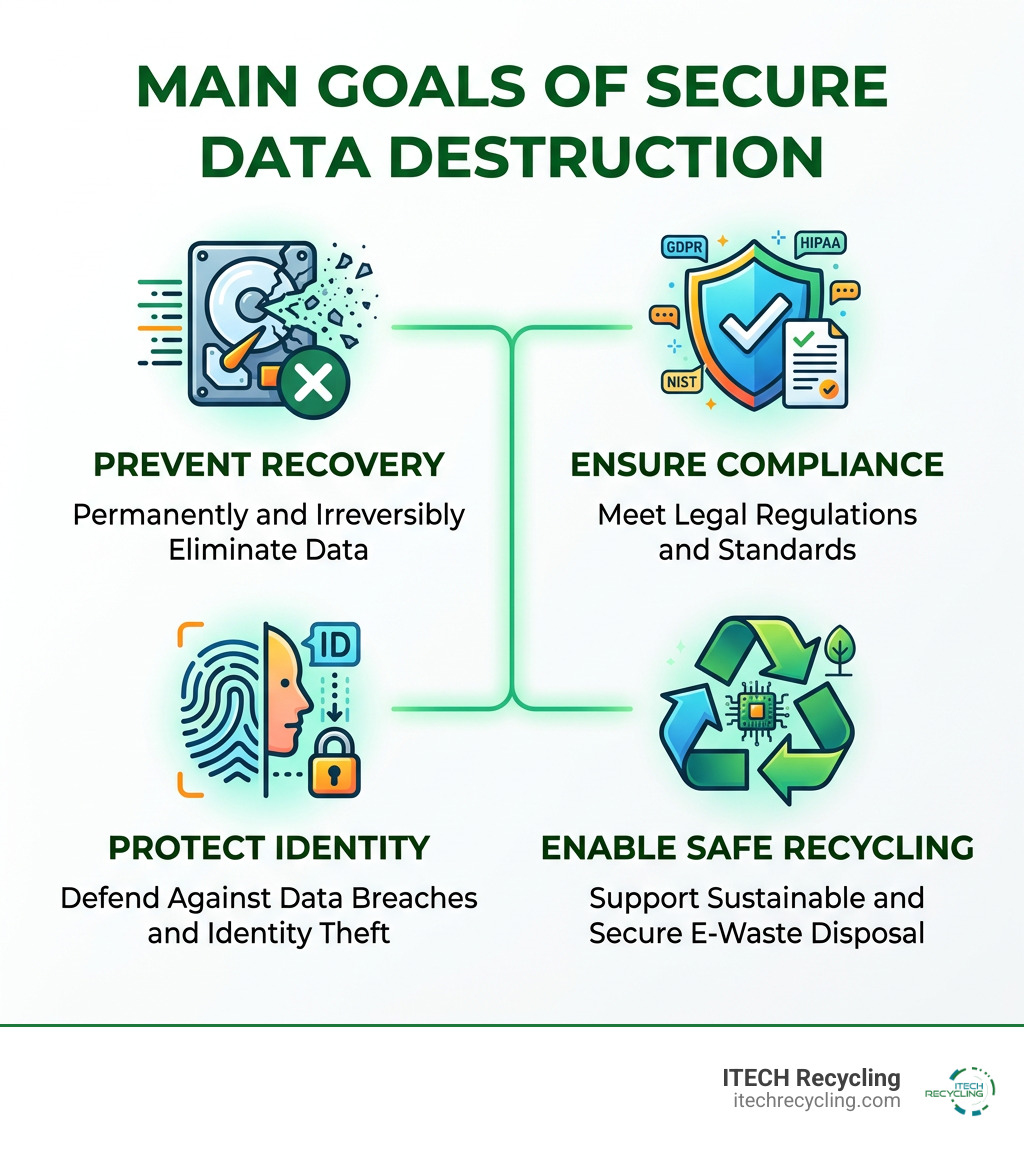
What is the main goal of secure data destruction? The primary goal is to permanently and irreversibly eliminate sensitive data from storage devices so it cannot be recovered, accessed, or misused by unauthorized parties.
In short, secure data destruction aims to:
- Prevent unauthorized access to sensitive personal, financial, or business data
- Protect against data breaches and identity theft
- Ensure legal compliance with regulations like GDPR, HIPAA, and NIST standards
- Eliminate residual data risk after devices reach end of life
This matters more than most people realize. A striking 42% of second-hand hard drives have been found to still contain sensitive data that was never fully erased. Simply deleting files or formatting a drive is not enough — data can still be recovered with widely available tools.
When devices are retired, donated, or recycled without proper data destruction, that information doesn’t disappear. It waits.
The consequences can be severe. GDPR fines alone can reach €20 million or 4% of a company’s annual global revenue. In one real-world case, a hospital was fined €65,000 after patient records were discovered in a public recycling facility.
Secure data destruction closes that gap — for good.
At ITECH Recycling, we’ve spent years helping businesses navigate the critical intersection of what is the main goal of secure data destruction and responsible electronics disposal. In that time, we’ve seen how the right destruction process protects organizations from breaches while also supporting sustainable e-waste management.
What is the Main Goal of Secure Data Destruction?
When we talk about the “main goal” of this process, we aren’t just talking about breaking things. We are talking about the complete, irreversible removal of data. Think of it like this: if you delete a file on your computer, you’ve essentially just hidden the “map” to that file. The data itself is still sitting on the drive platters or flash chips, waiting for someone with the right software to find it.
The actual goal is to ensure that even a forensic expert with a million-dollar lab couldn’t put that data back together. This is vital because unauthorized access to your company’s “crown jewels”—whether that’s customer lists, proprietary code, or employee social security numbers—can lead to catastrophic data breaches.
In today’s regulatory climate, failing to reach this goal isn’t just a security risk; it’s a legal one. For instance, GDPR violations and non-compliance risks can lead to fines that would make any CFO’s head spin. By focusing on the goal of irretrievability, we protect the business from both hackers and heavy-handed regulators.
Defining the Primary Goal of Secure Data Destruction
At its core, the primary goal is data sanitization. This is a fancy industry term that means the data is gone for good. We want to ensure confidentiality throughout the entire lifecycle of an IT asset. Whether you are in Naperville or Aurora, when your old office laptops reach their end of life, they shouldn’t become a liability.
It is important to understand the difference between simply tossing a drive and truly destroying the data. We often see businesses confuse “disposal” with “destruction.” For a deeper dive, you can check out our More info about data disposal vs destruction guide. The main takeaway? Disposal is about getting rid of the hardware; destruction is about making the information on that hardware disappear.
Why Secure Destruction is Essential for Sensitive Information
Why do we go to such lengths? Because the bad guys are patient. Identity theft and corporate espionage are multi-billion dollar industries. Cybercriminals often scour second-hand markets or even recycling bins looking for discarded hardware.
42% recovery statistic we mentioned earlier? That’s not just a random number; it’s a wake-up call. If nearly half of all used drives sold online still have data on them, it means a lot of organizations are failing at their data security duties. Whether it’s financial records, medical information, or trade secrets, if it’s on a drive, it needs a professional exit strategy. For more on the “why,” read The essential guide to electronic data destruction.
Methods of Sanitization: Shredding, Degaussing, and Overwriting
Not all destruction methods are created equal. Depending on the type of media (like an old-school spinning hard drive vs. a modern SSD) and the sensitivity of the data, we use different “tools of the trade.”
Which Method is Considered the Most Secure and Why?
If you want 100% peace of mind, hard drive shredding is the undisputed heavyweight champion. This is a physical destruction process where we feed the drives into a high-torque industrial shredder that turns them into tiny pieces of scrap metal.
Why is this the most secure? Because it physically destroys the storage medium. You can’t “un-shred” a platter. This is especially important for modern Solid State Drives (SSDs). SSDs use “wear-leveling” technology that can sometimes make software wiping unreliable. Physical shredding bypasses those technical hurdles entirely. If you’re wondering why so many of our clients in Elgin and Joliet choose this route, here are 5 reasons to choose hard drive shredding services.
The Role of Degaussing and Overwriting in ITAD
While shredding is the most visual and final, other methods like degaussing and overwriting have their place in a solid IT Asset Disposition (ITAD) strategy.
- Degaussing: This uses a massive magnetic field to scramble the data on magnetic media (like HDDs and tapes). It essentially wipes the drive and the firmware, making the device completely unusable. Note: This does not work on SSDs because they don’t store data magnetically!
- Overwriting (Data Wiping): This is a software-based approach. Special software writes random characters (0s and 1s) over every sector of the drive. The benefit here is that the drive can sometimes be reused or resold, which is great for the environment.
When we perform these services, we follow strict guidelines, such as the NIST SP 800-88 Rev. 2 Guidelines for Media Sanitization, to ensure the data is truly gone.
Comparison of Destruction Methods
| Method | How it Works | Best For | Pros | Cons |
|---|---|---|---|---|
| Shredding | Physical destruction into tiny bits | HDDs, SSDs, Tapes | 100% secure, visual proof | Device cannot be reused |
| Degaussing | High-powered magnetic field | HDDs, Backup tapes | Very fast, high security | Doesn’t work on SSDs |
| Overwriting | Software replaces data with random bits | Functional HDDs/SSDs | Allows for device reuse | Time-consuming, potential for error |
Navigating Compliance: GDPR, HIPAA, and NIST Standards
In data security, “I didn’t know” is not a valid defense. Organizations are held to incredibly high standards by various regulatory bodies.
How Secure Data Destruction Ensures Regulatory Compliance
Regulations like GDPR include “Article 17,” also known as the Right to be Forgotten. This means if a customer asks you to delete their data, you have to actually do it—completely. If you just “hide” the file, you are technically in violation.
We’ve seen what happens when things go wrong. Take the Cork University Maternity Hospital incident: they were fined €65,000 because patient data for 78 people was found in a public recycling bin. That’s a lot of money and a massive blow to their reputation for a relatively small number of records. Using Secure data destruction in Chicago ensures you have the audit trails and certificates needed to prove you did things the right way.
Meeting International Standards for Data Disposal
To keep things consistent, we look to international standards like ISO 27001 (for information security management) and DIN 66399 (the European standard for shredding). In the US, the gold standard is often NIST 800-88, which provides a framework for choosing the right level of sanitization based on how sensitive your data is. Whether you’re managing a small office in Palatine or a large corporation in Chicago, understanding these standards is key. Learn more about Data destruction in Palatine and how it keeps local businesses compliant.
Developing an Organizational Data Destruction Policy
You wouldn’t run your accounting department without a policy, so why handle your data disposal on the fly? A formal Data Destruction Policy is your roadmap for staying secure.
Documentation and Verification Processes
The most important part of any policy is the “paper trail.” If a regulator knocks on your door in Bensenville and asks where your old server’s data went, you need a Certificate of Destruction. This document should include:
- The date of destruction
- The method used
- The serial numbers of the devices
- A signature from a certified professional
Working with a provider that follows NAID standards (National Association for Information Destruction) is the best way to ensure your documentation is audit-ready. Don’t let data haunt you with NAID certification—it’s the best way to sleep soundly at night.
Implementing a Systematic IT Asset Disposal Process
A good process starts long before the shredder turns on. It involves:
- Inventory: Knowing exactly what devices you have.
- Secure Storage: Keeping retired devices in locked bins until they can be destroyed.
- Chain of Custody: Tracking the device from the moment it leaves your desk until it is shredded.
For businesses in Franklin Park or Wood Dale, having a partner who can handle the Data destruction in Franklin Park with a secure chain of custody is essential to prevent “leakage” during transport.
Environmental Sustainability and E-Waste Reduction
Here’s the cool part: secure data destruction and environmentalism actually go hand-in-hand. When we shred a hard drive, we don’t just throw the dust in the trash. We separate the materials—aluminum, copper, gold, and palladium—and send them back into the manufacturing stream.
This is part of the circular economy. Instead of digging more holes in the ground for new metals, we recover what we’ve already used. Considering the UK alone generates over 1.45 million tonnes of e-waste annually (and the US is even higher!), responsible recycling is a must. Many electronics contain toxic materials like lead and mercury; by choosing Hard drive shredding in Skokie, you are ensuring those toxins stay out of Illinois landfills while keeping your data safe.
Frequently Asked Questions about Data Destruction
Who is responsible for overseeing data destruction within an organization?
It’s a shared responsibility. The IT team usually handles the technical side, while the Security or Compliance officer ensures the policy is followed. However, the “buck stops” with the business owner or executive leadership. Even if you outsource the work, you are still legally responsible for ensuring your chosen vendor is doing the job correctly.
What are the main risks and consequences of inadequate data destruction?
The risks are three-fold:
- Financial: Fines from GDPR, HIPAA, or PCI DSS can be millions of dollars.
- Legal: Lawsuits from customers whose identities were stolen.
- Reputational: Once customers lose trust in your ability to keep their secrets, they rarely come back.
What are the benefits of outsourcing data destruction to certified ITAD providers?
Outsourcing to a pro (like us!) gives you access to industrial-grade equipment that is too expensive for most businesses to own. More importantly, it provides you with a Certificate of Destruction, which is your “get out of jail free” card during a compliance audit. It also saves your internal IT team from the tedious (and dangerous) task of manually dismantling hardware.
Conclusion
At the end of the day, what is the main goal of secure data destruction? It’s about more than just compliance or recycling; it’s about trust. Your customers, employees, and partners trust you with their most private information. Secure data destruction is how you honor that trust when the technology is no longer needed.
At ITECH Recycling, we pride ourselves on providing the Chicago area—from Evanston to Bolingbrook and everywhere in between—with a secure, compliant, and sustainable way to handle e-waste. We don’t just recycle electronics; we protect reputations.
If you have a pile of old laptops or a server room full of retired drives, don’t leave your security to chance. Let us help you close the loop. Check out our Hard Drive Shredding and Data Destruction Services today and let’s keep your secrets safe, together.
 Prev
Prev