

Enterprise Data Destruction: 3 Critical Steps
Why Enterprise Data Destruction is the Foundation of Modern Data Security
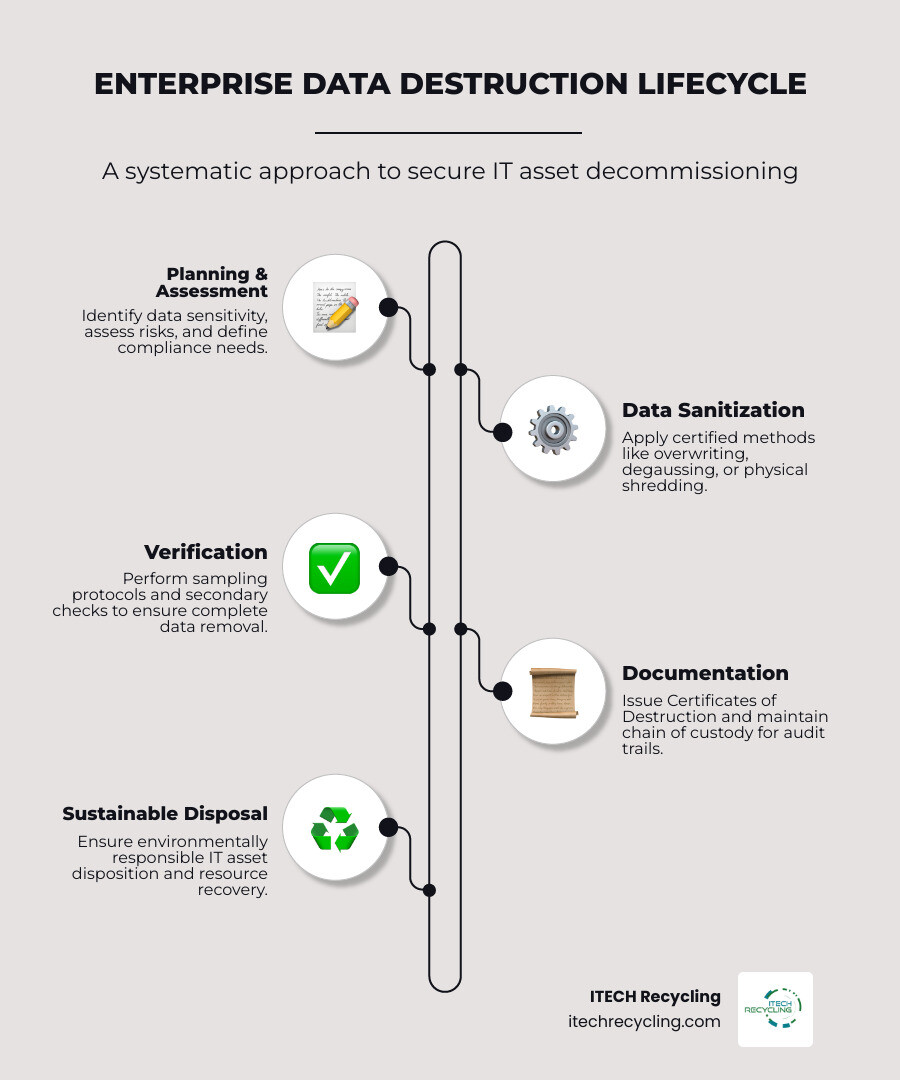
Enterprise data destruction is the systematic process of permanently eliminating data from storage devices to prevent unauthorized access, recovery, or disclosure. For organizations managing sensitive information, proper data destruction is not optional—it’s a critical security requirement that protects against data breaches, ensures regulatory compliance, and supports sustainable IT asset management.
Key aspects of enterprise data destruction include:
- Primary Methods: Overwriting (software-based data erasure), degaussing (magnetic field scrambling), and physical destruction (shredding/disintegration)
- Compliance Standards: NIST SP 800-88, GDPR, HIPAA, CCPA, and FACTA
- Service Options: On-site destruction for immediate verification or off-site processing at certified facilities
- Documentation: Certificates of destruction with chain of custody for audit trails
- Verification: Sampling protocols and secondary checks to confirm complete data sanitization
There are many concerns associated with modern cybersecurity—firewalls, cloud storage, antivirus software—but the role of data destruction should never be taken for granted. Even unused data on decommissioned devices remains a target for cybercriminals who can exploit residual information through forensic recovery techniques. Standard file deletion using commands like “del” or “rm” only removes pointers, not the actual data, making it easily recoverable without proper sanitization.
The stakes are high. Over 250 million devices have been securely erased using certified data destruction methods, yet countless more are disposed of improperly each year. Inadequate data destruction can lead to financial penalties under regulations like GDPR (up to 4% of annual revenue), litigation costs, and irreparable damage to brand reputation. For enterprises in healthcare, finance, telecom, and government sectors, a single data breach from improperly disposed hardware can expose millions of customer records.
As owner of iTech Recycling, I’ve spent years helping organizations implement secure, compliant data destruction protocols that protect sensitive information while maximizing material recovery from decommissioned IT assets. My experience leading enterprise data destruction operations has shown me that the most successful programs integrate security, compliance, and sustainability from the earliest stages of the IT lifecycle.
The Core Methods of Enterprise Data Destruction
When we talk about enterprise data destruction, we aren’t just talking about hitting the “delete” key and emptying the recycle bin. In a professional setting, data has a “secret life” on the platters and chips of your hardware, and it takes specialized techniques to ensure that life is truly over.
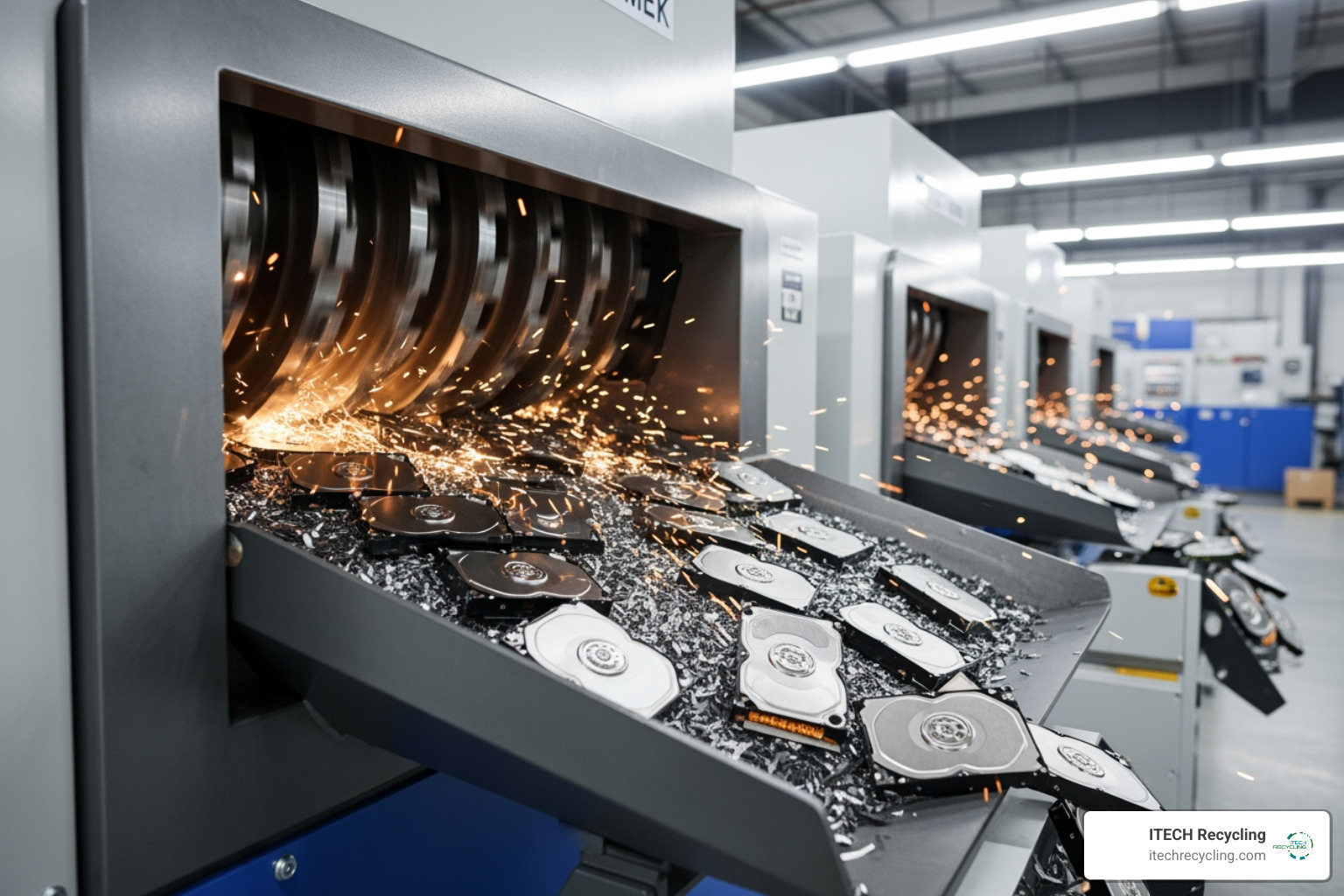
The three primary pillars of data destruction are overwriting, degaussing, and physical shredding. Each has its own place in a robust security strategy, and often, we use a combination of these to achieve the highest level of assurance.
- Overwriting: This is a software-based method that replaces existing data with random patterns of 1s and 0s. While it allows the hardware to be reused, it can be time-consuming for large drives.
- Degaussing: This method uses powerful electromagnets to scramble the magnetic fields on hard drives (HDDs) and tapes. It effectively “erases” the data but also destroys the drive’s firmware, rendering the device unusable.
- Physical Shredding: This is the “gold standard” for many. We feed the drives into an industrial shredder that reduces them to tiny pieces. If the data-bearing platter is in a thousand pieces, no one is getting that spreadsheet back.
To ensure consistency across the industry, we follow the Guidelines for Media Sanitization provided by NIST. This framework helps us categorize the level of effort required to make data recovery infeasible.
Technical Standards for Media Sanitization
The NIST SP 800-88 standard defines three levels of sanitization: Clear, Purge, and Destroy. Understanding these is vital for any Chicago-area business looking to manage its risk.
| Method | Definition | Best Use Case |
|---|---|---|
| Clear | Logical techniques to sanitize data in all user-addressable storage locations. | Internal redeployment of non-sensitive hardware. |
| Purge | Physical or logical techniques that render data recovery infeasible even using state-of-the-art laboratory techniques. | Decommissioning sensitive assets for resale or donation. |
| Destroy | Renders target data recovery infeasible and the media unable to store data. | End-of-life assets containing highly confidential information. |
For many modern enterprises, cryptographic erase (CE) is becoming a popular choice. This involves destroying the encryption keys for a drive that was already encrypted. Without the keys, the data remains on the drive but is mathematically impossible to decrypt. However, we always recommend verifying that encryption was enabled from the start before relying on CE. More info about choosing the right destruction method can help you decide which path fits your specific hardware profile.
Hardware-Specific Destruction Protocols
Not all hardware is created equal. A method that works for an old magnetic hard drive might fail miserably on a modern Solid State Drive (SSD).
- SSD Wear Leveling: SSDs use “wear leveling” to spread data across flash cells. This means traditional overwriting might miss some data hidden in “spare” cells. For SSDs, we use specialized “Secure Erase” commands or physical shredding to a very small particle size (often 2mm or less).
- Magnetic Platter Destruction: For HDDs, the goal is to destroy the magnetic coating on the platters. Degaussing is highly effective here, but shredding is the most visually verifiable method.
- Mobile Device Sanitization: Smartphones and tablets often require a factory reset combined with cryptographic erasure. Because these devices are so portable, they represent a significant “spill” risk if not handled correctly.
We provide specialized hard drive shredding and data destruction services that account for these hardware nuances, ensuring that whether it’s a server from a Naperville data center or a laptop from an office in Skokie, the data is gone for good.
Legal Frameworks and Regulatory Compliance
In enterprise data destruction, the law is just as important as the technology. If you are a business operating in Bensenville or Aurora, you are subject to a web of regulations designed to protect consumer privacy.
- GDPR (General Data Protection Regulation): Even if you’re based in Illinois, if you handle data of EU citizens, you must comply. Fines can reach 4% of annual global turnover.
- CCPA (California Consumer Privacy Act): Similar to GDPR, this affects any business doing significant business in California, emphasizing the “right to be forgotten.”
- HIPAA/HITECH: Crucial for our healthcare clients in Evanston and Glenview, these laws mandate the secure destruction of Protected Health Information (PHI).
- FACTA (Fair and Accurate Credit Transactions Act): Requires the destruction of consumer report information to prevent identity theft.
It is important to distinguish between “data disposal” and “data destruction.” Disposal is just getting rid of the item; destruction is the verified process of making the data unrecoverable. More info about data disposal vs. data destruction highlights why the distinction matters for your legal standing.
Accountability and Audit Trails
If a regulator knocks on your door in Arlington Heights, “we shredded it, we promise” isn’t going to cut it. You need an audit trail. A professional enterprise data destruction service provides a Certificate of Destruction. This document includes:
- The serial numbers of the destroyed devices.
- The method of destruction used.
- The date and time of the service.
- The names of the personnel involved.
This creates a clear “chain of custody,” proving that the media was under secure control from the moment it left your facility until it was destroyed. We strictly adhere to NIST Special Publication 800-88 Revision 1 to ensure our documentation meets federal and private-sector audit requirements.
Consequences of Inadequate Data Disposal
The “secret life” of a server can turn into a nightmare if it ends up in the wrong hands. Inadequate data destruction leads to more than just fines; it leads to a total breakdown of trust.
- Financial Penalties: Beyond regulatory fines, the cost of notifying victims and providing credit monitoring can be astronomical.
- Litigation Risks: Class-action lawsuits are a common byproduct of data breaches.
- Reputation Loss: Once customers lose faith in your ability to keep their data safe, they rarely come back.
By safeguarding proprietary data, businesses in Bolingbrook and beyond can avoid these pitfalls and maintain their competitive edge.
Cybersecurity Strategy and Risk Management
We often think of cybersecurity as a digital battle fought with firewalls and encryption. But the physical security of your data is the “last mile” of that strategy.
Cybersecurity Risks and Enterprise Data Destruction
Threat actors are increasingly sophisticated. They don’t just hack into active networks; they look for “low-hanging fruit” like discarded hard drives in dumpsters or sold on secondary markets.
- Forensic Recovery: High-end software can often recover data from drives that have been simply “formatted.”
- Malware Risks: Some malware, like the infamous Shamoon or other “wiper” attacks, are designed specifically to destroy data to interrupt business operations. By implementing our own controlled data destruction, we ensure that we are the ones in charge of the data’s end-of-life, not an adversary.
- Insider Threats: Disgruntled employees or contractors might attempt to walk off with decommissioned but un-erased drives.
Our work in secure data destruction in Chicago is designed to close these physical loopholes in your security posture.
Proactive Risk Mitigation Policies
The best way to manage risk is to have a policy in place before the hardware ever reaches its end-of-life.
- Asset Auditing: Keep a strict inventory of every drive and mobile device.
- Decommissioning Workflows: Define exactly who is responsible for pulling drives from servers and where they are stored while awaiting destruction.
- Security Hygiene: Regularly use file-level erasure for temporary data that is no longer needed, even on active systems.
Responsible computer recycling in Schaumburg is a key part of this hygiene, preventing data breaches before they can even begin. For larger operations, data center decommissioning requires a specialized, high-volume approach to ensure no drive is left behind.
IT Asset Disposition (ITAD) and the Circular Economy
Data destruction is a major part of a larger process called IT Asset Disposition (ITAD). This is how we manage the “retirement” of technology in a way that is secure, compliant, and environmentally friendly.
Sustainability Benefits of Enterprise Data Destruction
When we destroy data, we don’t have to destroy the environment. Many people think that “shredding” means the materials are gone forever, but that’s not the case. In fact, enterprise data destruction is a gateway to the circular economy.
- Resource Recovery: Hard drives are rich in valuable metals like gold, aluminum, copper, and palladium. After shredding, these materials are separated and refined to be used in new products.
- Carbon Footprint: By recycling these metals, we reduce the need for destructive mining operations, significantly lowering the carbon footprint of the IT industry.
- LEED Points: For property managers in Mundelein or Deerfield, we can provide certificates that track carbon emissions saved, which can contribute to LEED certification for their buildings.
We focus on sustainable IT asset management to balance the absolute need for security with our responsibility to the planet.
Supporting the Circular Economy
The circular economy is all about keeping materials in use for as long as possible.
- Refurbishment: If a device can be securely erased (using NIST-compliant software) rather than shredded, it can be refurbished and sold, extending its life.
- Component Harvesting: Even if a laptop is broken, its RAM or screen might be perfectly fine for use in repairs.
- Hazardous Material Handling: We ensure that lead, mercury, and other toxics found in older electronics are diverted from Illinois landfills.
Our electronics recycling for businesses ensures that your old gear becomes a resource for the future, not a liability for the present.
Selecting a Certified Service Provider
Choosing a partner for enterprise data destruction is a high-stakes decision. You are essentially handing over the “keys to the kingdom.”
Key Factors for Enterprise Partnerships
When evaluating a provider in Elk Grove Village or Franklin Park, look for these indicators of quality:
- Certifications: Look for NAID AAA, R2, or e-Stewards certifications. These prove the provider is audited for security and environmental standards.
- On-site vs. Off-site: Does the provider offer a mobile shredding truck? On-site destruction allows your security team to watch the drives being destroyed, providing immediate peace of mind.
- Operational Impact: A good partner will work around your schedule to minimize disruption to your business.
We pride ourselves on our reputation for IT asset disposition in Chicago, offering flexible solutions that fit the unique needs of local enterprises.
Verification and Accountability
The process doesn’t end when the shredder stops. Verification is the final step in a job well done.
- Secondary Verification: We often perform “spot checks” on 10% to 20% of sanitized media to ensure the software or degausser did its job.
- Sampling Protocols: For high-volume projects, we use statistical sampling to validate the entire batch.
- Compliance Documentation: Always ensure you receive your Certificate of Destruction promptly.
Whether you are in Bloomington or Hawthorn Woods, understanding why data destruction matters is the first step toward a more secure future.
Frequently Asked Questions about Data Security
What is the difference between clearing and purging data?
“Clearing” is a lighter level of sanitization typically used for internal redeployment. It protects against simple data recovery tools. “Purging” is more intense and is designed to protect against laboratory-level forensic attacks. For most modern ATA hard drives, these two methods have actually converged into a single, robust overwrite process.
Why is physical shredding considered the gold standard for high-security data?
Physical shredding is the gold standard because it is “audit-proof” and visually verifiable. While software erasure is effective, it requires technical verification. Shredding, on the other hand, leaves no doubt—once a drive is in 250 pieces, the data is physically gone. It also provides a psychological level of comfort for stakeholders who want to see the destruction happen.
How does a Certificate of Destruction protect my business during an audit?
A Certificate of Destruction is your legal shield. It proves that you followed a documented process to handle sensitive data. If a data breach occurs elsewhere, or if a regulator asks for proof of compliance with HIPAA or GDPR, this certificate provides the “who, what, when, and how” of your data’s end-of-life. It shifts the burden of proof from “we think we did it” to “here is the evidence.”
Conclusion
At ITECH Recycling, we believe that the “secret life” of your data should end on your terms. From the busy streets of Chicago to the quiet offices of Vernon Hills and Bensenville, we provide the expertise needed to steer the complex world of enterprise data destruction.
By combining state-of-the-art methods like NIST-compliant shredding and degaussing with a deep commitment to sustainability, we help businesses protect their reputations and the environment simultaneously. Don’t leave your decommissioned servers to chance. Ensure your business remains secure, compliant, and green by choosing a partner that understands the full lifecycle of your IT assets.
Ready to secure your data’s end-of-life? Learn more about our Secure Hard Drive Shredding and Data Destruction services and let us help you build a safer, more sustainable enterprise today.
 Prev
Prev