

Responsible IT Asset Disposal: Essential 2026 Guide
Why Responsible IT Asset Disposal is Critical for Your Business
Responsible IT asset disposal is the secure, compliant, and environmentally sound process of managing end-of-life technology equipment. It encompasses data destruction, regulatory compliance, environmental recycling, and value recovery to protect businesses from data breaches, legal penalties, and environmental harm.
Key components of responsible IT asset disposal:
- Secure data destruction – Complete sanitization of all data-bearing devices using certified methods
- Regulatory compliance – Adherence to GDPR, HIPAA, and other data protection laws
- Environmental responsibility – Proper recycling to prevent toxic e-waste from reaching landfills
- Chain of custody tracking – Documented handling from pickup through final disposition
- Certified processing – Working with R2 or e-Stewards certified recyclers
When businesses become more tech-dependent, a major challenge emerges: safely disposing of obsolete technology. Think about all those old servers, laptops, and hard drives. What happens to your IT assets? Without proper handling, old hardware can become easy targets for criminals, exposing sensitive data that costs an average of $3.86 million per breach. Even worse, 56 percent of consumers say they wouldn’t trust a company that’s been affected by a data breach.
The environmental stakes are equally high. In 2022 alone, the world generated 62 million tonnes of e-waste — an 82% increase since 2010 — yet only 22.3% was properly recycled. The rest often ends up in landfills, leaching toxic materials like lead, mercury, and cadmium into soil and water.
Responsible IT asset disposal is not just about recycling. It’s a critical component of IT lifecycle management that protects your data, ensures regulatory compliance, and demonstrates environmental stewardship. From initial assessment through final reporting, every step matters.
I’m owner of iTech Recycling, where we’ve built our business on secure, compliant responsible IT asset disposal for organizations throughout the Chicago area. Our full-service approach combines certified data destruction, transparent chain of custody, and sustainable recycling to help businesses manage technology end-of-life with confidence.
Why Modern Businesses Need Responsible IT Asset Disposal

In today’s landscape, a business is only as secure as its weakest link—and often, that link is a dusty laptop sitting in a storage closet. Modern businesses rely on a revolving door of technology. As we upgrade to faster, more efficient systems, we create a massive trail of retired hardware. Managing this trail through responsible IT asset disposal (ITAD) is no longer a “nice to have” corporate social responsibility goal; it is a fundamental pillar of risk mitigation.
When we talk about risk, we aren’t just talking about a lost laptop. We’re talking about brand reputation. If your company’s sensitive data—or your customers’ private information—ends up on a discarded hard drive sold on a secondary market, the damage is often irreversible. Beyond the average data breach cost of $3.86 million, there is the human element. A 2024 survey revealed that 56 percent of consumers would not trust a company that has suffered a data breach. Trust is hard to build but incredibly easy to destroy with one poorly managed trash bin.
At ITECH Recycling, we see how responsible computer recycling in Schaumburg, IL prevents data breaches. By treating every retired asset as a potential security threat, we ensure that your brand’s reputation remains as shiny as your new hardware.
The Financial and Legal Risks of Neglect
Ignoring the proper disposal of IT assets can lead to a financial nightmare. Take, for example, Morgan Stanley Smith Barney LLC, which agreed to pay $35 million in fines for improper ITAD practices. They hired an inexperienced moving company to decommission servers, which eventually resulted in customer PII (Personally Identifiable Information) being exposed. This was a direct violation of Regulation S-P, which requires firms to protect customer records.
The legal risks extend beyond just fines. Under certain frameworks like HIPAA, improper disposal of protected health information can even lead to jail time. Litigation costs, non-compliance penalties, and the price of notifying thousands of affected customers can bankrupt a small to mid-sized firm. That is why we emphasize IT asset disposition in Arlington Heights, IL as a primary defense mechanism for local businesses.
ITAD as a Pillar of IT Lifecycle Management
We like to think of ITAD as the “final act” of a device’s life. A smart hardware refresh strategy doesn’t end when the new computers arrive; it ends when the old ones are safely neutralized. Without a clear end-of-life strategy, end-of-life IT assets can become major liabilities.
Proper asset tracking is essential. You need to know exactly where every serial number is, from the moment it leaves your desk to the moment it hits the shredder. This is why we provide IT asset disposition in Chicago, IL that integrates seamlessly into your existing IT lifecycle management, ensuring no device is left behind or unaccounted for.
The Core Components of an Effective ITAD Process
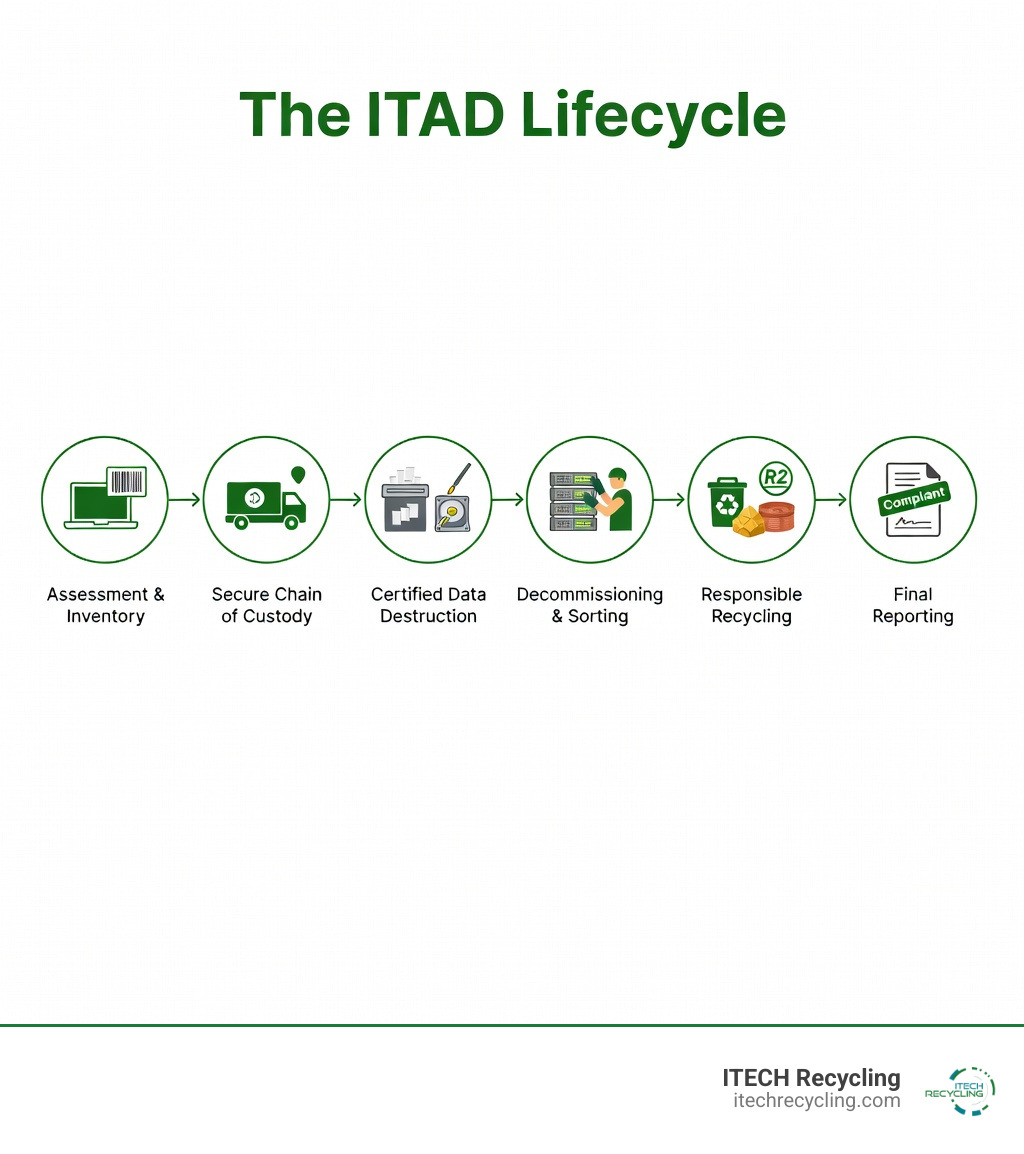
An effective responsible IT asset disposal program is a structured journey. It begins with a comprehensive inventory assessment. You can’t protect what you haven’t counted. Our technicians work with you to log every asset—desktops, servers, printers, and mobile devices—ensuring a clear audit trail from the start.
Once inventoried, devices must be decommissioned properly. This isn’t just about unplugging cords. It involves removing assets from your network and preparing them for transport. For many of our clients in the Chicago suburbs, our Service: Local Pick-up Service is the easiest way to ensure this transition happens smoothly. Before we arrive, we recommend checking out our guide on how to prepare your device for computer recycling in Melrose Park, IL.
Secure Chain of Custody for Responsible IT Asset Disposal
The “Chain of Custody” is the documented “handshake” that happens at every stage of the disposal process. If this chain breaks, your data is at risk. A sobering example occurred when an ITAD company driver pleaded guilty to stealing and reselling government-issued devices that were supposed to be destroyed.
To prevent this, we employ rigorous logistics security, including GPS tracking on our vehicles and sealed, tamper-evident containers. We specialize in secure corporate electronics recycling in Arlington Heights, IL, providing the peace of mind that comes with knowing your hardware never enters a “black hole” during transit.
Documentation and Audit Readiness
If you are audited, “we recycled it” isn’t an answer—you need proof. The gold standard of proof is the Certificate of Destruction (CoD). This document lists the serial numbers of the destroyed assets and the methods used.
To help you understand your options, here is a quick comparison of common sanitization methods:
| Method | Best For | Security Level | Reuse Potential |
|---|---|---|---|
| Data Wiping | Functional Laptops/PCs | High (if NIST compliant) | Excellent |
| Degaussing | Magnetic Hard Drives/Tapes | Very High | Zero |
| Physical Shredding | Highly Sensitive Data/SSDs | Maximum | Zero |
| Cryptographic Erasure | Self-Encrypting Drives | High | Excellent |
Maintaining these audit trails is a core part of safeguarding proprietary data in Bolingbrook, IL. Whether you are in healthcare, finance, or tech, having this documentation ready makes audit season a breeze instead of a nightmare.
Secure Data Destruction and Regulatory Compliance
Data sanitization is the heart of responsible IT asset disposal. At ITECH, we follow the NIST 800-88 guidelines, which are the industry standard for media sanitization. Simply “formatting” a drive or hitting “delete” is like trying to erase a pencil drawing with your thumb—the ghost of the data is still there, and a professional can easily recover it.
We help our clients explore data destruction in Chicago, IL to find the balance between security and cost. For many, the goal is to secure data destruction in Chicago, IL to ensure that proprietary secrets never leave the facility alive.
Methods for Media Sanitization and Physical Destruction
Different hardware requires different “death certificates.”
- Degaussing: This uses a powerful magnetic field to scramble the data on traditional hard drives. It’s fast and effective, but it renders the drive unusable.
- Hard Drive Shredding: This is exactly what it sounds like. We use industrial-grade shredders to turn your drives into tiny bits of metal. There are 5 reasons to choose hard drive shredding, with the number one being absolute certainty.
- Cryptographic Erasure: For modern self-encrypting drives, we can wipe the encryption key, making the data on the drive instantly unreadable.
Our Service: Hard Drive Shredding and Data Destruction is designed to meet the highest security standards, ensuring that even the most determined cybercriminal couldn’t piece your data back together.
Navigating GDPR, HIPAA, and Global Regulations
Compliance is a moving target. If you handle European data, you must comply with the General Data Protection Regulation (GDPR). If you are in healthcare, the Health Insurance Portability and Accountability Act (HIPAA) dictates how you handle patient records.
There are also environmental laws like the Secure E-Waste Export and Recycling Act (SEERA), which aims to stop the export of electronic waste to countries that might use it to create counterfeit goods. Responsible IT asset disposal ensures you stay on the right side of all these acronyms, protecting your PII and your bottom line.
Environmental Impact and the Circular Economy
When we throw a computer in the trash, we aren’t just tossing out plastic and glass. We are tossing out lead, mercury, and cadmium. These are toxic materials that, when left in a landfill, can leach into the groundwater. We’ve all seen the news about “host dumping sites” in developing nations where e-waste is burned, releasing carcinogens that harm children and the environment.
At ITECH, we believe in resource recovery. Your old electronics contain precious metals like gold, silver, and copper. By choosing responsible electronics recycling, we can recover these materials and put them back into the manufacturing stream, reducing the need for destructive mining.
Mitigating the Global E-Waste Crisis
The numbers are staggering: 62 million tonnes of e-waste generated in 2022. That is an 82% increase since 2010. E-waste is a significant global issue that requires local action. By providing electronics recycling for businesses in the Chicago area, we help divert thousands of pounds of hazardous material from Illinois landfills every year.
Implementing a Sustainable Strategy for Responsible IT Asset Disposal
Sustainability is about more than just recycling; it’s about moving toward a circular economy. This means keeping products and materials in use for as long as possible. We align our practices with initiatives like the Climate Neutral Data Centre Pact to help our clients reduce their carbon footprint.
Our approach to sustainable IT asset management in Wheeling, IL balances the need for high-level security with the goal of zero-waste. We look for every opportunity to refurbish or repurpose equipment before we resort to recycling.
Maximizing Value Recovery and Choosing a Certified Provider
Many businesses don’t realize that their “junk” might actually be worth something. Refurbishment and resale are key components of responsible IT asset disposal. If a laptop is only three years old, it might still have significant resale value. By refurbishing these units, we can return value to your company, often offsetting the costs of the disposal process itself.
We provide comprehensive electronics recycling for businesses that includes evaluating your gear for potential buyback. This turns a liability into a cost-saving opportunity.
Identifying R2 and NAID AAA Certified Partners
When choosing a partner, certifications are your best friend.
- R2 (Responsible Recycling): This ensures that the recycler follows strict environmental and health standards.
- NAID AAA: This is the gold standard for secure data destruction.
Working with a certified provider means you aren’t just taking their word for it—they are being audited by third parties to ensure they follow a strict Business Partner Code of Conduct.
Frequently Asked Questions about Responsible IT Asset Disposal
What are the primary risks of improper IT asset disposal?
The biggest risks are data breaches, which can lead to massive financial fines and a total loss of customer trust. Additionally, improper disposal can lead to environmental lawsuits and violations of state and federal e-waste regulations.
How can businesses ensure data is unrecoverable on SSDs?
Solid State Drives (SSDs) are different from traditional hard drives. Standard “wiping” often leaves data behind in “wear-leveling” blocks. To ensure data is gone, we recommend either cryptographic erasure (if supported) or physical shredding to a very small fragment size.
What certifications should I look for in an ITAD provider?
Always look for R2v3 (Responsible Recycling) and NAID AAA. These ensure that the provider handles both the environmental and security aspects of disposal with the highest level of professionalism and accountability.
Conclusion
At the end of the day, responsible IT asset disposal is about more than just getting rid of old gear. It’s about protecting the business you’ve worked so hard to build, keeping your customers’ data safe, and doing your part to protect the planet.
At ITECH Recycling, we are proud to serve the Chicago area—from Naperville to Arlington Heights and everywhere in between—with secure, compliant, and sustainable e-waste solutions. Whether you need a one-time pick-up or a long-term strategy for your data center, we are here to help.
Don’t let your old technology become a future liability. Understand the importance of electronics recycling in Chicago, IL and choose a partner who takes your security as seriously as you do. Let’s work together to build a more secure and sustainable future for our community.
 Prev
Prev