


Hire a Professional to Kill Your Hard Drive Once and For All
Why Professional Hard Drive Destruction Matters More Than Ever
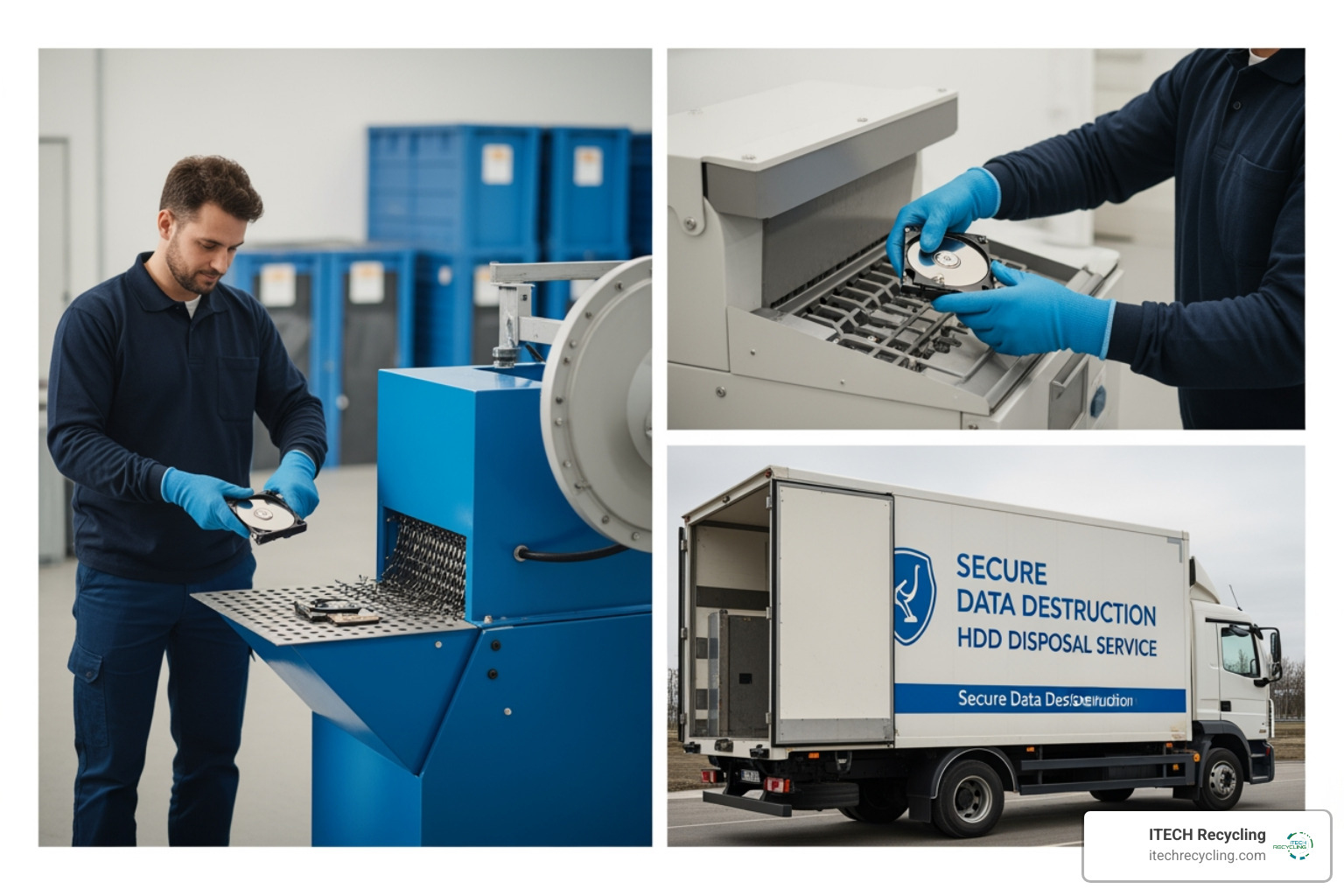
An HDD disposal service ensures your old hard drives are permanently and securely destroyed, protecting sensitive data from breaches while meeting environmental and compliance standards. Here’s what to look for:
Key Features of Professional HDD Disposal:
- Physical destruction methods – Industrial shredding, crushing (7,500 lbs force), or shearing (40,000 lbs force) that renders data completely unrecoverable
- Certified processes – NAID AAA, R2v3, or e-Stewards certification with full chain of custody tracking
- Compliance documentation – Certificate of Destruction with serial numbers, date, method, and witness signatures
- On-site or off-site options – Mobile shredding trucks for witnessable destruction or secure facility processing
- Environmental responsibility – Certified recycling of shredded materials including aluminum, magnets, and circuit boards
Simply deleting files or reformatting your hard drives won’t protect your business. As the research shows, physically intact drives can still have data retrieved from them – even after software wiping or degaussing. That’s why businesses handling sensitive information increasingly mandate professional destruction services.
The stakes are high. Healthcare facilities produce over 4.67 million tons of e-waste annually, much of it containing patient data. Financial institutions store years of transaction records. Even small businesses accumulate confidential client information that could lead to devastating breaches if improperly disposed.
Physical destruction is the only method that guarantees your data won’t fall into the wrong hands. Whether through crushing that punches holes through internal platters or shearing that slices drives into small pieces, professional services ensure complete data obliteration while responsibly recycling the remaining materials.
I’m Felix Bagr, owner of iTech Recycling, where I’ve spent years developing secure, compliant HDD disposal service solutions for businesses of all sizes across the Chicago area. My team and I focus on maximizing data security while minimizing environmental impact through certified recycling processes.
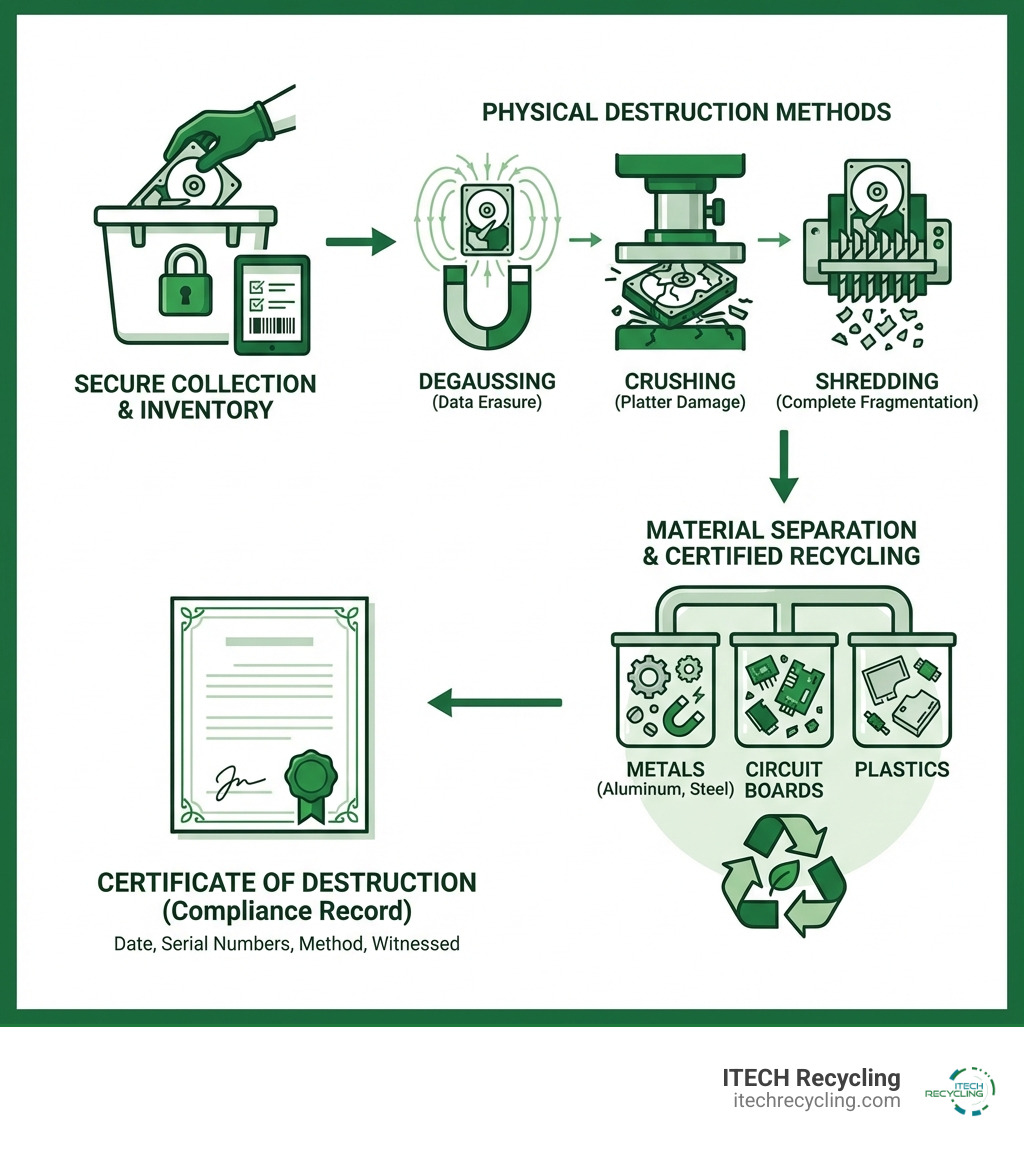
Why Your Business Needs a Professional HDD Disposal Service
When we talk about “killing” a hard drive, we aren’t just being dramatic. In cybersecurity, a “undead” hard drive—one that was retired but not properly destroyed—is a nightmare waiting to happen. Many businesses in Chicago, Naperville, and Aurora mistakenly believe that hitting the “delete” button or performing a factory reset is enough. It’s not.
Data recovery software has become incredibly sophisticated. If a hard drive leaves your custody intact, a motivated individual can often reconstruct the data you thought was gone. This leads to massive risks, including:
- Data Breaches and Identity Theft: If customer social security numbers or credit card details are recovered from a discarded drive, your business is on the hook.
- Corporate Liability: Regulatory bodies don’t care if you “meant” to delete the data. If it wasn’t destroyed according to industry standards, the fines can be astronomical.
- Loss of Proprietary Information: Think about your internal memos, future product designs, and financial records. You wouldn’t leave those in a dumpster, so why leave them on a hard drive?
Using a professional HDD disposal service provides a “Certificate of Destruction,” which acts as your legal shield. It proves that you took the necessary steps to protect data before the hardware was recycled. For more insight into why this is a non-negotiable for modern companies, check out our guide on 5 Reasons to Choose Hard Drive Shredding Services.
Physical Destruction vs. Software Erasure: What’s the Difference?
In our industry, we see a lot of confusion regarding “wiping” versus “destroying.” Let’s break it down. Software erasure, often following NIST 800-88 standards, involves overwriting the data with random patterns. While effective for drives you plan to reuse, it’s not 100% foolproof if the software fails or if the drive has “bad sectors” that the software can’t reach.
Degaussing is another method that uses high-powered magnets to disrupt the magnetic field on the platter. It’s great for traditional HDDs, but here’s the kicker: it’s completely useless for Solid State Drives (SSDs) because they don’t store data magnetically!
Physical destruction is the only way to be sure. Whether you are in Elgin or Bolingbrook, physical shredding ensures that the drive is reduced to tiny bits of scrap metal. You can learn more about our specific processes at Hard Drive Data Destruction | ITECH Recycling.
The Mechanics of a Secure HDD Disposal Service
When you hire a professional HDD disposal service, you aren’t just paying for someone to hit a drive with a hammer. We use industrial-grade machinery designed to exert massive amounts of force.
- Crushing: This method applies roughly 7,500 pounds of force to a conical punch that goes right through the center of the drive. This ripples and breaks the internal ceramic or glass platters, making data retrieval physically impossible.
- Shearing/Shredding: For the ultimate security, we use shearing machines that apply up to 40,000 pounds of force. These machines slice the drive into small, confetti-like pieces.
| Method | Effectiveness | Best For | Recovery Risk |
|---|---|---|---|
| Data Erasure | High (if done right) | Reusing equipment | Low (but possible) |
| Degaussing | High (Magnetic only) | Magnetic HDDs, Tapes | Low (for HDDs) |
| Physical Shredding | Absolute | End-of-life security | Zero |
Choosing a Certified HDD Disposal Service
Not all shredding services are created equal. If you are looking for a partner in Des Plaines or Franklin Park, you need to look for specific certifications. These aren’t just badges; they are promises of security.
- NAID AAA: This is the gold standard for data destruction. It ensures the company follows strict security protocols, including employee background checks and 24/7 surveillance.
- R2v3 and e-Stewards: These certifications focus on the environmental side. They ensure that once your drive is shredded, the remains don’t end up in a landfill or shipped illegally overseas.
A secure chain of custody is also vital. This means every drive is scanned and tracked from the moment it leaves your office in Mundelein or Deerfield until it is processed. For a deeper dive, read Data Destruction in Des Plaines, IL: What Every Business Needs to Know.
Compliance and Data Privacy Regulations
We live in a world of acronyms: HIPAA, GDPR, FACTA, and SOX. If your business handles healthcare data in Evanston or financial records in Springfield, you are legally required to protect that information.
- HIPAA: Requires healthcare providers to ensure that “Protected Health Information” (PHI) is rendered unreadable and indecipherable.
- FACTA: The Fair and Accurate Credit Transactions Act requires businesses to dispose of consumer report information properly to prevent identity theft.
- GDPR: Even for businesses in Chicago, if you have European clients, you must comply with strict “Right to be Forgotten” rules.
A professional HDD disposal service helps you maintain an audit trail. If a regulator ever knocks on your door, you can produce a log of every serial number destroyed. To see how we help local businesses stay compliant, visit Secure Data Destruction in Chicago, IL: Protect Business Information.
On-Site vs. Off-Site: Finding the Right Destruction Method
One of the most common questions we get from clients in Elk Grove Village and Arlington Heights is: “Should you come to us, or should we come to you?”
On-Site Destruction is perfect for companies with high-security requirements. We bring a mobile shredding truck to your parking lot. Your IT manager can literally watch the hard drives go into the hopper and come out as scrap. This eliminates the “transportation risk”—the tiny chance that something could happen to the drives while they are in transit.
Off-Site Destruction is often more cost-effective for smaller batches. We use secure, GPS-tracked vehicles to transport your media to our central facility. Once there, the drives are logged and destroyed under constant video surveillance.
Both methods are secure, but on-site service provides that extra peace of mind for those who want to witness the “execution” of their data. Learn more about these options at Hard Drive Shredding and Data Destruction Services.
Beyond the Platter: Destroying Other Media and Recycling
While we focus heavily on HDDs, a modern HDD disposal service must handle all types of storage media. Data isn’t just on spinning disks anymore. We also destroy:
- Solid State Drives (SSDs): These require specialized shredding because the data chips are so small.
- Backup Tapes: Old LTO or DLT tapes can hold massive amounts of legacy data.
- Optical Media: CDs, DVDs, and Blu-rays often contain sensitive backups.
- Mobile Devices: Smartphones and tablets are essentially pocket-sized hard drives.
After destruction, we enter the “Circular Economy” phase. We don’t just throw the scrap away. We separate the materials—aluminum from the casings, rare earth magnets, and the precious metals found on circuit boards. This resource recovery ensures that your old tech helps build the next generation of electronics. For more on what happens to your hardware, check out Laptop Recycling in Wood Dale, IL: What Happens to Your Data?.
Frequently Asked Questions about Hard Drive Disposal
Can hard drives be recycled after they are shredded?
Yes! In fact, they should be. Once a hard drive is shredded, the mixed metal and plastic are sent to a refiner. We recover:
- Aluminum: Most HDD casings are high-grade aluminum.
- Rare Earth Magnets: Neodymium magnets are recovered for reuse in motors and turbines.
- Circuit Boards: These contain small amounts of gold, silver, and copper.
What information is included in a Certificate of Destruction?
A valid Certificate of Destruction (CoD) is your “get out of jail free” card for audits. It typically includes:
- The unique serial number of each drive.
- The date and time of destruction.
- The method used (shredding, crushing, etc.).
- The name of the technician who performed the work.
- A witness signature (if requested).
Is degaussing effective for Solid State Drives (SSDs)?
Absolutely not. Degaussing works by using a powerful magnetic field to “scramble” the data stored on magnetic platters. SSDs use flash memory chips (NAND), which are not affected by magnetic fields. To secure an SSD, you must use either a specialized cryptographic erase or, more reliably, physical shredding. You can find more details on media-specific destruction at Hard Drive Shredding and Data Destruction Services.
Conclusion
At ITECH Recycling, we believe that data security shouldn’t be a headache. Whether you’re a small startup in Bloomington or a large corporation in Chicago, your data deserves the highest level of protection. Our HDD disposal service isn’t just about destroying hardware; it’s about protecting your reputation and our environment.
By choosing a professional partner, you ensure that hazardous materials stay out of Illinois landfills and that your proprietary information stays out of the hands of criminals. We are proud to serve the entire Chicago metro area, from Vernon Hills to Hawthorn Woods and beyond, providing a sustainable, secure, and compliant end-of-life solution for your IT assets.
Ready to secure your data? Visit us for Secure Hard Drive Shredding and Data Destruction and let’s kill those old hard drives once and for all.
 Prev
Prev