

Finding the Right Service for Your Dead Devices
Why Electronics Disposal Services Are Essential Today
Electronics disposal services help you safely recycle old devices while protecting your data and the environment. Here’s what you need to know:
Main Options for Electronics Disposal:
- Drop-off locations – Bring devices to certified recycling centers
- Mail-back programs – Ship small electronics in prepaid packaging
- Professional pickup – Schedule collection for bulk or business equipment
- Community events – Attend local recycling drives for free disposal
- Donation programs – Give working devices to charities for reuse
Key Services to Look For:
- Secure data destruction (wiping, shredding, or physical destruction)
- Environmental compliance (R2, e-Stewards, or ISO certifications)
- Certificate of recycling for businesses
- Proper handling of hazardous materials
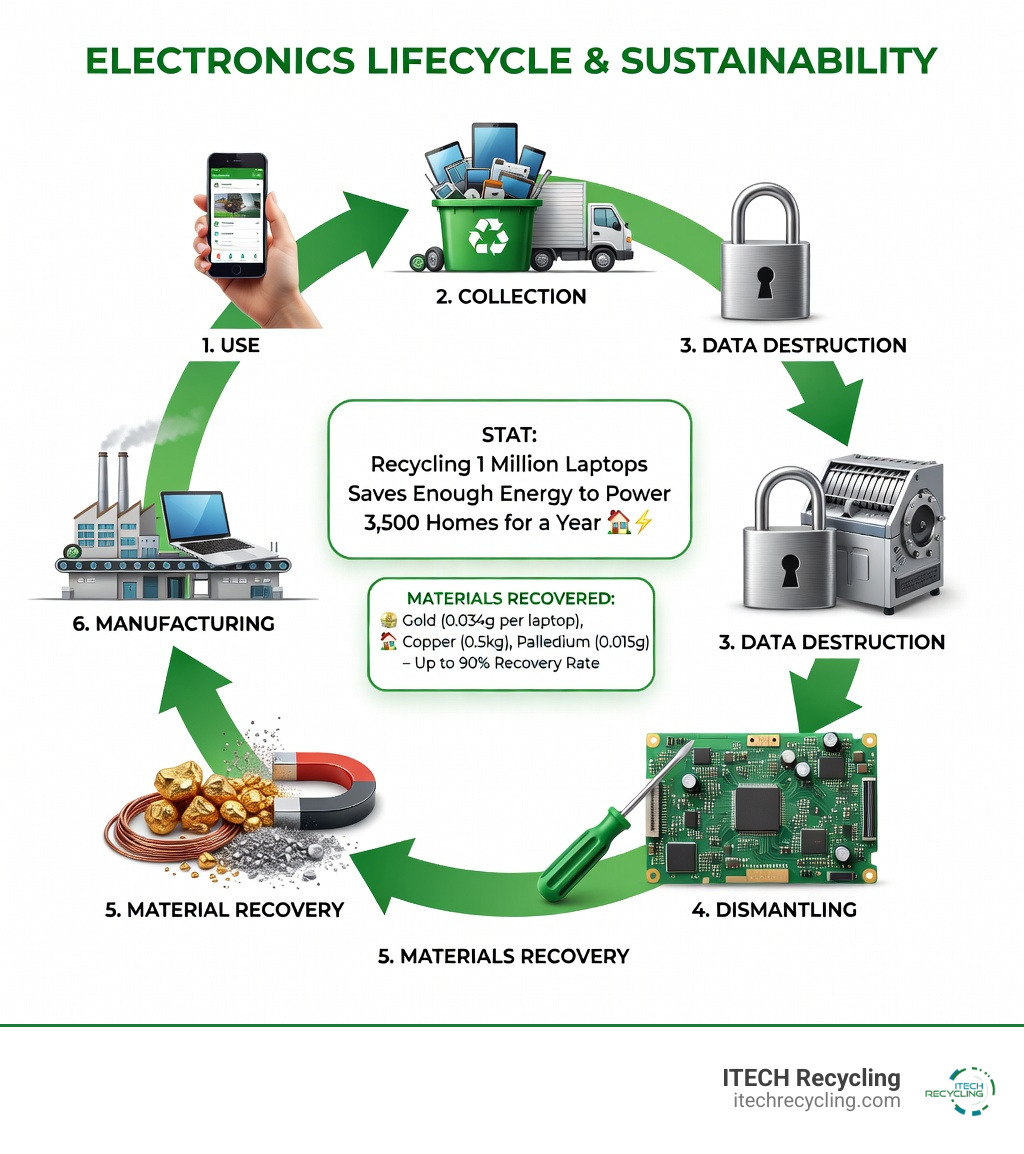
E-waste is the fastest growing municipal waste stream in America, according to the EPA. When electronics end up in landfills, they leak toxic materials like lead and mercury into soil and water supplies. Meanwhile, recycling one million laptops saves enough energy to power 3,500 homes for a year, and recovers valuable materials like gold, copper, and palladium.
The challenge? Not all recycling services offer the same level of security, environmental responsibility, or convenience. Some focus only on residential drop-offs, while others specialize in business asset disposition. Many don’t provide data destruction certificates or comply with industry standards.
This creates real risks. A hard drive purchased in a Ghana e-waste market was found to contain sensitive Pentagon documents. Another discarded drive from a UK family ended up with personal photos potentially used by scammers. Without proper disposal, your deleted files remain recoverable – deletion only removes pointers, not the actual data.
I’m Felix Bagr, owner of iTech Recycling, where I’ve spent years helping businesses and individuals steer secure, compliant electronics disposal services while maximizing material recovery and minimizing environmental impact. In this guide, I’ll walk you through the different disposal options available, what to look for in a trusted provider, and how to ensure your data stays protected throughout the recycling process.
Why Proper Electronics Disposal Services Matter
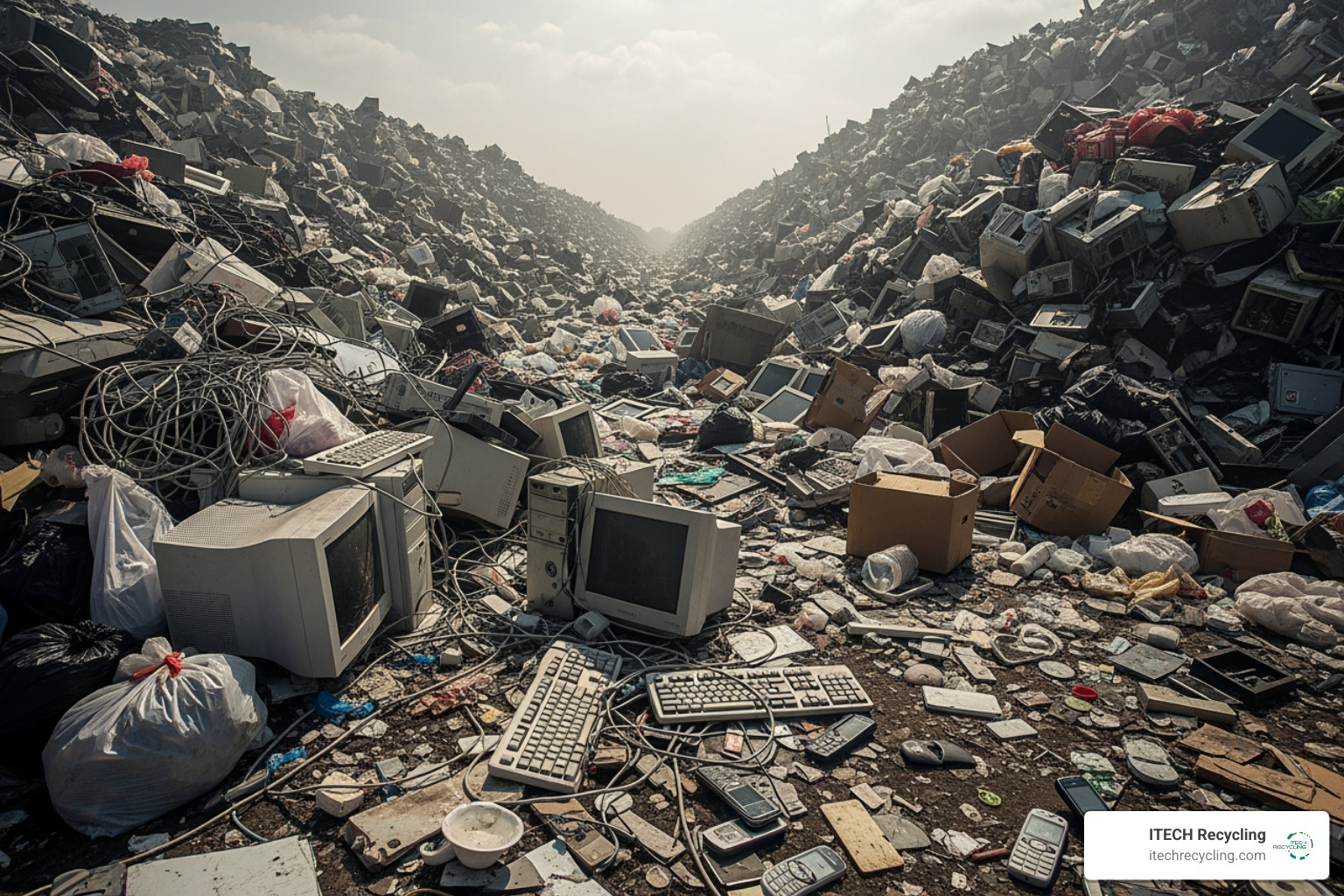
When we talk about “dead devices,” we aren’t just talking about clutter in your “junk drawer” (we all have one, don’t lie!). We are talking about a significant environmental challenge. Electronic waste, or e-waste, including computers, monitors, and televisions, is actually prohibited from regular garbage collection in many areas, including throughout Illinois. Why? Because these items are packed with toxic materials that are hazardous to both human health and the environment.
The Hidden Dangers in Your Trash
When electronics sit in a landfill, they don’t just stay there quietly. Over time, they break down and leak harmful toxins. Lead, found in older CRT monitors and solder, can cause neurological damage. Mercury, often found in the backlights of older laptops and flat-screen monitors, is a potent neurotoxin. These substances can seep into the soil and eventually contaminate the water supply. By utilizing professional electronics disposal services, we protect our local air, soil, and water from these dangerous pollutants. You can learn more about why this matters on our page about Electronics Recycling in Chicago, IL: Why It Is Important.
Mining Your Closet for Gold
It’s not all doom and gloom, though! There is a massive upside to proper recycling: resource recovery. A large number of what we label as “e-waste” isn’t actually waste at all. Much of it consists of whole equipment or parts that can be refurbished or recycled for materials recovery.
Did you know that recycling one million mobile phones can recover 800 pounds of silver, 30,000 pounds of copper, 70 pounds of gold, and 30 pounds of palladium every year? That is a literal gold mine sitting in our landfills if we don’t act. By recovering these precious metals, we reduce the need for destructive mining operations, which in turn slashes greenhouse gas emissions. For those looking to make the most sustainable choices, the Electronic Product Environmental Assessment Tool is a fantastic resource for identifying responsibly manufactured tech.
Comparing Different Electronics Disposal Services
Choosing the right service depends on what you have and how much of it is piling up. At ITECH Recycling, we’ve designed our services to meet the needs of everyone from a homeowner in Naperville with one old TV to a massive data center in Chicago needing a full decommissioning.
| Service Type | Best For | Key Benefit |
|---|---|---|
| Residential Drop-off | Individuals with a few items | Convenient and often low-cost |
| Mail-Back Programs | Small devices (phones, tablets) | No travel required; ship from home |
| Professional Pickup | Businesses or bulk residential | We do the heavy lifting for you |
| Community Events | Neighborhood cleanups | Great for clearing out the garage for free |
Custom Solutions for Every Need
If you’re a resident in Wood Dale or Bensenville, our Residential Electronics Recycling is the perfect way to clear out those old monitors and keyboards. For those specifically struggling with bulky old televisions, we offer a specialized TV Recycling Guide to Responsible Electronics Disposal in Chicago Area to help you steer the tricky process of disposing of CRTs and flat screens.
We also pride ourselves on our local pick-up service. Whether you are in Elgin or Aurora, we can come to you. This is especially helpful for those who don’t have the vehicle space (or the back strength!) to move heavy servers or old “tube” TVs.
Reuse and Donation
Before we break a device down for parts, we always look for opportunities for refurbishment. We partner with local charities to extend the life of equipment. Providing a refurbished laptop to a student or a non-profit is the highest form of recycling—it bridges the digital divide and keeps the device out of the waste stream entirely.
Residential vs. Commercial Electronics Disposal Services
There is a big difference between tossing a personal laptop and managing the retirement of 500 office workstations. For our business clients in the Chicago area, we provide comprehensive IT Asset Disposition (ITAD) services. You can explore our specific Electronics Recycling for Businesses in Chicago Area to see how we handle large-scale needs.
Commercial services require a much higher level of documentation. Businesses often need:
- Data Center Decommissioning: Securely removing servers, hubs, and switches.
- Certificate of Destruction: Legal proof that all data has been irretrievably destroyed.
- LEED Points: Property managers can earn credits by tracking the carbon emissions saved through our recycling efforts.
- Volume-Based Logistics: Using fuel-efficient vans and trucks to manage large hauls efficiently.
Cost Factors for Electronics Disposal Services
We believe in transparency when it comes to pricing. For most electronics disposal services, costs are determined by volume. However, there are several factors that can influence the final price:
- Item Type: Some items, like CRT monitors or certain appliances, require more labor-intensive processing because of the hazardous materials inside.
- On-site Services: If we are performing on-site hard drive punching or shredding, there is a service fee for bringing the equipment to your location.
- Asset Recovery: In some cases, if your equipment is modern and functional, the resale value of the parts can offset the cost of the recycling service.
Check out our guide on IT Asset Disposition in Chicago, IL: Secure Solutions for Technology for a deeper look at how we value business assets.
Ensuring Secure Data Destruction During Disposal
This is the part where we get a little serious. Data security isn’t just a “feature”—it’s a necessity. In an era of rampant identity theft and corporate espionage, you cannot afford to let your data fall into the wrong hands. Simply “deleting” your files or formatting your drive is like taking the table of contents out of a book; the chapters are all still there if someone knows how to look.
Professional Destruction Methods
We use several methods to ensure your data is 100% destroyed, adhering to Department of Defense (DoD) and NIST standards.
- Hard Drive Shredding: Physically cutting the drive into tiny pieces. It’s the “gold standard” for security.
- Degaussing: Using powerful magnets to scramble the data on magnetic media.
- On-site Punching: A cost-effective method where a steel bolt is driven through the platters of the drive, making it unreadable. This is a great option for businesses that want to witness the destruction.
- Data Wiping: Using specialized software to overwrite every bit of data on a drive multiple times.
We’ve written extensively about How Responsible Computer Recycling in Schaumburg, IL Prevents Data Breaches because we want our neighbors to stay safe. Whether you need Hard Drive Shredding and Data Destruction in Skokie or Springfield, we ensure the chain of custody is never broken. Our processes are designed to meet ISO 27001 standards for information security, giving you total peace of mind.
Regulatory Compliance and the Recycling Journey
What happens after we pull away from your curb in Franklin Park or Mundelein? The journey of a recycled device is a fascinating example of the “circular economy” in action.
The Recycling Process
First, we inventory the items. Then, devices are dismantled by hand to harvest valuable components like CPUs, RAM, and circuit boards. If you’re curious about the specifics, we have A Complete Guide to CPU Recycling that explains how we recover precious metals from processors.
Hazardous materials, such as leaded glass from old TVs or lithium-ion batteries, are separated and sent to specialized downstream processors. Lithium-ion batteries, in particular, are classified as dangerous goods and require expert handling to prevent fires during transport.
Compliance and Standards
We operate within a strict regulatory framework. In the U.S., the EPA sets the baseline for e-waste management. While organizations like EPRA and ERA play a massive role in managing stewardship programs in Canada, here in Illinois, we focus on maintaining R2 and e-Stewards-level practices. These certifications ensure that we aren’t just shipping our “trash” overseas to be burned in open pits. Instead, we ensure every ounce of material is handled responsibly. You can read more about the mechanics of this in our article: What is E-Waste Recycling and How Is It Done?.
Frequently Asked Questions about Electronics Disposal Services
What happens to my data after I drop off a device?
When you trust us with your devices, data security becomes our top priority. We follow a strict chain of custody. Once the device reaches our secure facility, the storage media (hard drive or SSD) is removed. Depending on your service level, it is either wiped using DoD-standard software or physically shredded. For our business clients, we provide a Certificate of Destruction. We’ve detailed the process for specific devices, like in our guide on Laptop Recycling in Wood Dale, IL: What Happens to Your Data?. You can also learn how we Protect Business Information through our specialized Chicago services.
Are there free electronics disposal services near me?
Yes! We frequently host community recycling events throughout the Chicago suburbs, including Mundelein, Deerfield, and Elgin. These events are often sponsored by local municipalities or businesses, allowing residents to drop off most electronics for free. We also recommend checking with your local municipality for “Community Environment Days,” which are excellent opportunities for landfill diversion.
Can I put small electronics in the blue recycling bin?
No! Please, for the love of all things green, do not put electronics in your standard blue recycling bin. Standard recycling facilities are designed for paper, plastic, and glass. Electronics can damage their sorting machinery and, more importantly, lithium-ion batteries can cause fires in the collection trucks or at the sorting centers. Electronics require specialized Electronics and Computers Recycling facilities to be processed safely.
Conclusion
At the end of the day, electronics disposal services are about more than just getting rid of an old “brick” of a computer. They are about protecting our community, securing our private information, and ensuring that the finite resources used to build our tech are recovered for future generations.
At ITECH Recycling, we are committed to providing the most responsible, secure, and sustainable recycling options in the Chicago area. Whether you are in Naperville, Evanston, or right in the heart of the city, we are here to help you turn your e-waste into a force for good. Ready to clear out the clutter? Check out our main page on Electronics Recycling in Chicago to get started today!
 Prev
Prev