

Smart IT Recycling Solutions for Modern Businesses
Why IT Recycling Solutions Matter for Every Business Today
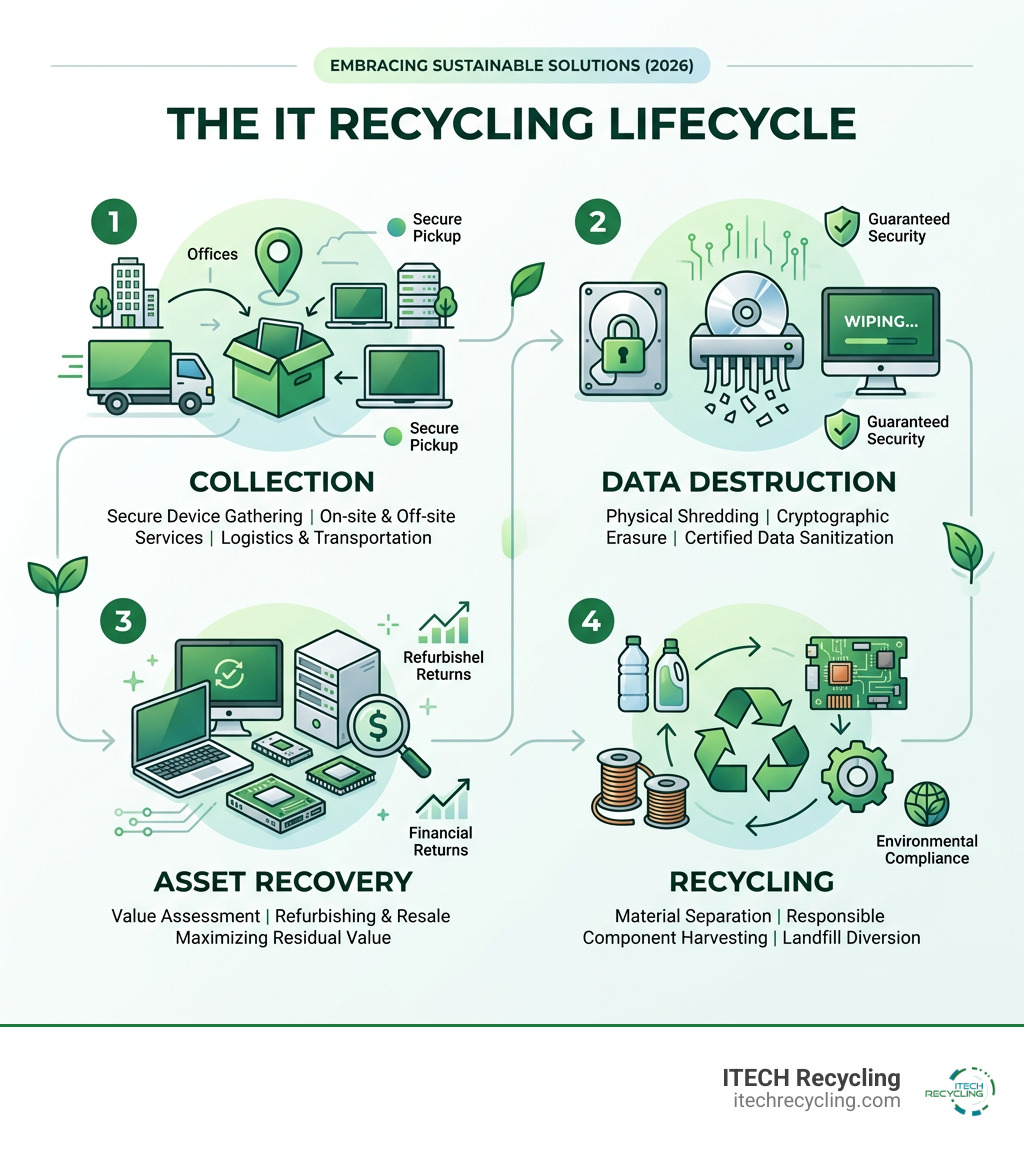
IT recycling solutions are the processes, services, and programs that help businesses securely dispose of, repurpose, or recycle old electronic equipment — while protecting sensitive data and meeting environmental regulations.
Here’s a quick overview of what modern IT recycling solutions include:
| Service | What It Does |
|---|---|
| Data Destruction | Permanently wipes or shreds hard drives to prevent data breaches |
| IT Asset Disposition (ITAD) | Manages the full end-of-life process for old hardware |
| Equipment Buyback | Recovers residual value from retired devices |
| Electronics Recycling | Diverts e-waste from landfills through certified material recovery |
| Compliance Reporting | Documents the recycling chain of custody for regulatory needs |
Most businesses have old servers, laptops, and hard drives sitting in storage right now. Those devices carry real risk — both to data security and to the environment if disposed of improperly.
Consider this: 76% of U.S. employees say workplace sustainability is more important than ever. And yet, improper e-waste disposal remains one of the most overlooked compliance gaps in organizations of all sizes.
The good news? A structured IT recycling program solves all of this at once — protecting your data, recovering value from old assets, and keeping hazardous materials out of landfills.
I’ve spent years helping businesses of all sizes build secure, compliant, and sustainable IT recycling solutions tailored to their specific needs. In this guide, I’ll walk you through everything you need to know to make smart decisions about managing your organization’s end-of-life electronics.
Learn more about it recycling solutions:
The Core Components of Enterprise IT Recycling Solutions
When we talk about it recycling solutions for the enterprise level, we aren’t just talking about dropping a box of old cables at a local center. For a modern business, this is a strategic operation known as IT Asset Disposition (ITAD). It involves a sophisticated mix of logistics, security, and environmental science.
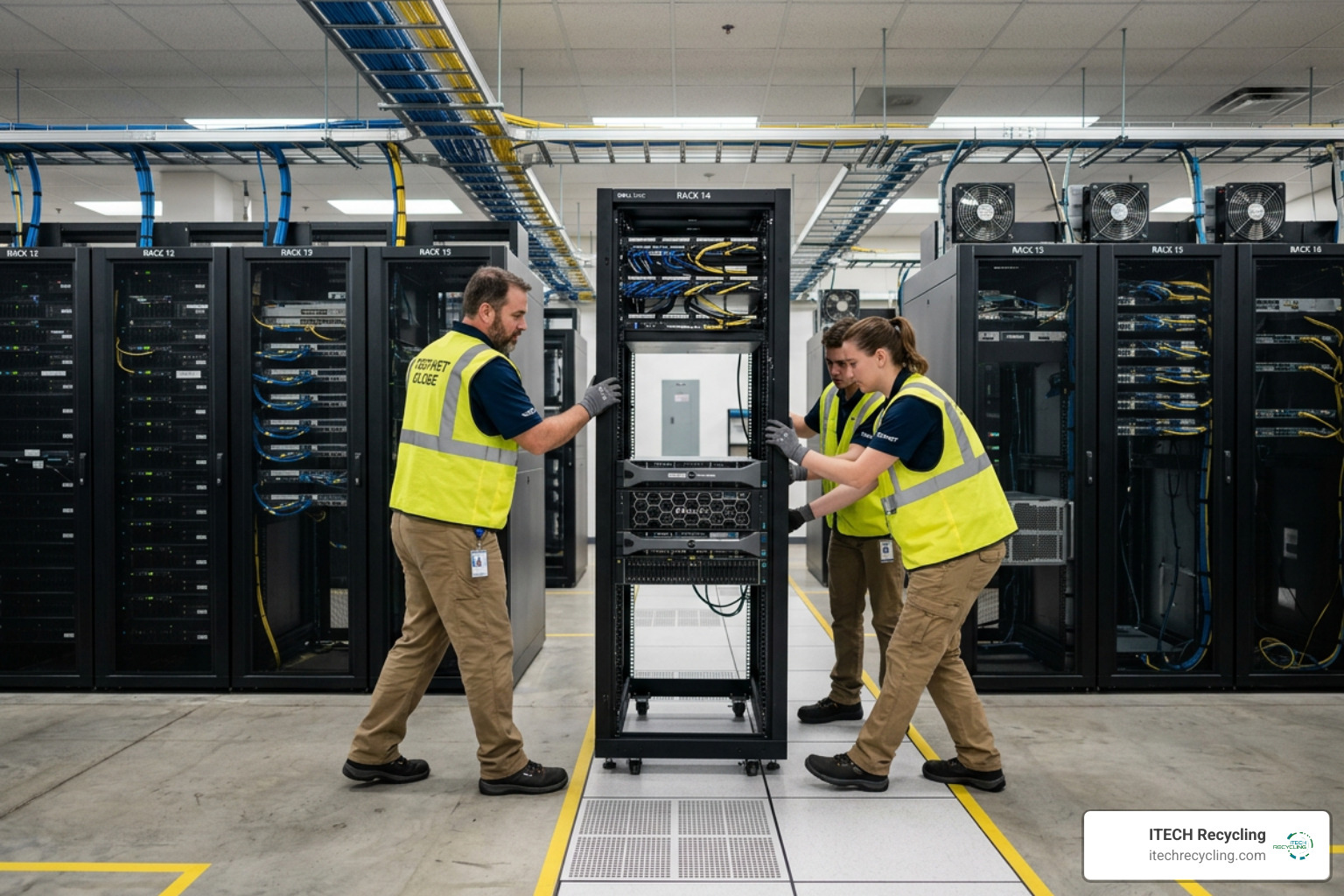
At its heart, enterprise recycling focuses on three things: risk mitigation, environmental compliance, and value recovery. Whether you are closing an office in Naperville or refreshing a data center in Chicago, the process must be seamless. Decommissioning, for instance, isn’t just “unplugging things.” It’s a methodical removal of infrastructure—servers, switches, and storage arrays—ensuring that every serial number is tracked from the moment it leaves the rack until it is either refurbished or shredded.
Secure Data Destruction and Sanitization in IT Recycling Solutions
The single biggest fear for any IT Director is a data breach. Old hard drives are gold mines for cybercriminals. That is why professional it recycling solutions prioritize data sanitization above all else.
We utilize several methods to ensure your “deleted” files stay gone forever:
- Hard Drive Shredding: This is exactly what it sounds like. Industrial-grade shredders turn your drives into tiny metal confetti. It is the most “visual” way to ensure data is gone.
- Degaussing: This uses high-intensity magnetic fields to disrupt the magnetic domain on the drive, making the data unrecoverable. It’s fast and effective for older magnetic media.
- Software Wiping (NIST 800-88): For devices that still have life in them, we use NIST 800-88 compliant software. This overwrites every sector of the drive multiple times, ensuring data is destroyed while allowing the hardware to be reused.
To sleep soundly at night, businesses should look for Independent verification for secure disposition. This third-party audit ensures that the recycler actually did what they said they would do, providing a “trust but verify” layer to your security protocol.
IT Asset Disposition (ITAD) and Value Recovery
One of the most pleasant surprises for our clients is finding out that their “junk” is actually worth money. Effective it recycling solutions include an equipment buyback or profit-sharing component.
By refurbishing laptops, tablets, and even certain server components, we can return value to your bottom line. Instead of paying for disposal, you might receive a check that helps fund your next hardware refresh.
Common Recoverable Assets Include:
- Recent model laptops (MacBooks, Dell Latitudes, HP EliteBooks)
- High-end networking gear (Cisco switches, firewalls)
- Server RAM and CPUs
- Graphics cards (GPUs) and specialized processing units
- Smartphones and tablets
Ensuring Compliance and Data Security in the Recycling Process
Compliance isn’t just a buzzword; it’s a legal requirement. Depending on your industry, you might be beholden to HIPAA (for healthcare), GDPR (for international data), or FACTA (for financial records). If your old hard drive ends up in a ditch with patient records on it, the fines can be catastrophic.
This is why certifications matter. When vetting it recycling solutions, look for these “gold standards”:
- R2v3 (Responsible Recycling): The latest version of the R2 standard, focusing on high-level security and environmental transparency.
- ISO 14001: This ensures the company has a certified environmental management system in place.
- e-Stewards: Often considered the most rigorous environmental standard, prohibiting the export of toxic waste to developing nations.
You can learn more about these global benchmarks at the Sustainable Electronics standards and certifications website.
On-Site vs. Off-Site Security: A Comparison
| Feature | On-Site Destruction | Off-Site (Plant-Based) |
|---|---|---|
| Convenience | High (We come to you) | Moderate (Requires transport) |
| Verification | Immediate (You watch it happen) | Delayed (Via certificate) |
| Cost | Slightly Higher | More Economical |
| Ideal For | High-security labs, banks | General office refreshes |
Environmental Impact and Supporting Corporate ESG Goals
The “E” in ESG (Environmental, Social, and Governance) is becoming a major metric for investors and employees alike. Proper it recycling solutions are a cornerstone of the “Circular Economy.” Instead of mining the earth for more gold, copper, and palladium, we “mine” old electronics.
The statistics are staggering. For example, some leading ITAD programs have achieved an 89.3% reuse rate across hundreds of thousands of units. This means nearly 9 out of 10 devices are given a second life rather than being broken down for scrap. This significantly reduces the carbon footprint associated with manufacturing new devices.
By choosing a partner that follows a “Zero Landfill” policy, your business can report exact metrics—like tons of carbon emissions saved or pounds of lead diverted from the environment—directly in your annual sustainability report.
Implementing Effective IT Recycling Solutions for Your Organization
Ready to clear out that storage closet in Elgin or Springfield? Implementation is all about logistics and the “Chain of Custody.” You need to know exactly who touched your equipment at every stage.
Choosing the Right IT Recycling Solutions Partner
If you are operating in the Chicago area—from the tech hubs in the West Loop to the industrial parks in Elk Grove Village—you need a partner who understands local regulations and logistics.
A good partner offers:
- Transparency: A portal where you can see the status of your assets.
- Downstream Due Diligence: They should know exactly where every ounce of plastic and metal goes after it leaves their facility.
- Local Presence: Serving areas like Wood Dale, Bensenville, Franklin Park, and Mundelein ensures fast response times and lower transport emissions.
The Step-by-Step ITAD Process
- Audit: We create a detailed list of every asset to be retired.
- Collection: Secure pickup using tracked vehicles.
- Sanitization: Data is wiped or shredded according to your security requirements.
- Reporting: You receive a full inventory report and financial breakdown.
- Certificate of Destruction: The legal document proving your data is gone forever.
Frequently Asked Questions about IT Recycling
What types of IT assets can be recycled?
Almost anything with a circuit board! This includes:
- Computing: Laptops, desktops, workstations, and tablets.
- Data Center: Servers, storage arrays, blades, and UPS systems.
- Networking: Switches, routers, firewalls, and access points.
- Storage: Hard drives (HDD), solid-state drives (SSD), and backup tapes.
- Peripherals: Monitors, docking stations, and VOIP phones.
How do business services differ from residential recycling?
Residential recycling is often about “drop-off” convenience. Business it recycling solutions are about risk management. Businesses require a documented chain of custody, certified data destruction, and often handle much larger volumes (hundreds of units at a time) compared to a single household.
What certifications are most important for data security?
For data security, NAID AAA and R2v3 are the heavy hitters. ISO 27001 is also vital as it specifically governs information security management systems.
Conclusion
Managing your company’s hardware doesn’t have to be a headache. By implementing smart it recycling solutions, you protect your brand from data breaches, satisfy your ESG goals, and potentially even recover some budget through asset buybacks.
Whether you’re located in the heart of Chicago or in the surrounding suburbs like Aurora, Bolingbrook, or Arlington Heights, we are here to ensure your e-waste is handled with the highest standards of security and sustainability.
Ready to secure your data and clean out your tech clutter? Contact ITECH for professional IT recycling solutions
 Prev
Prev