


Why Your Business Needs a Data Destruction Strategy
Why Data Destruction Is Important for Every Business
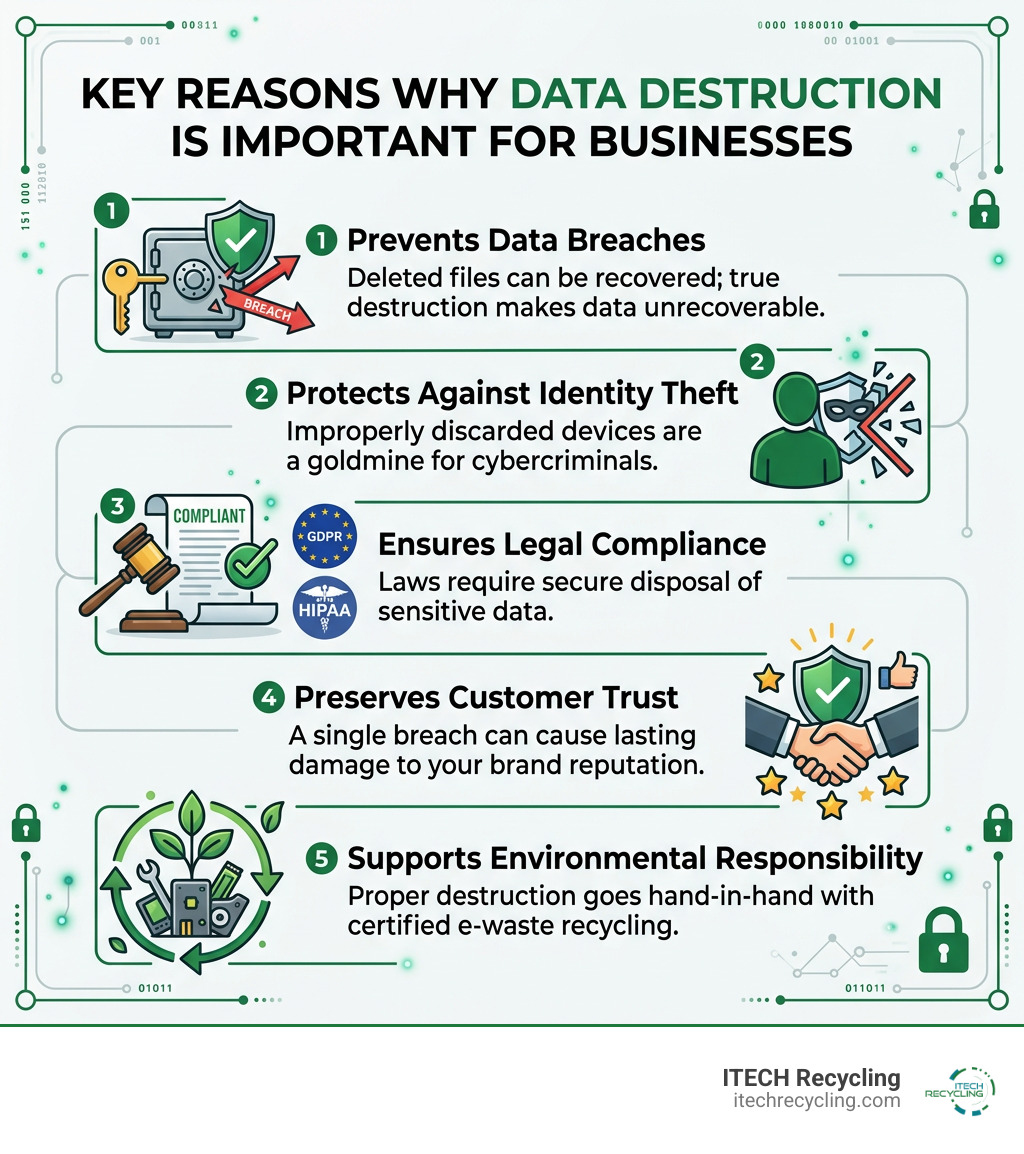
Why is data destruction important? Here’s the short answer:
- Prevents data breaches – Deleted files can still be recovered. True destruction makes data unrecoverable.
- Protects against identity theft – Improperly discarded devices are a goldmine for cybercriminals.
- Ensures legal compliance – Laws like GDPR and HIPAA require secure disposal of sensitive data.
- Preserves customer trust – A single breach can cause lasting damage to your brand reputation.
- Supports environmental responsibility – Proper destruction goes hand-in-hand with certified e-waste and computer parts recycling.
Every business accumulates old computers, hard drives, and servers over time. And when those devices are retired, most people assume hitting “delete” or doing a factory reset is enough.
It isn’t.
Data recovery tools available online for as little as $30 can pull “deleted” files right back off a discarded drive. In fact, over 65% of secondhand hard drives sold online still contain recoverable data. The consequences of getting this wrong are severe — the average cost of a data breach in the United States reached $10.22 million in 2025, according to IBM’s Cost of a Data Breach Report.
The threat isn’t just hackers breaking through firewalls. Often, the vulnerability walks right out the door in a recycling bin.
This guide walks you through everything you need to know about building a solid data destruction strategy — from understanding what true data destruction actually means, to choosing the right methods, staying compliant, and disposing of electronics and computer parts responsibly.
At ITECH Recycling, we have spent years helping businesses securely and sustainably dispose of end-of-life IT equipment and computer parts — and we’ve seen why understanding why data destruction is important is the first step toward protecting your organization. Let’s break it all down.
Why is data destruction important glossary:
Understanding the Basics: What is Data Destruction?
To truly grasp why is data destruction important, we first need to define what it actually is. In the simplest terms, data destruction is the process of permanently and irreversibly eliminating data from a storage medium. This isn’t just about making it hard to find; it’s about making it impossible to recover using any known forensic tool or software.
In our work across Chicago and Franklin Park, we often see businesses treat data disposal like throwing a letter in the trash. But digital data is more like a permanent marker on a whiteboard—even if you wipe it away, a ghost of the image often remains. True destruction is like melting the whiteboard entirely.
Whether it is on a traditional spinning hard drive, a modern Solid State Drive (SSD), or even an old backup tape, the goal is the same: total irretrievability. For a deeper dive into these processes, check out the essential guide to electronic data destruction.
Why is data destruction important compared to simple deletion?
We hear this question all the time: “Can’t I just right-click and hit delete?” Or even better, “I reformatted the drive, so we’re good, right?”
Unfortunately, no. When you “delete” a file on a Windows or Mac computer, the operating system doesn’t actually erase the data. Instead, it just removes the “pointer”—the address that tells the computer where the file is located. It’s like removing a chapter title from a book’s table of contents but leaving all the pages intact. The data stays on the disk until it is eventually overwritten by new information.
Cybercriminals use specialized recovery software to scan the drive for these “orphaned” files. This is one of the biggest reasons data disposal vs. data destruction is such a critical distinction for businesses in Des Plaines and Elgin. Without a verified destruction process, your sensitive “deleted” files are still sitting there, waiting for someone with a $30 software tool to find them.
The difference between HDD and SSD sanitization
Not all storage devices are created equal, and the method we use to destroy the data depends heavily on the hardware.
- Hard Disk Drives (HDDs): These use magnetic platters. Data is stored in magnetic fields. To destroy this data, we can use “degaussing” (a massive magnetic pulse) or software that overwrites the entire disk multiple times with random patterns of 1s and 0s.
- Solid State Drives (SSDs): These are found in almost all modern laptops and smartphones. They use flash memory and a process called “wear leveling,” which moves data around to extend the life of the drive. Because of this, standard overwriting software often misses chunks of data hidden in “over-provisioned” areas.
Because SSDs are so resilient, physical destruction or specialized cryptographic erasure is often the only way to be 100% sure the data is gone. If you are upgrading your office tech in Bensenville or Mundelein, knowing which type of drive you have is the first step in your security plan.
Why is data destruction important for modern businesses?
Data is a business’s most valuable asset—and its greatest liability. Whether you are a small medical practice in Evanston or a large manufacturing firm in Elk Grove Village, your drives contain a treasure trove of sensitive information:
- Employee Social Security numbers
- Customer credit card data
- Proprietary blueprints and trade secrets
- Privileged legal communications
If this data falls into the wrong hands, it can lead to identity theft, which cost Americans over $43 billion in 2023 alone. It can also lead to corporate espionage, where competitors get ahold of your intellectual property. According to the Cost of a Data Breach Report 2024, the financial impact is staggering, but the damage goes beyond the balance sheet.
Protecting your “secret sauce” is vital, which is why we emphasize safeguarding proprietary data for our clients in Bolingbrook and beyond.
Maintaining customer trust and brand reputation
Trust is easy to lose and incredibly hard to gain back. Imagine your customers finding out that their personal medical records or financial statements were found on a hard drive sold at a flea market because your business didn’t dispose of its old servers correctly.
A data breach is a public relations nightmare. It signals to the world that you don’t take privacy seriously. In a competitive market like Chicago, a reputation for poor security can drive customers straight to your competitors. Using secure data destruction in Chicago isn’t just a security measure; it’s a brand-preservation strategy.
Why is data destruction important for regulatory compliance?
For many industries, secure data destruction isn’t just a good idea—it’s the law. Various federal and international regulations mandate how sensitive information must be handled at the end of its life:
- HIPAA (Health Insurance Portability and Accountability Act): Requires healthcare providers to ensure patient data is unrecoverable. Violations average $2.3 million per incident.
- GDPR (General Data Protection Regulation): Mandates that European citizens’ data be deleted securely upon request or when no longer needed.
- FACTA (Fair and Accurate Credit Transactions Act): Requires businesses to dispose of consumer report information in a way that prevents unauthorized access.
Failing to follow these frameworks can result in massive fines that could bankrupt a small business. By implementing a formal destruction policy, you aren’t just protecting data; you’re protecting your company from the government’s “naughty list.”
The High Cost of Improper Data Disposal

When businesses cut corners on data security, the “bill” eventually comes due. We’ve seen it happen to some of the biggest names in the world.
One of the most famous examples is the Morgan Stanley $35 million SEC fine. The financial giant failed to properly decommission old hardware during a data center move. Unencrypted drives—containing the data of millions of customers—ended up being resold online. This wasn’t a sophisticated hack; it was a simple failure of physical logistics.
Closer to home, businesses in Aurora and Naperville face similar risks every time they toss an old laptop in a standard recycling bin. This is why hard drive destruction in Aurora is a core part of a responsible business strategy.
Real-world consequences of data leaks
The stories are enough to keep any business owner up at night. Take the Health Net breach, where server drives containing the medical and personal data of nearly 2 million customers simply vanished from a data center. The devices were never recovered, leading to a cascade of lawsuits and investigations.
Then there is the “secondhand market” risk. Research from the MIT Cybersecurity Lab found that over 65% of secondhand hard drives sold online still contained recoverable data. This data often ends up on the dark web, where it is sold to the highest bidder for use in phishing attacks and fraud. If you think your old office PC in Springfield isn’t worth a hacker’s time, think again—every piece of PII (Personally Identifiable Information) has a price tag.
Hidden risks in office equipment
When people think about data destruction, they usually think of laptops and servers. But some of the biggest risks are sitting right in your breakroom or hallway.
- Printers and Copiers: Most modern office “multi-function” printers have internal hard drives that store a digital copy of every document ever scanned, printed, or faxed.
- IoT Devices: Smart security cameras, smart thermostats, and even some office appliances store network credentials and usage data.
- USB Drives: These tiny devices are easily lost and often contain massive amounts of sensitive data.
At ITECH Recycling, we treat every device with a circuit board as a potential data risk. Whether we are working in Deerfield or Arlington Heights, our team ensures that these “hidden” drives are identified and destroyed.
Secure Methods: From Software Wiping to Physical Destruction
So, how do we actually get the job done? We follow industry-leading standards like NIST 800-88 and DoD 5220.22-M. These aren’t just random numbers; they are the “gold standards” for data sanitization used by the government and top-tier corporations.
| Method | Best For | Security Level | Pros | Cons |
|---|---|---|---|---|
| Software Wiping | Functional drives for reuse | High | Allows for device resale/reuse | Time-consuming; doesn’t work on broken drives |
| Degaussing | Magnetic HDDs & Tapes | Very High | Fast; extremely secure for magnetic media | Does not work on SSDs; ruins the drive |
| Physical Shredding | End-of-life HDDs & SSDs | Maximum | 100% secure; visual proof | Drive cannot be reused; creates e-waste |
Why is data destruction important through physical shredding?
If you want absolute peace of mind, physical shredding is the answer. It is the only 100% secure way to ensure data can’t be retrieved or reconstructed. We use industrial-grade shredders that chew through steel and silicon, turning your hard drives into tiny, irretrievable fragments.
Many of our clients in Chicago prefer this method because it offers visual confirmation. There is something incredibly satisfying (and secure) about seeing a drive that once held your company’s secrets turned into a pile of metal confetti. For more on this, explore our hard drive shredding and data destruction services.
The role of Certificates of Destruction
In compliance, if you didn’t document it, it didn’t happen. A Certificate of Destruction (COD) is a legal document that proves your data was destroyed according to specific standards. It includes:
- The date and time of destruction
- The method used
- The serial numbers of the devices destroyed
- A signature from a certified professional
This document is your “get out of jail free” card during a HIPAA or GDPR audit. It provides a clear chain of custody and proves your business exercised due diligence. This is why NAID certification importance cannot be overstated—it ensures your provider is held to the highest security standards in the industry.
Environmental Responsibility and E-Waste Management
Why is data destruction important for the planet? Most people don’t realize that data security and environmental health are two sides of the same coin.
Electronics are packed with hazardous materials like lead, mercury, and cadmium. If you just toss a hard drive in the trash to “destroy” it, those toxins eventually leak into the groundwater. Conversely, if you send your electronics to a “recycler” who doesn’t prioritize data security, your information might end up in an overseas e-waste dump where scammers scavenge for data.
By choosing a responsible partner, you ensure a “circular economy.” We recover valuable materials like gold, silver, and rare earth elements from the shredded remains, ensuring they can be used to make new products. It’s hard disk recycling for the planet and your privacy.
Diverting electronics from landfills
The Global E-waste Monitor reports that only 22.3% of global e-waste is properly recycled. The rest ends up in landfills or is processed in ways that harm workers and the environment.
Sustainable IT Asset Disposition (ITAD) is about more than just shredding; it’s about ensuring that every part of the computer—from the plastic casing to the copper wiring—is diverted from the landfill. Our work in Schaumburg and Glenview focuses on responsible computer recycling to prevent both data breaches and environmental degradation.
Corporate Social Responsibility (CSR) in IT
Modern consumers want to do business with ethical companies. Including secure data destruction in your Corporate Social Responsibility (CSR) initiatives shows that you care about both your customers’ privacy and the health of the community.
Whether it is laptop recycling in Wood Dale or a large-scale server decommissioning project, doing it the right way reduces your carbon footprint and builds a “green” reputation for your brand.
Frequently Asked Questions about Data Destruction
Does formatting a hard drive protect my data?
As we discussed earlier, a “quick format” is essentially just clearing the index. Even a “full format” can often be bypassed by sophisticated recovery tools. Formatting is like erasing a pencil mark—if you press hard enough, you can still see the indentations. For business data, formatting is never a sufficient substitute for certified destruction.
What is the most secure method for SSD destruction?
Because SSDs store data on chips rather than platters, they require different techniques. Physical disintegration (shredding the drive into pieces smaller than 2mm) is the most secure physical method. Cryptographic erasure—where the encryption key for the drive is destroyed—is also a highly effective digital method, provided it is done correctly.
How often should a business perform data destruction?
We recommend integrating data destruction into your regular IT lifecycle.
- End-of-life: When a device is replaced.
- Employee turnover: When a laptop is being reassigned (wiping).
- Decommissioning: When moving or closing an office.
For businesses with large data centers in Naperville, we offer specialized data center decommissioning solutions to handle high-volume destruction securely.
Conclusion
At the end of the day, understanding why is data destruction important is about understanding risk management. When a single misplaced hard drive can lead to a $10 million fine and a ruined reputation, the “DIY” approach to data disposal simply isn’t worth it.
At ITECH Recycling, we are proud to serve the Chicago area—from Mundelein to Bloomington and everywhere in between. Our mission is to provide a seamless, secure, and sustainable solution for your end-of-life electronics and computer parts. We follow R2v3 standards to ensure your hazardous materials stay out of landfills and your sensitive data stays out of the hands of criminals.
Don’t let your old data come back to haunt you. Secure your business with professional hard drive shredding and data destruction today. Whether you need a one-time pickup in Vernon Hills or a recurring service in Hawthorn Woods, we’re here to help you stay secure, compliant, and green.
 Prev
Prev