

UChicago and Beyond: Institutional Tech Recycling Guide
Why Schools Need Electronics Recycling Solutions Now
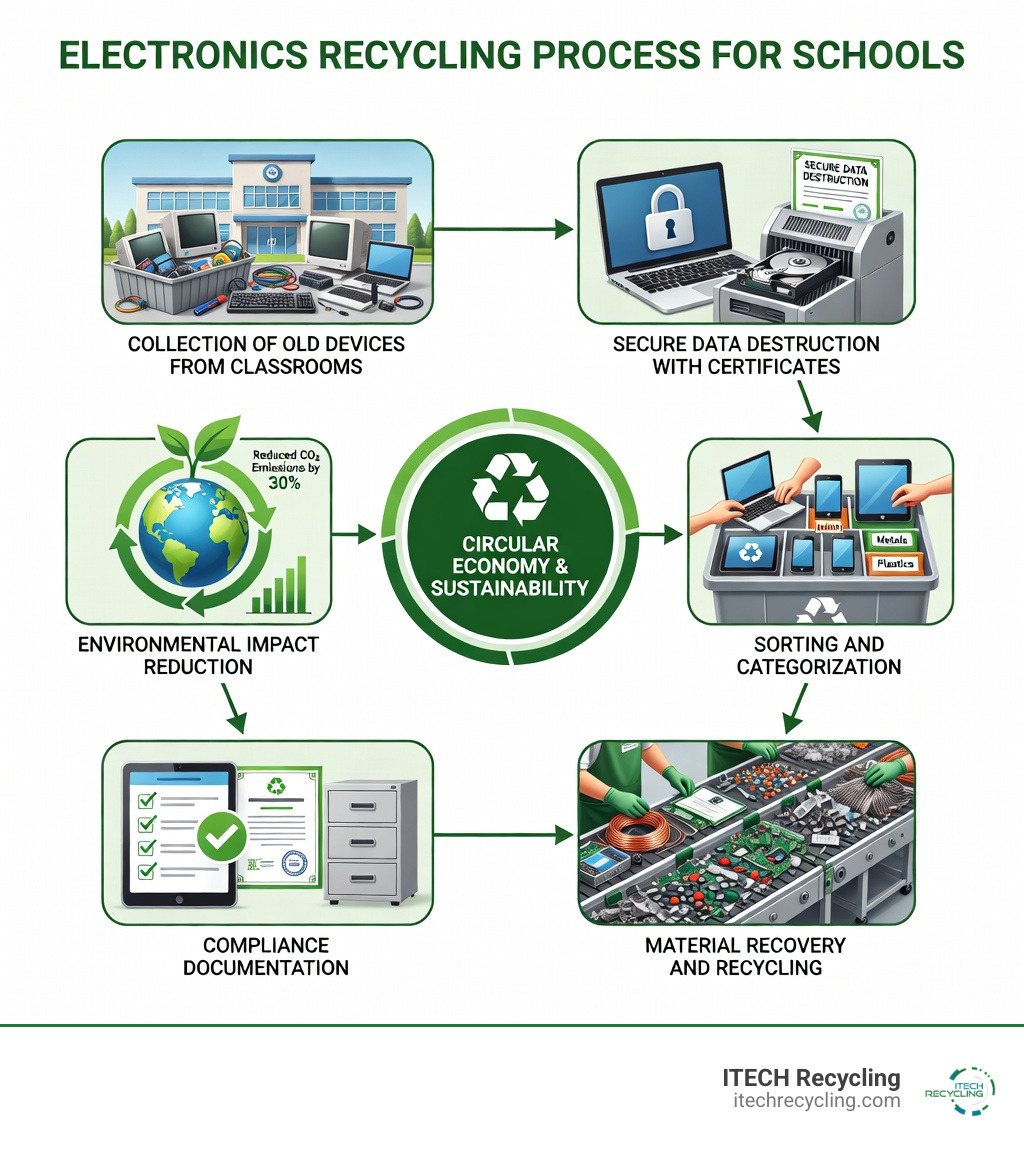
Electronics recycling for schools is essential for managing the growing volume of outdated technology devices while protecting student data and the environment. Here’s what schools need to know:
Key Steps for School E-Waste Management:
- Identify e-waste – Computers, tablets, projectors, printers, and peripherals
- Partner with certified recyclers – Look for R2V3 or e-Stewards certification
- Ensure data security – Require hard drive destruction or DOD-standard erasure
- Schedule pickups – Use palletized bins or campus-wide collection events
- Document compliance – Obtain certificates for regulatory requirements
Schools across America face a mounting challenge. As classrooms shift from textbooks to tablets and computer labs expand, the pace of technology turnover accelerates dramatically. In 2022, the US generated 164 million tons of electronic waste, with schools contributing a significant portion as they replace outdated devices with newer models.
The stakes are high. Old computers and tablets contain hazardous materials like lead and mercury that can contaminate soil and groundwater if dumped in landfills. Even more concerning for educational institutions: discarded devices may harbor sensitive student data that could lead to privacy breaches if not properly destroyed.
But here’s the good news – responsible electronics recycling for schools doesn’t have to be complicated or expensive. Many states now offer manufacturer-subsidized programs specifically for K-12 institutions, and certified recyclers provide convenient pickup services that handle everything from data destruction to compliance documentation.
As owner of iTech Recycling, I’ve helped numerous Chicago-area schools implement secure and sustainable electronics recycling for schools programs that protect both student privacy and the environment. My team specializes in compliant disposal that meets regulatory requirements while maximizing material recovery.
Why Electronics Recycling for Schools is a Critical Priority
Why is this such a big deal? For starters, back in 2005, the EPA estimated that between 26 to 37 million computers became obsolete annually. That number has exploded as the “one-to-one” device ratio (one tablet or laptop per student) has become the standard in modern education.
When these devices reach the end of their lifecycle, they can’t just be tossed in the dumpster. In fact, many electronics are legally banned from landfills in Illinois. These devices contain a cocktail of hazardous materials:
- Lead: Found in cathode ray tubes (CRTs) of old monitors and glass.
- Mercury: Present in switches and flat-panel display backlights.
- Cadmium: Used in older rechargeable batteries and circuit board coatings.
If these toxins leach into the ground, they pose severe health risks to our communities. By participating in initiatives like the EPA Electronics Recycling Challenge, schools can lead the way in environmental stewardship.
Beyond avoiding fines and protecting the soil, recycling allows for resource recovery. Modern electronics are “urban mines” filled with gold, silver, copper, and rare earth elements. Recovering these materials reduces the need for destructive mining practices. We believe that schools have a unique opportunity to model this behavior for the next generation. For more details on how we handle these materials, check out our more info about electronics and computers recycling page.
Implementing Effective Electronics Recycling for Schools Programs
We know that school administrators are busy. Between curriculum planning and student safety, managing a pile of old printers in the basement is usually low on the “to-do” list. However, a disorganized approach to e-waste leads to “IT closets” overflowing with junk, creating fire hazards and making inventory management a nightmare.
The most effective programs use a unified school-wide cleanout. Instead of dealing with one broken laptop at a time, schools should organize a single event. This streamlines logistics, reduces the carbon footprint of transportation, and ensures nothing gets left behind.
We often provide palletized bins—heavy-duty cardboard containers (sometimes called e-Boxes) that can hold 30-40 desktops each. Once these are full, a quick call to a partner like us ensures they are picked up within 72 hours.
Comparing Pickup Options for Schools
| Feature | One-Time Cleanout | Recurring Pickup Program |
|---|---|---|
| Best For | Annual “spring cleaning” or major tech refreshes | Large districts with constant turnover |
| Logistics | Single scheduled event; high volume | Ongoing bin placement; scheduled intervals |
| Cost | Often lowest per-unit cost | Predictable, manageable budget |
| Space | Clears out storage rooms instantly | Requires dedicated space for bins |
For schools in the Chicagoland area, including Wood Dale, Naperville, and Elgin, we offer specialized electronics recycling for businesses in Chicago area that can be custom to the specific needs of educational campuses.
Identifying Common School E-Waste
It isn’t just computers. “Anything with a plug” is a good rule of thumb. In a school setting, e-waste typically includes:
- Classroom Tech: Laptops, tablets (iPads/Chromebooks), and interactive whiteboards.
- AV Equipment: Projectors, speakers, and old televisions.
- IT Infrastructure: Server racks, routers, and uninterruptible power supplies (UPS).
- Peripherals: Keyboards, mice, cables, and toner cartridges.
If you’re wondering about the “how” behind the process, we have a guide on what is e-waste recycling and how is it done? that breaks down the mechanical separation and smelting processes.
Best Practices for Electronics Recycling for Schools
To ensure your school is protected, always follow these best practices:
- Verify Certifications: Ensure your recycler is R2V3 certified. This is the gold standard for responsible recycling, ensuring that e-waste isn’t illegally shipped offshore or dumped.
- Check State Mandates: Programs like the State Electronics Challenge encourage schools to manage obsolete electronics in an environmentally safe way.
- Use Local Services: Choosing a local pick up service reduces the environmental impact of shipping and supports the local economy in cities like Aurora and Bolingbrook.
Data Security and Regulatory Compliance in Education
In the education sector, data security isn’t just a suggestion—it’s a legal requirement. Schools handle sensitive student information, including grades, health records, and personal identifiers. Under the Family Educational Rights and Privacy Act (FERPA), schools must ensure this data is protected even when the hardware is retired.
Simply “deleting” files or formatting a hard drive isn’t enough. Professional data recovery software can easily retrieve information from a formatted drive. In one famous case, researchers bought a discarded hard drive at an e-waste dump and found sensitive government contracts still on it!
To prevent this, we use:
- Physical Destruction: Shredding or “punching” the hard drive so it can never be read again.
- Degaussing: Using high-powered magnets to scramble the data on magnetic media.
- DOD-Standard Erasure: Using software to overwrite every sector of the drive multiple times.
We provide schools with a Certificate of Destruction that includes the serial numbers of every destroyed drive. This creates a clear chain of custody for your records. Learn more about our secure data destruction in Chicago to see how we protect your institution.
Legal Requirements for Institutional Disposal
In Illinois, the IL EPA regulates how institutions dispose of electronics. Schools are often classified differently than residential households. While a resident might be able to drop off a TV at a municipal site for free, schools usually need to arrange for professional IT asset disposition in Chicago to remain compliant.
Failing to document where your e-waste goes can lead to significant liability. If your school’s branded equipment is found in an illegal dump, the “producer responsibility” laws could result in heavy fines. Proper compliance tracking ensures that 100% of your materials are diverted from landfills.
Educational Integration and Community Awareness
Electronics recycling provides a “teachable moment.” Schools can integrate e-waste topics into their science and sustainability curricula.
- Workshops: Host sessions where students learn about the rare minerals inside their phones.
- Field Trips: Visit a certified recycling facility to see the shredding and sorting process in person.
- Recycling Drives: Organize a community-wide event where parents can bring their old tech to the school for responsible disposal.
Resources like the E-Cycle Wisconsin educational resources (which offer great templates even for Illinois schools) provide posters and activities for grades 6-12. When students learn these habits early, they carry them home, influencing their families to recycle responsibly. This creates a ripple effect of community awareness that goes far beyond the classroom walls.
Frequently Asked Questions about School E-Waste
Are there free electronics recycling for schools options?
Yes! Many K-12 schools are eligible for manufacturer-subsidized recycling programs. Because manufacturers are often required by state law to recycle a certain poundage of electronics, they frequently partner with recyclers to cover the costs for schools. Additionally, if your school has a large volume of high-value equipment (like relatively recent laptops), the resale value of those parts can sometimes offset the cost of the entire pickup.
How do schools ensure student data is protected during recycling?
The only 100% foolproof way is physical destruction or certified data sanitization. We recommend that schools look for a partner that offers onsite hard drive destruction. This allows your IT staff to witness the drives being crushed or shredded before they even leave the school grounds. Always demand a Certificate of Destruction for your FERPA compliance files.
What types of electronics can schools recycle?
We accept almost anything with a cord or battery. This includes:
- Computers (Desktops and Laptops)
- Monitors and Televisions (including old CRTs)
- Printers, Scanners, and Copiers
- iPads, Tablets, and E-readers
- Cables, Wires, and Power Strips
- Server Racks and Networking Gear
- Uninterruptible Power Supplies (UPS)
Conclusion
Managing technology in a school environment is a balancing act between budget, security, and sustainability. By implementing a formal program for electronics recycling for schools, you aren’t just cleaning out a storage room; you’re protecting student privacy, complying with Illinois state law, and teaching the next generation about environmental responsibility.
At ITECH Recycling, we are proud to serve the educational communities in Chicago, Evanston, Arlington Heights, and throughout the region. We handle the heavy lifting—from providing the bins to certifying the data destruction—so you can focus on what matters most: education.
Ready to clear out the clutter and protect your school? Understanding electronics recycling in Chicago: why it is important is the first step toward a greener, more secure campus. Contact us today to schedule your school’s next cleanout.
 Prev
Prev