

Why Absolute Data Shredding is Better Than a Paper Cut
Why Absolute Data Shredding is Critical for Modern Data Security
Absolute data shredding refers to the complete and irreversible destruction of sensitive information stored on physical media—whether paper documents, hard drives, solid state media, or other electronic devices. Here’s what you need to know:
What Absolute Data Shredding Includes:
- Paper documents: Cross-cut shredding to 1x5mm particles
- Hard drives and SSDs: Physical destruction or degaussing beyond recovery
- Electronic media: Thumb drives, tapes, phones, and security badges
- Compliance: Meets NIST SP 800-88r1 standards (Clear, Purge, Destroy)
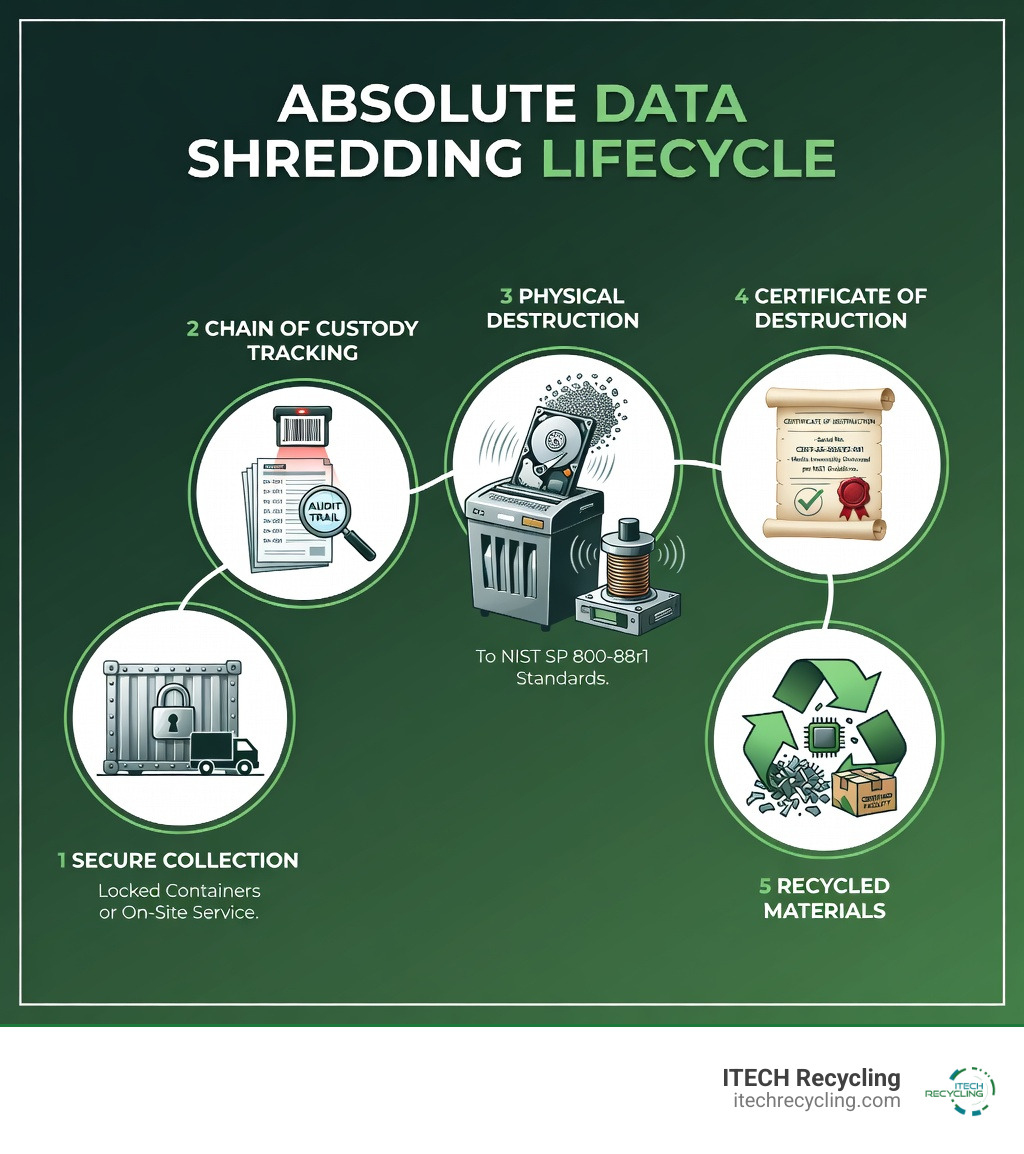
- Proof: Certificate of destruction with auditable serial numbers
Why It Matters:
- Legal requirement: Secure destruction is mandated by law for sensitive data
- Risk prevention: 68% of security breaches originate at endpoints
- Identity protection: Prevents corporate espionage and identity theft
- Compliance: Required for HIPAA, GDPR, and federal regulations
The stakes are higher than most businesses realize. As one privacy commissioner noted, recycling is not viewed as an adequate alternative to shredding—deleted data isn’t really gone until it’s physically destroyed. Research shows that thieves actively target recycled computers to recover data for blackmail, extortion, and identity theft.
Many organizations assume that deleting files or formatting drives provides adequate protection. The reality is far different. For ATA disk drives manufactured after 2001, NIST guidelines confirm that proper sanitization requires at minimum one complete overwrite—but even this only addresses digital sanitization. Physical destruction remains the gold standard for high-security applications.
The vulnerability doesn’t end with the data itself. The most critical risk occurs during transport of storage devices from your facility to destruction sites. This is where many well-intentioned security plans fail.
I’m owner of iTech Recycling, where we’ve helped hundreds of organizations implement compliant absolute data shredding programs that protect sensitive information while supporting sustainability goals. Our experience has shown that the right destruction partner makes all the difference between genuine security and false confidence.
Comprehensive Services for Absolute Data Shredding
When we talk about absolute data shredding, we aren’t just talking about a heavy-duty office shredder that jams every five minutes. We are talking about industrial-grade destruction that turns hardware into confetti. Our services are designed to be a “one-stop shop” for everything that holds data.
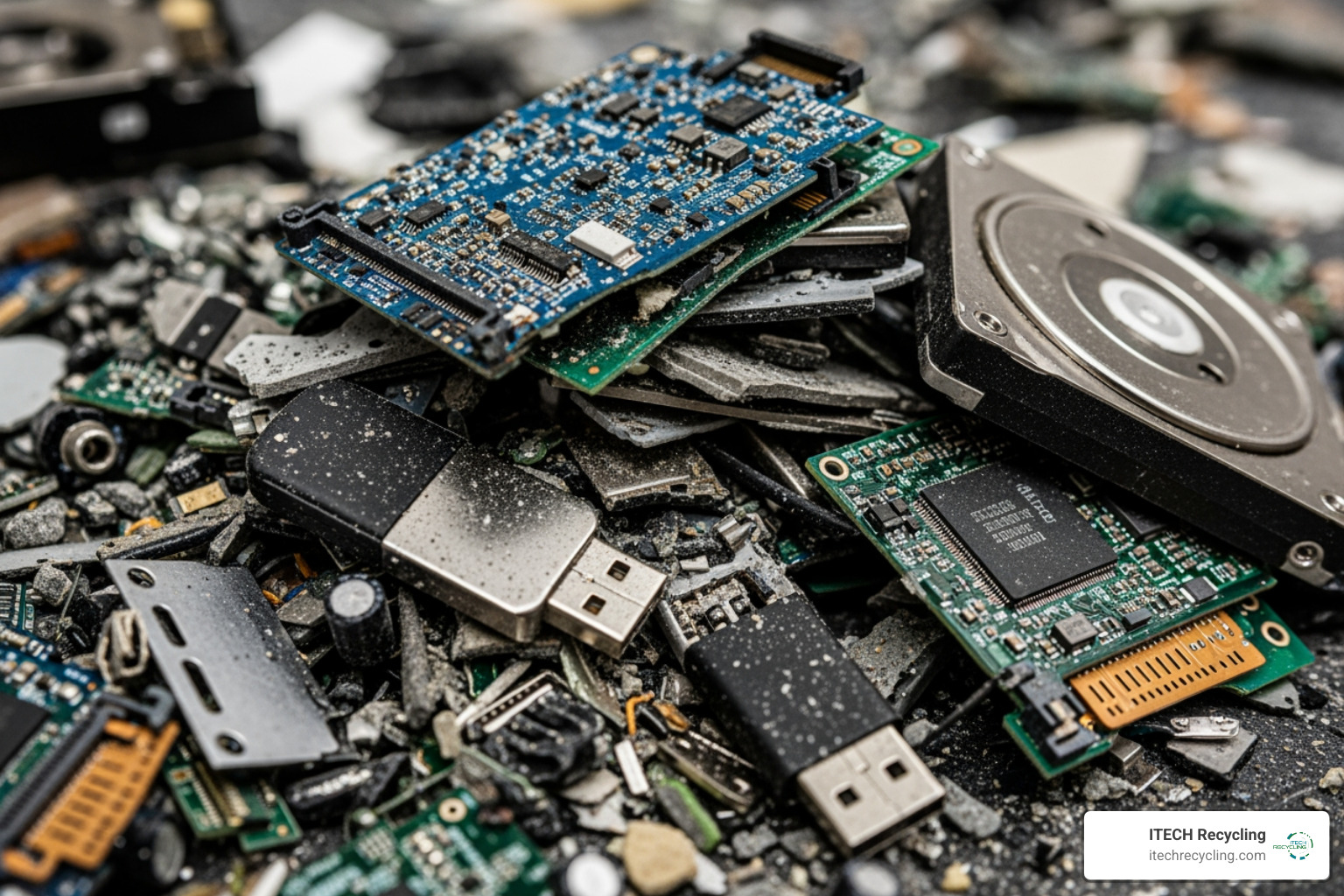
At ITECH Recycling, we handle a massive variety of media types. This includes traditional hard drives, solid state media (SSDs), thumb drives, and even cellular phones. But it doesn’t stop at your computer. Think about your security badges or those old storage tapes sitting in the back of the closet. If it has a chip or a magnetic strip, it has your data.
We offer specialized Hard Drive Shredding and Data Destruction that ensures your hardware is physically pulverized. To give you peace of mind, every item we destroy is tracked. We record auditable serial numbers for each device, providing you with a formal Certificate of Destruction. This isn’t just a receipt; it’s your legal “get out of jail free” card if an auditor ever asks where your data went.
Beyond standard IT assets, we also provide product destruction services. If your business has prototypes, returns, or branded products that shouldn’t reach the secondary market, shredding is the most secure way to protect your intellectual property.
Secure Digital Media Disposal
Modern data storage is surprisingly resilient. Magnetic tapes and optical disks (CDs/DVDs) require specific destruction methods to ensure data cannot be reconstructed. For example, optical media must be reduced to particles with nominal edge dimensions of 5 mm and a surface area of 25 mm² to meet high-security standards.
For devices that are still functional but need to be decommissioned, we look to the Absolute Device Wipe FAQ guidelines for endpoint security. While software wipes (like cryptographic wipes) are excellent for remote sanitization, they are often used as a precursor to physical destruction to ensure a multi-layered security approach.
Commercial and Residential Document Shredding
While we live in a digital world, paper hasn’t gone away. Whether you are a large corporation in Chicago or a resident in Naperville, sensitive documents like tax returns, medical records, and client contracts need a secure exit strategy.
We offer both one-time purge services—perfect for that “spring cleaning” of the filing cabinet—and regularly scheduled services. For ongoing needs, we provide lockable security containers at no cost. You simply drop the documents in, and we handle the rest. This ensures Secure Data Destruction in Chicago IL is convenient and foolproof.
Compliance, NIST Guidelines, and Legal Security
In data, “oops” is an expensive word. Secure destruction of sensitive data is not just a good idea; it is the law. Between HIPAA (healthcare), GDPR (privacy), and FIPS 199 (federal standards), the regulatory landscape is a minefield.
The gold standard for our industry is the NIST Guidelines for Media Sanitization. NIST SP 800-88r1 outlines three levels of sanitization:
- Clear: Overwriting data using standard read/write commands.
- Purge: More advanced methods like degaussing or “Secure Erase” commands that protect against laboratory-level recovery.
- Destroy: Physical destruction (shredding, incinerating, or pulverizing) that makes the media unusable.
Statistics show that 68% of security breaches originate at the endpoint. This means your old laptops and discarded phones are the biggest targets for hackers.
| Method | Protection Level | Best For |
|---|---|---|
| Clear | Keyboard Attacks | Reusing devices within the same department |
| Purge | Laboratory Attacks | Reusing devices outside the organization |
| Destroy | Absolute Security | End-of-life hardware and high-sensitivity data |
Technical Standards for Destruction
We don’t just guess when the job is done. We follow strict technical metrics. For ATA disk drives manufactured after 2001 (over 15 GB), a single overwrite is often adequate for “clearing” the media. However, for physical destruction, the requirements are much tighter. Paper must be cross-cut into 1x5mm particles. Optical media must be reduced to 5mm edge dimensions and 25mm² surface area. These aren’t just random numbers; they are the thresholds that prevent data reconstruction by even the most determined bad actors.
Why Professional Certification Matters
Choosing a provider with certifications like NAID AAA is vital. A NAID AAA certification means the company undergoes rigorous, unannounced audits to ensure they are following the highest security protocols. For banks, being an OBA (Oklahoma Bankers Association) strategic member or following similar regional banking standards is a mark of trust.
Failing to use a certified provider can result in massive government fines and legal liability. You can learn more about Why Use a NAID Certified Company to understand how these standards protect your business from the “cheap” shredding services that might just dump your intact hard drives in a public bin.
On-Site vs. Off-Site: Maximizing Chain of Custody
One of the biggest questions we get is: “Should you shred it here or take it away?” Both have their place in an absolute data shredding strategy.
The “Chain of Custody” is the most important part of the process. It is the documented trail that shows who had your data at every second. Whether you choose mobile shredder deployment (on-site) or plant-based processing (off-site), maintaining total material control is our priority.
Understanding the difference between Data Disposal vs Data Destruction is key. Disposal is just getting rid of things. Destruction is the verified process of making data unrecoverable.
Mobile Shredding Advantages
On-site shredding is the “VIP” service of the data world. A mobile shredding truck comes to your location in Aurora, Elgin, or Evanston, and you can actually watch your hard drives or documents being destroyed.
- On-site verification: You see it happen.
- Immediate destruction: Nothing leaves your sight intact.
- No intact transport: Eliminates the risk of a device falling off a truck during transit.
Secure Off-Site Processing
Off-site shredding at our secure facility is often more cost-effective for high-volume jobs. We use secure transport boxes and GPS-tracked vehicles to ensure the chain of custody remains unbroken. Once at the facility, the material is shredded, baled in-house, and sent directly to a paper mill or metal refinery. This ensures a zero-landfill policy and maximum security.
Why Professional Shredding Beats In-House Efforts
We’ve all seen it: the small office shredder that sits in the corner, surrounded by a pile of un-shredded paper because it overheated after ten minutes. In-house shredding is often a false economy.
There are at least 5 Reasons to Choose Hard Drive Shredding Services over doing it yourself. First, it saves significant money and office space. More importantly, it boosts employee productivity. Do you really want your highly-paid office manager spending three hours a week feeding paper into a tiny machine?
Professional services also offer a much higher level of security. Most office shredders only do “strip-cut,” which can be easily pieced back together. Our industrial shredders use “cross-cut” technology that turns paper into dust.
We also care about our community. We offer a 10% discount for non-profit organizations to help them stay compliant on a budget. Furthermore, our process is eco-friendly. By choosing us, you are supporting Hard Disk Recycling for Privacy, ensuring that the raw materials from your old electronics are recovered and reused rather than ending up in a landfill.
Frequently Asked Questions
What is the NIST standard for absolute data shredding?
The primary standard is NIST SP 800-88r1. It provides the framework for “Media Sanitization,” which includes Clearing, Purging, and Destroying data. For high-security needs, physical shredding is the recommended “Destroy” method because it renders the media physically unusable and the data unrecoverable by any known technology.
How do I get proof of destruction?
After every service, we provide a formal Certificate of Destruction. This document includes auditable serial numbers for hard drives and electronic media, the date of service, and a signature from the technician. This provides a clear chain of custody that satisfies HIPAA, GDPR, and other regulatory audits.
What areas are covered by absolute data shredding services?
ITECH Recycling provides comprehensive services across the greater Chicago area and beyond. We serve businesses and residents in Chicago, Wood Dale, Bensenville, Franklin Park, Mundelein, Deerfield, Naperville, Elgin, Springfield, Evanston, Elk Grove Village, Bloomington, Glenview, Hawthorn Woods, Vernon Hills, Bolingbrook, Aurora, and Arlington Heights. If you are looking for Data Destruction Services in Evanston IL, we’ve got you covered.
Conclusion
At ITECH Recycling, we believe that security shouldn’t be a headache. Whether you’re dealing with a decade’s worth of old hard drives in Bolingbrook or sensitive employee records in Glenview, our absolute data shredding services provide the ultimate peace of mind. We combine industrial-strength destruction with a commitment to sustainability, ensuring your e-waste is handled responsibly and your private information stays private.
Don’t leave your data to chance. A “paper cut” in your security protocol can lead to a massive financial wound. Schedule your absolute data shredding service today and let us help you stay compliant, secure, and green.
 Prev
Prev