

R2 and e-Stewards: Navigating the World of Certified Electronics Recycling
Why Certified Electronics Recycling Matters for Your Data and the Planet
Certified electronics recycling is the process of managing end-of-life electronics through facilities verified by independent third-party auditors to meet rigorous environmental, data security, and worker safety standards. Two main certifications exist:
- R2 (Responsible Recycling): Managed by SERI, focuses on responsible recycling practices and includes specialized appendices for data destruction, ITAD, and materials recovery
- e-Stewards: Managed by the Basel Action Network, emphasizes ethical practices including prohibition of hazardous waste exports to developing countries and integrates NAID AAA data security standards
Both certifications ensure continual oversight, proper data destruction, safe handling of toxic materials like lead and mercury, and compliance with environmental regulations.
When electronics are improperly disposed of, they can harm the environment in ways that last for generations. Studies show that over 35% of used hard drives purchased online contained residual data, creating serious risks for identity theft and legal liabilities. Meanwhile, only 20% of e-waste is recycled properly each year, sending toxic materials into landfills where they contaminate soil and water.
Certification makes the difference. Certified electronics recyclers undergo independent audits by accredited bodies like ANAB (ANSI-ASQ National Accreditation Board) to verify they meet strict standards for environmental protection, data security, and worker safety. They’re required to track materials through secure chains of custody, prevent illegal exports to dangerous operations abroad, and maximize resource recovery—90% of electronics components including gold, silver, copper, and palladium can be recycled into new products.
For businesses, certification provides proof of compliance for data protection regulations and ESG commitments. For households, it ensures toxic materials stay out of local ecosystems. For everyone, it means electronics get a second life through refurbishment or responsible recycling instead of ending up in remote graveyards damaging communities and the environment.
I’m owner of iTech Recycling, where we’ve built our business around certified electronics recycling practices that protect both your sensitive data and our shared environment. Through years of managing secure, compliant e-waste disposal for businesses and residents across the Chicago area, I’ve seen how proper certification transforms recycling from a liability risk into a sustainability solution.
What is Certified Electronics Recycling?
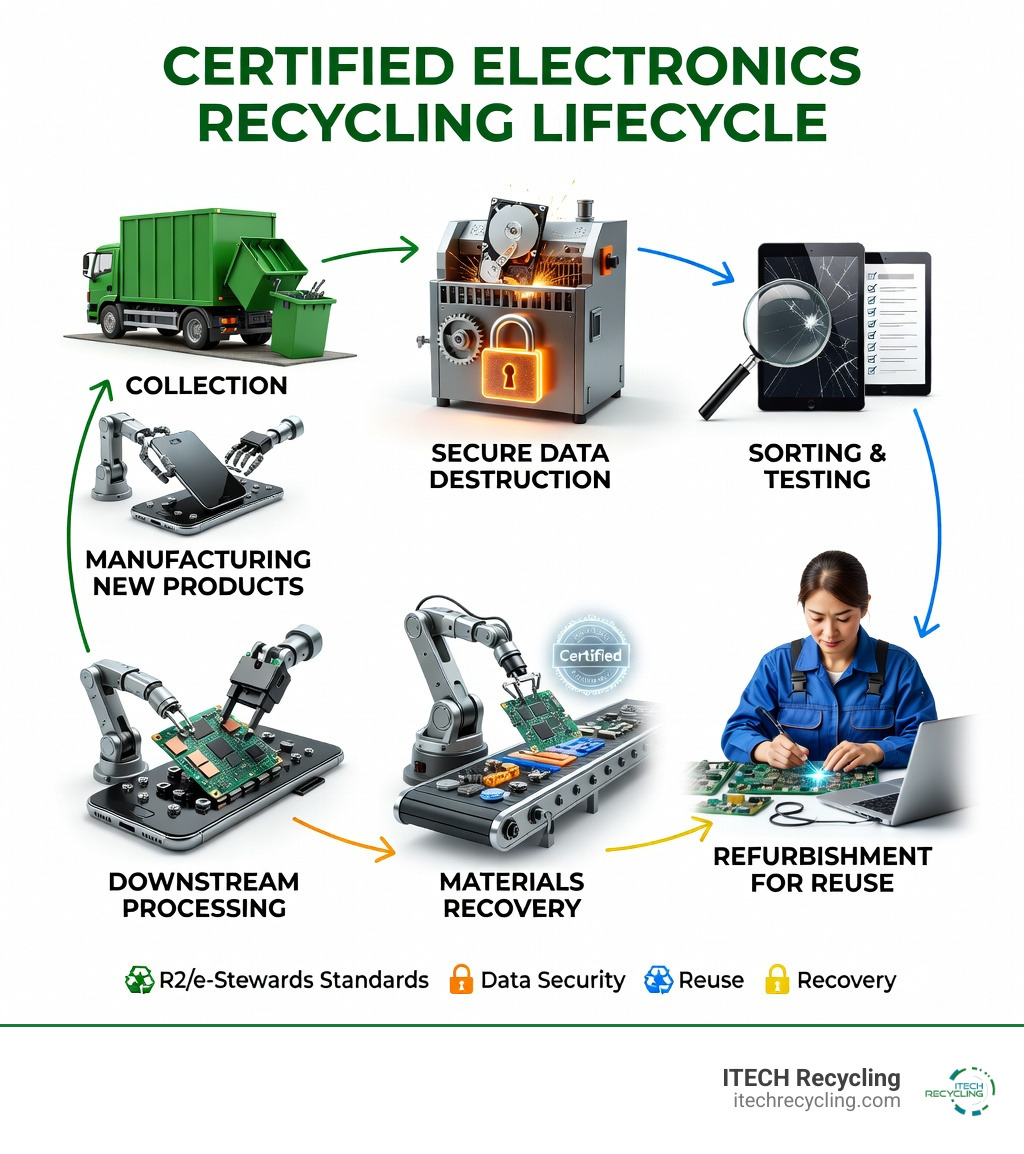
At its core, Certified electronics recycling is about accountability. It isn’t enough for a company to simply say they are “green” or “eco-friendly.” In our industry, those terms are often used loosely. True certification means that a recycling facility has opened its doors to independent, third-party auditors who verify every step of the process.
These auditors work under the oversight of the ANSI-ASQ National Accreditation Board (ANAB), ensuring that the recycler meets specific, high-level standards. These standards cover several critical areas:
- Environmental Management: Ensuring no hazardous waste ends up in a landfill or is illegally exported to non-OECD countries.
- Worker Health and Safety: Protecting the people who handle and dismantle these devices from exposure to toxins like lead dust or mercury vapors.
- Data Security: Verifying that every bit of sensitive information is destroyed before a device is resold or shredded.
The US EPA strongly encourages businesses and individuals to use certified recyclers because they provide a transparent “chain of custody.” This means we can account for where your old laptop goes, from the moment it leaves your office in Naperville or Elgin until it is fully processed into raw materials or refurbished for a new user.
Comparing the Standards: R2 vs. e-Stewards
If you are looking for a Certified electronics recycler, you will likely encounter two primary names: R2 and e-Stewards. While both are excellent and far superior to non-certified options, they have slightly different origins and focuses.
The R2 Standard (Responsible Recycling)
R2 is currently in its “v3” version. It was developed through a multi-stakeholder process facilitated by SERI (Sustainable Electronics Recycling International). R2v3 is highly flexible and uses “Appendices” to certify facilities for specific tasks. For example:
- Appendix B focuses on enhanced data destruction.
- Appendix C covers ITAD and refurbishment.
- Appendix E is for high-volume materials recovery.
The e-Stewards Standard
e-Stewards was created by the Basel Action Network (BAN). It is often described as the most stringent standard because it strictly prohibits the export of hazardous e-waste to developing countries, even if the destination country allows it. It also integrates the NAID AAA standard for data destruction, making it a favorite for highly regulated industries like healthcare and finance.
| Feature | R2v3 Standard | e-Stewards Standard |
|---|---|---|
| Primary Focus | Market-driven, flexible, circular economy | Ethical exports, highest environmental bar |
| Data Security | Appendix B (Logical & Physical) | Integrates NAID AAA Standards |
| Export Rules | Prohibits illegal exports | Prohibits all hazardous waste export to developing nations |
| Oversight | Managed by SERI | Managed by Basel Action Network |
Both standards are recognized by the US EPA as being effective at protecting the environment and ensuring data security. Whether a recycler holds one or both, they are demonstrating a commitment to the highest industry benchmarks.
Why Businesses and Households Need Certified Electronics Recycling
In the Chicago area—from the busy streets of the Loop to the industrial hubs of Elk Grove Village and Bensenville—e-waste is a growing problem. We generate massive amounts of it, but only 20% is handled correctly. This is a missed opportunity for resource recovery. Did you know that 90% of electronic components can be recycled? We can recover gold, silver, copper, and palladium, which reduces the need for destructive mining.
Using a Certified electronics recycler ensures that your devices don’t just sit in a warehouse; they are moved back into the economy.
Benefits of Certified Electronics Recycling for Businesses
For our business clients in Arlington Heights or Bolingbrook, electronics recycling for businesses is a matter of risk management.
- ITAD (IT Asset Disposition): We help manage the end-of-life cycle for your IT assets, ensuring that old servers and workstations are decommissioned properly.
- Compliance: Certified recycling helps you meet HIPAA, FACTA, and GLB Act requirements.
- ESG Goals: Most modern corporations have Environmental, Social, and Governance (ESG) targets. Using a certified recycler provides the documentation needed to prove you are diverting waste from landfills.
Protecting Households and Local Communities
Residents in communities like Mundelein, Vernon Hills, and Hawthorn Woods often wonder why they can’t just throw an old printer in the trash. The answer lies in the toxins. Electronics contain mercury, lead, and cadmium. When these sit in a landfill, they leak into the soil and groundwater. Residential electronics recycling through a certified program ensures these materials are captured and neutralized, protecting the health of our local neighborhoods.
The Critical Role of Data Destruction in Certified Electronics Recycling
One of the biggest myths we hear is that “deleting” files or “formatting” a drive is enough. It isn’t. Research shows that over 35% of used hard drives sold online still contain recoverable data. This is why e-waste recycling is important—it isn’t just about the glass and plastic; it’s about your privacy.
Certified recyclers follow strict “Chain of Custody” protocols. From the moment we pick up your gear in Deerfield or Evanston, it is tracked. We provide Certificates of Destruction that prove the data is gone forever, reducing your legal liability.
Data Security in Certified Electronics Recycling
We use several methods for data destruction:
- Physical Shredding: Literally grinding the hard drive into tiny bits.
- Logical Sanitization: Using software (like Blancco) to overwrite every sector of the drive multiple times, following NIST 800-88 standards.
- Degaussing: Using powerful magnets to scramble the data on magnetic media.
Hard drive shredding is often the preferred choice for government and healthcare sectors because it offers visual proof of destruction.
Role in ITAD and Refurbishment
Not everything needs to be shredded. In a circular economy, the best outcome is reuse. Certified recyclers evaluate assets for refurbishment. If a laptop from a company in Bloomington is still functional, we can sanitize the data and prepare it for resale. This responsible e-waste disposal maximizes the value of the asset while ensuring the previous owner’s data is 100% secure.
Environmental and Health Protections of Certified Programs
The “Big Three” toxins in electronics—Lead, Mercury, and Cadmium—are incredibly dangerous if they enter the food chain. Lead, found in CRT monitors and solder, causes neurological damage. Mercury, found in older LCD backlights, is a potent neurotoxin. Cadmium, used in certain batteries and circuit boards, is a known carcinogen.
Certified programs require recyclers to:
- Divert from Landfills: Ensure 0% of hazardous e-waste goes to municipal dumps.
- Safe Downstream Processing: Only work with other certified vendors who also follow these strict rules.
- Resource Recovery: For every 1 million laptops recycled, we save enough energy to power 3,657 homes for a year.
Risks of Using Non-Certified Recyclers
Choosing a non-certified recycler is a gamble where the stakes are your reputation and the planet’s health.
- Illegal Dumping: Many “recyclers” are actually just “exporters.” They strip the valuable metals and dump the toxic remains in developing nations, creating “global graveyards” where children often manually dismantle electronics over open fires.
- Identity Theft: If a recycler doesn’t have a certified data destruction process, your company’s financial records or your personal photos could end up in the wrong hands.
- Regulatory Fines: In Illinois, there are strict laws regarding e-waste. If your business’s branded equipment is found in a ditch or an illegal dump, you could face massive fines and brand damage.
Frequently Asked Questions about Certified Electronics Recycling
What types of electronics can be recycled through certified programs?
Almost anything with a plug or a battery! This includes:
- Computers & Laptops: Desktops, Macs, Chromebooks, and tablets.
- Mobile Devices: Smartphones, old flip phones, and pagers.
- Data Center Gear: Servers, racks, switches, and UPS batteries.
- Office Equipment: Printers, scanners, fax machines, and photocopiers.
- Monitors & TVs: Both modern LEDs and old CRT “tube” televisions.
- Cables & Accessories: Keyboards, mice, and power cords.
How can I find and choose a certified electronics recycler?
The best way is to check the official directories. You can visit the SERI website for R2 certified facilities or the e-Stewards directory. If you are in the Chicago area, look for a local provider that lists their certifications clearly and offers on-site services for added security.
What is the process for a facility to become certified?
It isn’t easy! A facility must:
- Develop a Management System: Document every process for safety, environment, and data.
- Internal Audit: Run the system for several months to ensure it works.
- Stage 1 Audit: A third-party auditor reviews the documentation.
- Stage 2 Audit: The auditor visits the facility to watch the work in action.
- Annual Surveillance: Auditors return every year to make sure standards are still being met.
Conclusion
At ITECH Recycling, we believe that Certified electronics recycling is the only responsible way forward. Whether you are a business in Wood Dale needing to clear out a warehouse or a family in Glenview with a drawer full of old phones, the choices you make today impact our community’s health and security for years to come.
We are proud to serve the entire Chicago region—from Aurora to Arlington Heights—with a focus on sustainability, data security, and compliance. Don’t let your old tech become a liability. Let’s work together to recover resources and protect our planet.
Ready to clear out your e-waste responsibly? Schedule a pickup for certified electronics recycling in Chicago today and let us handle the rest!
 Prev
Prev