


Chicago Electronics Recycling Drop Off: Your Local Map
Where to Drop Off E-Waste in Chicago (Quick Answer)
Chicago e-waste drop off is free for city residents at several locations year-round and seasonally. Here are your main options at a glance:
| Option | Location | Hours |
|---|---|---|
| HCCRF (Permanent) | 1150 N. North Branch St | Tue 7am–12pm, Thu 2–7pm, 1st Sat 8am–3pm |
| Seasonal City Events | 6 rotating sites citywide | 9am–1pm, April–January |
| UChicago Drop-Off | 929 E. 57th St (Gordon Center) | During facility hours |
| UIC CERC Program | UIC campus collection point | Contact UIC directly |
| Certified Private Recycler | 200 S Wacker Dr, 31st Floor | Mon–Fri 8am–5pm |
Note: City drop-off sites stop accepting items once trucks are full. Arrive early.
Electronics are now the fastest-growing part of the solid waste stream — and they contain hazardous materials like lead and mercury that do real damage when they end up in a landfill. Chicago has built out a solid network of free drop-off options for residents, but knowing which facility accepts what, and when to show up, can save you a wasted trip across town.
That’s exactly what this guide is here to solve.
The team at ITECH Recycling has helped countless Chicago residents and businesses navigate chicago e-waste drop off options — from city-run facilities to certified private recyclers — with a focus on secure, compliant, and zero-landfill disposal. Let’s walk through every option so you can find the right fit quickly.
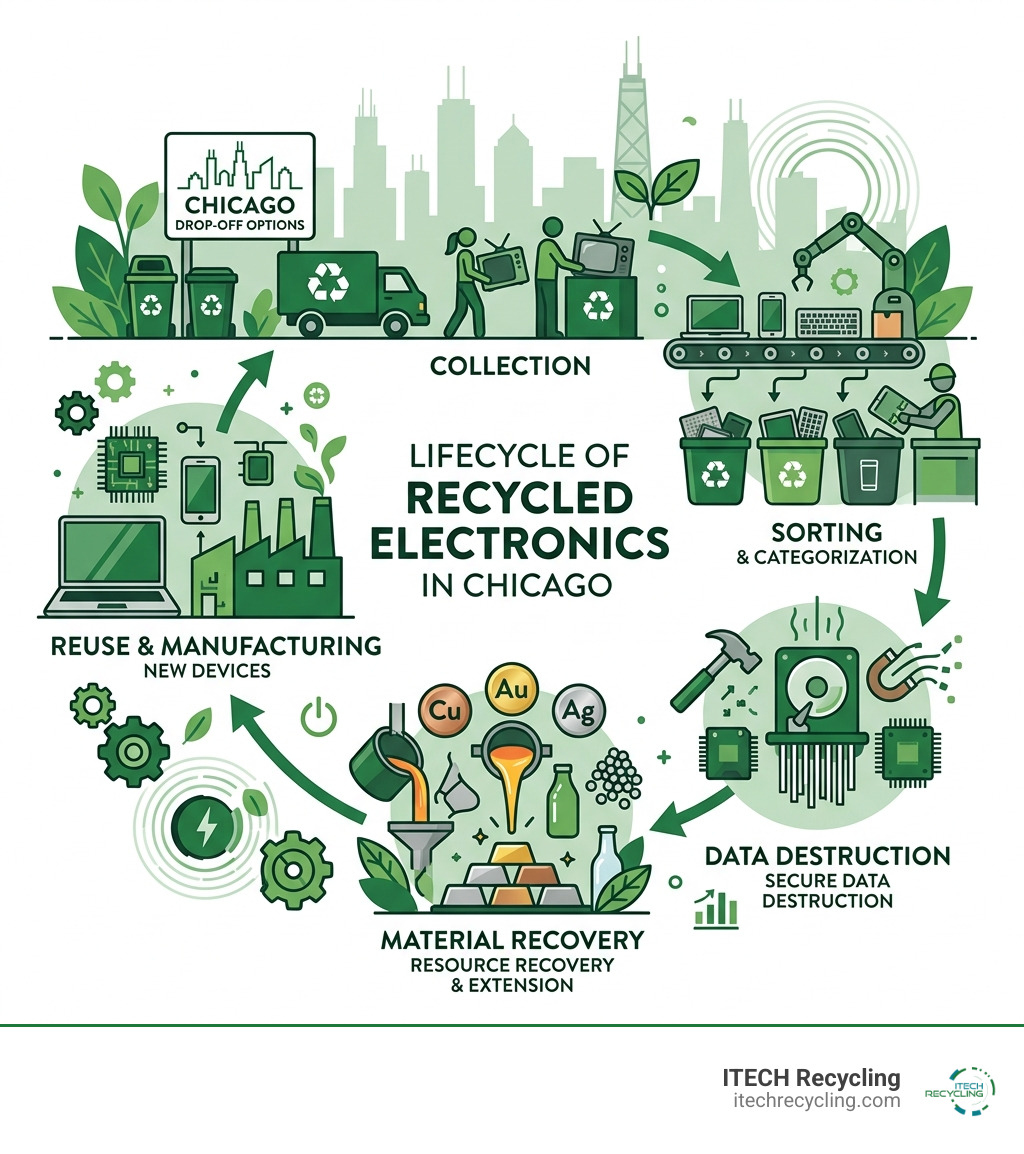
Chicago e waste drop off basics:
Permanent Chicago E-Waste Drop Off Locations and Hours
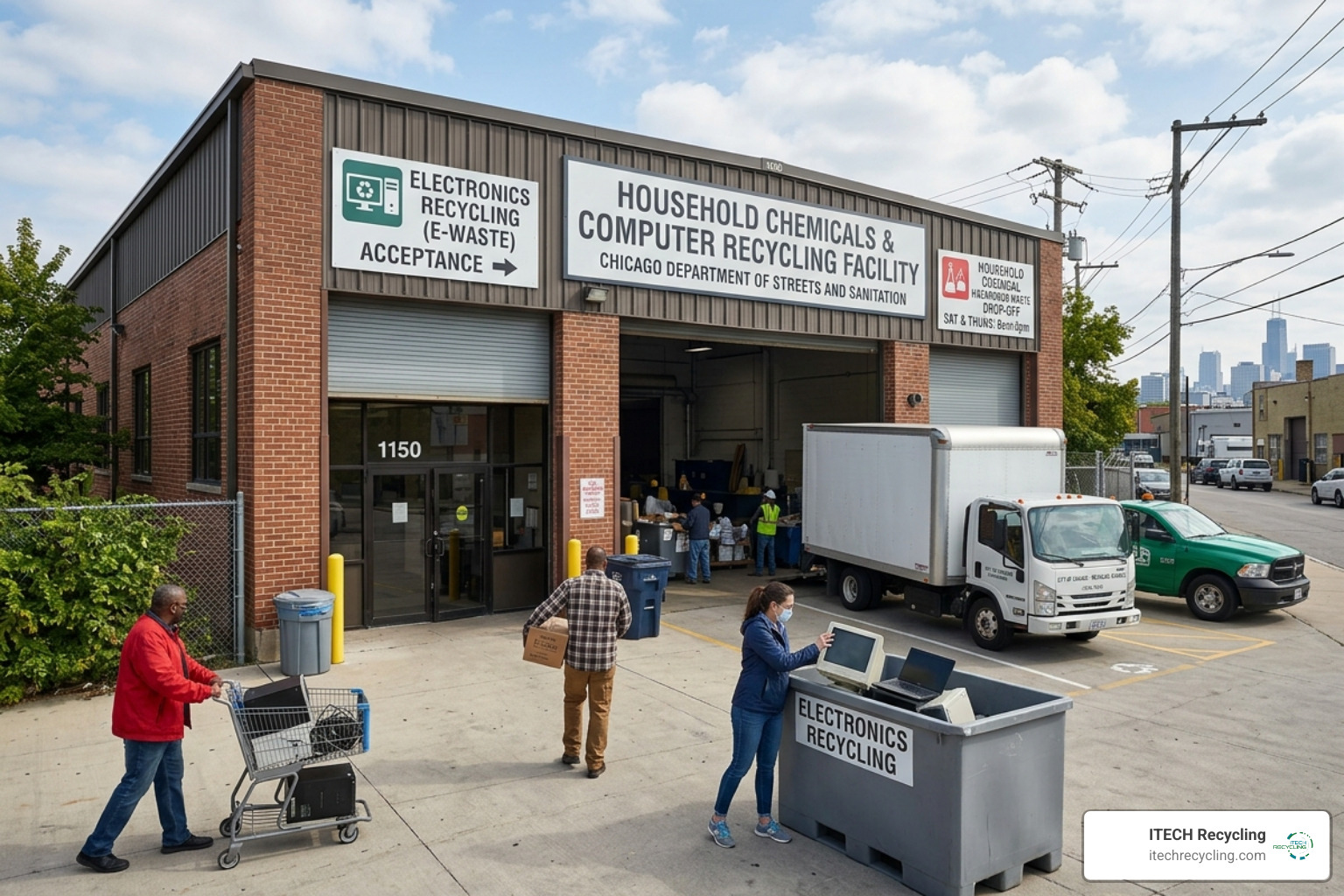
When you have a pile of old laptops or a tangled mess of power cords, you don’t always want to wait for a neighborhood event. Chicago’s primary solution is the Household Chemicals & Computer Recycling Facility (HCCRF). This is the “gold standard” for city-run disposal, managed by the Department of Streets and Sanitation in partnership with the Chicago Department of Public Health.
Located at 1150 N. North Branch Street, the facility sits just two blocks east of the Kennedy Expressway at Division Street. It’s a dedicated, permanent site designed specifically for Residential Electronics & Household Chemicals Recycling Overview.
We often recommend this site because it is reliable and staffed with attendants who help ensure your items are sorted correctly. If you’re looking for a deeper dive into how the city manages these programs, check out our Chicago Residential Electronics Recycling Program Guide.
Operating Hours for the Main Facility
Timing is everything. You can’t just drop items at the gate after hours (in fact, that’s illegal and can result in fines). The HCCRF operates on a very specific weekly schedule as of April 2026:
- Tuesdays: 7:00 a.m. – 12:00 p.m. (Great for early birds)
- Thursdays: 2:00 p.m. – 7:00 p.m. (Perfect for dropping off after work)
- First Saturday of every month: 8:00 a.m. – 3:00 p.m.
When you arrive, you’ll see two distinct areas: a blue building for chemicals and a yellow building for electronics. Stay in your vehicle; attendants will verify your residency and assist with unloading.
Finding a Seasonal Chicago E-Waste Drop Off Event
If driving to North Branch Street isn’t convenient, the city hosts dozens of rotating chicago e-waste drop off events from April through December. These events move through different wards to ensure every neighborhood has access to responsible disposal.
However, there is a catch: Truck capacity is limited. These events typically run from 9:00 a.m. to 1:00 p.m., but once the recycling truck is full, the event ends. We’ve seen residents arrive at noon only to find the gates closed because the community was particularly active that morning.
Current seasonal locations often include:
- North Side: 6441 N. Ravenswood Ave and 4808 W. Wilson Ave
- West Side: 1817 S. Pulaski
- South Side: 8559 S. Vincennes, 2300 W. 52nd St, and 900 E. 103rd St
For those who can’t make these windows or have bulky items that won’t fit in a sedan, you might want to look into a local pickup service to handle the heavy lifting for you.
What You Can (and Can’t) Bring to City Facilities
Not all “e-waste” is created equal in the eyes of the city. The municipal program is strictly for residential waste. If you bring a pallet of computers from your office, you will be turned away.
| Accepted Residential Electronics | Prohibited Items & Hazardous Waste |
|---|---|
| Computers (Towers & Laptops) | Business-generated E-Waste |
| Monitors (Flat Screen) | Large Appliances (Fridges/Stoves) |
| Televisions (Flat Screen) | Latex Paint (Dry it out instead!) |
| Tablets & Cell Phones | Medical Waste / Sharps |
| Video Game Consoles | Air Conditioners & Dehumidifiers |
| Printers, Scanners & Fax Machines | Microwaves (at most city sites) |
If you specifically need to get rid of an old screen, read our guide on the easy way to handle a computer monitor drop off to ensure you’re following the latest safety protocols.
Accepted Residential Electronics
The list of accepted items is actually quite broad for residents. Beyond the “big” items like computers, you can also drop off:
- Digital converter boxes and cable/satellite receivers.
- Small-scale servers (residential grade).
- Portable music players (iPods, MP3 players).
- Keyboards, mice, and bundled cords.
- VCRs, DVD players, and recorders.
Prohibited Items and Hazardous Materials
It’s important to note that the HCCRF is one of the few places that handles household chemicals alongside electronics, but they have strict limits. For example, they do not accept latex paint. Why? Because latex paint isn’t hazardous; you can actually dry it out with kitty litter and throw it in your regular trash.
Additionally, large “white goods” (appliances) are a no-go. For residents in the suburbs, such as Naperville, the rules might vary slightly, so it’s worth checking Electronics Recycling | The City of Naperville if you live on the edge of the city limits.
Step-by-Step Guide to a Chicago E-Waste Drop Off
Using a chicago e-waste drop off site is designed to be a “contactless” and efficient process. Whether you are going to the permanent facility or a seasonal ward event, the procedure is generally the same:
- Pack your vehicle: Place all electronics in your trunk or the back of your SUV.
- Enter the queue: Follow the signs and stay in your vehicle.
- Verification: An attendant will ask for proof of Chicago residency (usually a driver’s license or utility bill).
- Unloading: You simply pop your trunk, and the staff will remove the items for you. This keeps the line moving and ensures safety.
For more details on how these programs differ for homeowners, see our page on residential electronics recycling.
Preparing Your Devices for a Chicago E-Waste Drop Off
Before you drive off, you have some homework to do. Dropping off a computer is like leaving your diary on a park bench if you haven’t cleared the data. We recommend:
- Back up your data: Once it’s dropped off, you can’t get it back.
- Perform a factory reset: This is a basic first step for phones and tablets.
- Remove storage media: If a computer is dead, physically remove the hard drive.
- Bundle your cords: Use a rubber band or twist tie to keep cables neat. It helps the recyclers sort materials faster.
If you are worried about sensitive information, our hard drive shredding and data destruction service provides the ultimate peace of mind.
Ensuring Data Security and Privacy
The City of Chicago does its best to handle materials responsibly, but the ultimate responsibility for data privacy lies with the resident. Professional recyclers follow NIST 800-88 standards, which are the federal guidelines for media sanitization. This involves either high-level software wiping or physical destruction (shredding) of the drive.
For businesses or residents in high-security fields like healthcare (HIPAA) or finance (FACTA), a simple “delete” isn’t enough. Physical shredding turns your hard drive into “confetti,” making data recovery impossible.
University and Private Recycling Alternatives
Chicago’s universities are leaders in sustainability. If you are a student, faculty member, or sometimes even a neighbor, these campus programs offer fantastic alternatives for a chicago e-waste drop off.
Campus-Specific E-Waste Programs
- University of Chicago: The UChicago Gordon Center for Integrative Science (929 E. 57th St) has a dedicated bin in the west lobby. They also operate a facility at 5225 S. Cottage Grove Avenue. UChicago is particularly impressive, currently recycling about 37% of on-campus waste.
- UIC CERC Program: The Campus Electronic Recycling Collection (CERC) at UIC accepts personal electronics from the community. They emphasize compliance with the Illinois Electronic Products Recycling and Reuse Act.
- Reuse Platforms: Programs like the Rheaply marketplace help universities trade and reuse equipment internally before it ever hits the recycling bin.
For those looking for general electronics and computers recycling options near these campuses, there are many private drop-off points available as well.
Certified Private Recyclers for Businesses
As mentioned, city facilities are for residents only. Businesses must use private, certified recyclers. When choosing a partner, look for R2v3 certification. This ensures that the recycler follows the highest international standards for environmental protection and worker safety.
Certified recyclers offer:
- Commercial volume handling: From one laptop to a whole data center.
- Zero-landfill policies: Ensuring 100% of materials are recovered or responsibly processed.
- Certificates of Destruction: Essential for legal compliance and proving that your data was handled correctly.
The Environmental Impact of Responsible Disposal
Why go through the trouble of a chicago e-waste drop off? Because “urban mining” is far more efficient than traditional mining. Electronics are packed with valuable materials that are difficult and environmentally “expensive” to extract from the earth.
Statistics on Material Recovery
The numbers are staggering when we look at the potential of recycled electronics:
- Recycling one million laptops saves enough energy to power 3,500 American homes for an entire year.
- Recycling one million mobile phones recovers:
- 800 pounds of silver
- 30,000 pounds of copper
- 70 pounds of gold
- 30 pounds of palladium
- CFL Bulbs: While they contain tiny amounts of mercury (less than 5mg), using ENERGY STAR qualified CFLs uses 75% less electricity than incandescent bulbs.
By choosing a responsible recycling path, you are directly contributing to these resource recovery efforts.
Legal Compliance and Illinois Law
In Illinois, it isn’t just a good idea to recycle—it’s the law. The Electronic Products Recycling and Reuse Act bans many electronics from landfills. This includes computers, monitors, TVs, and printers.
As we move through 2026, regulations have become even stricter regarding “CRT” (cathode ray tube) devices—the old heavy “tube” TVs. These contain significant amounts of lead and must be handled by specialized facilities to prevent environmental contamination.
Frequently Asked Questions about Chicago E-Waste
Is e-waste recycling free for Chicago residents?
Yes. Dropping off accepted electronics at the HCCRF or city-sponsored seasonal events is completely free for Chicago residents. This program is funded by the city to encourage legal disposal and protect the environment.
What happens if the recycling truck is full?
If you arrive at a seasonal neighborhood event and the truck is full, the attendants will stop accepting items immediately. You will be directed to the permanent HCCRF facility on North Branch Street or advised to wait for the next scheduled event. This is why we recommend arriving within the first hour of any event.
Can I drop off my old tube TV (CRT)?
Yes, the city’s permanent facility (HCCRF) accepts CRT televisions and monitors from residents. However, some smaller neighborhood “partner” locations or private retail drop-offs may exclude them due to their weight and the hazardous leaded glass inside. Always check the specific site’s “accepted items” list before hauling a heavy TV. If you’re in the suburbs, check local guides like E-Recycling | Village of Franklin Park for their specific CRT rules.
Conclusion
The future of Chicago is sustainable, and it starts with how we handle the gadgets of our past. By utilizing a chicago e-waste drop off location, you aren’t just cleaning out your closet; you’re participating in a vital cycle of resource conservation. Whether you visit the permanent HCCRF facility, attend a neighborhood ward event, or utilize a university program, you are helping divert hazardous lead and mercury from our local landfills.
At ITECH Recycling, we believe in making this process as seamless as possible. From ensuring your data is physically destroyed to recovering precious metals that can be used in the next generation of technology, we are committed to a zero-landfill Chicago.
Ready to clear out your old tech? Learn why electronics recycling in Chicago is important and join your neighbors in keeping our city clean and secure.
 Prev
Prev