

Don’t Trash It: How to Recycle Electronics the Right Way
The E-Waste Crisis: Why Everyone Needs to Know How to Recycle Electronics
Knowing how to recycle electronics is one of the most important things you can do for the environment — and for protecting your personal data.
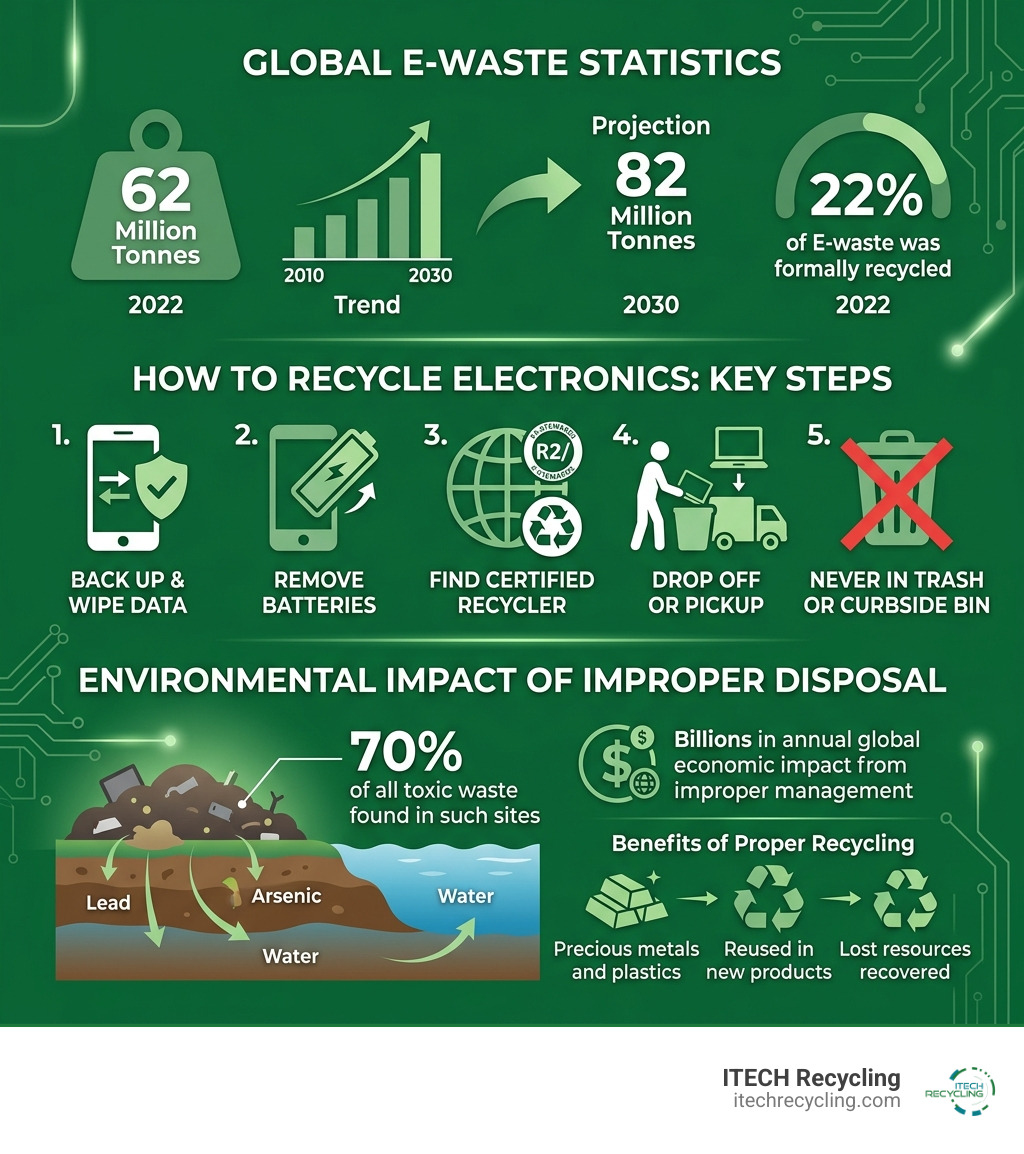
Here’s a quick overview of how to do it right:
- Back up your data and perform a factory reset or secure wipe on all devices
- Remove batteries (especially lithium-ion) and set them aside for separate recycling
- Find a certified recycler — look for R2 or e-Stewards certification
- Drop off or schedule a pickup through a local recycler, retailer program, or manufacturer take-back program
- Never put electronics in the trash or curbside bin — it’s illegal in 25 U.S. states plus D.C.
The scale of the problem is staggering. In 2022, the world generated a record 62 million tonnes of e-waste — an 82% increase since 2010. And that number is projected to hit 82 million tonnes by 2030. Yet only about 22% of that e-waste was formally recycled.
The rest? Much of it ends up in landfills, where toxic materials like lead and arsenic leach into soil and water. Electronics alone account for 70% of all toxic waste found in landfills and illegal dump sites.
This isn’t just an environmental issue. Every discarded device that isn’t recycled properly represents lost resources, potential data breaches, and real financial and environmental costs — estimated at $78 billion annually from improper e-waste management alone.
At ITECH Recycling, we work with businesses and organizations every day to solve exactly this problem — helping them dispose of old devices securely, compliantly, and sustainably. This guide covers everything you need to know about how to recycle electronics the right way, from preparing your devices to finding the right drop-off point.
Why You Should Learn How to Recycle Electronics
It is easy to think of an old smartphone as just a piece of plastic and glass, but it is actually a concentrated “urban mine” of precious resources. When we talk about how to recycle electronics, we aren’t just talking about keeping trash out of the ground; we are talking about recovering the very materials that make modern life possible.
The Toxic Reality of Landfills
As of April 2026, the volume of discarded tech continues to grow five times faster than our recycling investments. When these items are tossed into regular trash, they don’t just sit there. They break down and release hazardous substances.
Electronics are responsible for approximately 70% of the heavy metals found in landfills. This includes lead (found in CRT glass and solder), mercury (in switches and flat-panel displays), and arsenic. These toxins can seep into groundwater or be released into the air if the waste is incinerated, posing a direct threat to public health in our communities. By following proper Electronics Donation and Recycling | US EPA guidelines, we can stop this toxic cycle.
Recovering “Hidden” Treasure
Did you know that in 2022, the raw materials sitting in global e-waste were worth a staggering $91 billion? Unfortunately, only about $28 billion of that was recovered. When you recycle a million cell phones, you aren’t just getting rid of junk; you are recovering:
- 35,000 pounds of copper
- 772 pounds of silver
- 75 pounds of gold
- 33 pounds of palladium
These are finite resources. Mining them from the earth is an energy-intensive and often environmentally destructive process. In fact, over 70% of a computer’s total carbon footprint comes from the manufacturing process alone. By choosing to recycle, we reduce the demand for new mining and save massive amounts of energy. For instance, recycling just one million laptops saves enough electricity to power more than 3,500 U.S. homes for an entire year. This is why understanding Electronics Recycling in Chicago, IL: Why It Is Important is so vital for our local ecosystem.
Preparing Your Devices: Data Security and Safety
Before you head to a drop-off center, there is some homework to do. You wouldn’t hand your diary to a stranger, so why would you hand over a hard drive full of tax returns, passwords, and family photos?

How to Recycle Electronics Safely by Wiping Data
Data security is our top priority at ITECH Recycling, and it should be yours too. A simple “delete” or “empty trash” command doesn’t actually remove data from a drive; it just tells the computer that the space is available to be written over. Hackers can easily recover “deleted” files using basic software.
To truly protect yourself, you need to follow a more rigorous process. We recommend following the The Ultimate Guide to Wiping Your Hard Drive Before It Wipes You Out to ensure your digital life stays private.
- Back Everything Up: Move your important files to a cloud service or an external drive.
- Sign Out: Log out of iTunes, iCloud, Microsoft accounts, and any “Find My Device” services.
- Perform a Factory Reset:
- Windows: Use the “Reset this PC” feature and select the option to “Clean Data.”
- Mac: Use the “Erase All Content and Settings” tool in System Settings.
- Chromebook: Perform a “Powerwash.”
- Professional Destruction: For highly sensitive data, especially for businesses in Chicago or Naperville, we recommend Hard Drive Shredding and Data Destruction Services. This physically destroys the drive, making data recovery 100% impossible. We adhere to NIST 800-88 standards to ensure the highest level of security.
Removing Hazardous Components Before Disposal
Safety isn’t just about data; it’s about physical hazards too.
- Lithium-Ion Batteries: These are the rechargeable batteries in your laptops and phones. They are highly flammable and can cause “thermal runaway” (basically a fire that is very hard to put out) if they are crushed in a garbage truck. Always remove them if possible and recycle them separately.
- Ink and Toner: Remove cartridges from printers. Many retailers will take these back for free or even give you store credit.
- CRT Monitors: If you still have an old “tube” TV or monitor, be careful. These contain 4 to 8 pounds of lead and are vacuum-sealed. If they break, they can implode and release toxic dust.
- Cords and Peripherals: Bundle your cords with a rubber band or twist tie. This prevents them from becoming a “spaghetti mess” that can tangle up recycling machinery.
For a deeper dive into making your old tech ready for its next life, check out our guide on How to Give Your Old Laptop a Sustainable Send-Off.
Where to Go: Finding the Right Disposal Method
Once your devices are wiped and prepped, it’s time to find them a new home. You have several great options depending on whether your gear still works or is ready for the scrap heap.
Finding Local Sites for How to Recycle Electronics
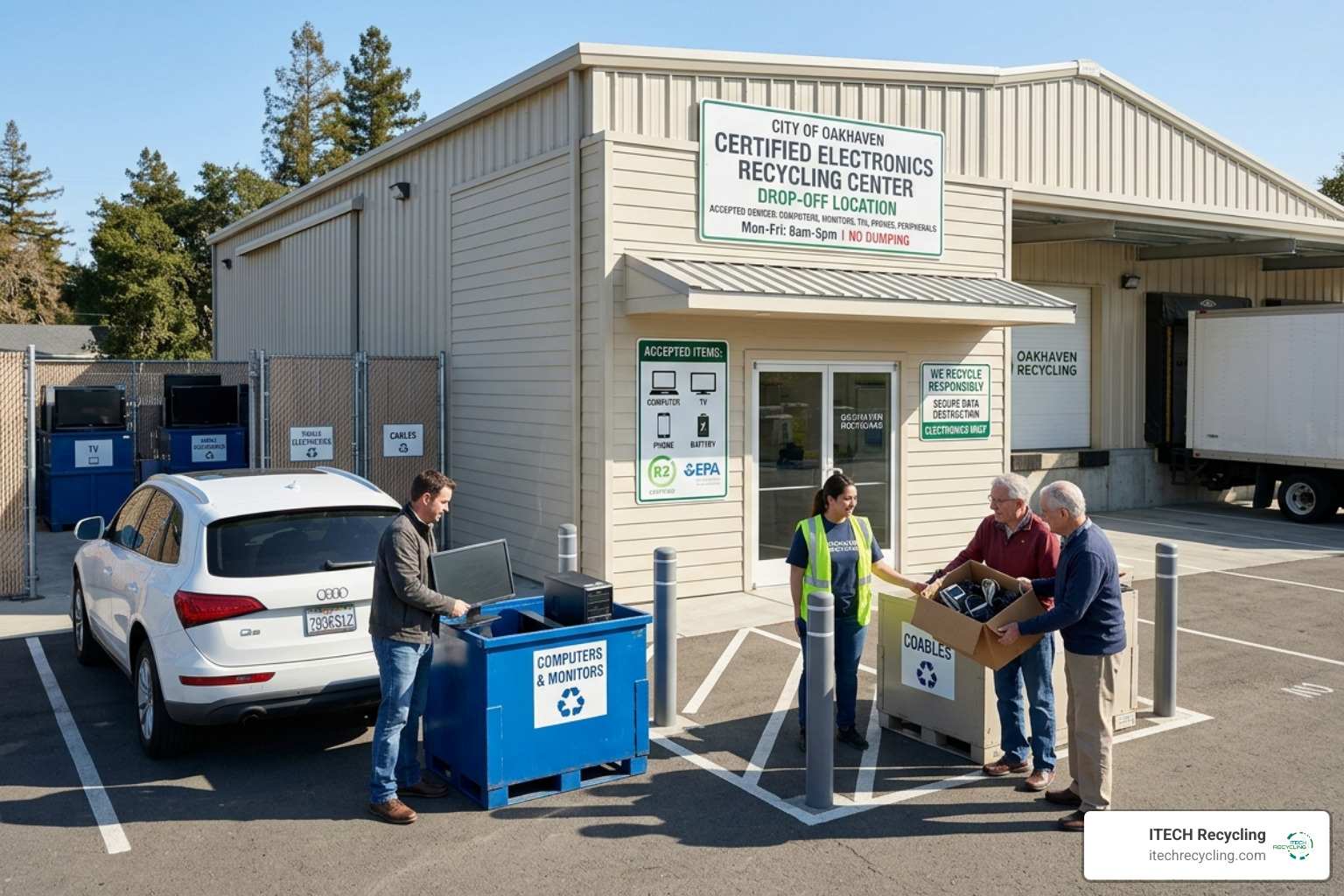
If you live in the Chicago area or suburbs like Wood Dale, Bensenville, or Franklin Park, you are in luck. There are numerous ways to handle your e-waste responsibly.
- ITECH Drop-Off and Events: We host and participate in various recycling events throughout the year. Whether it’s a community drive in Deerfield or a municipal collection in Mundelein, we make it easy to drop off your old tech.
- Retailer Programs: Major chains like Best Buy and Staples often accept a limited number of items per day, such as cables, printers, and some computers. However, they may have restrictions on large items like CRT TVs.
- Manufacturer Take-Back: Companies like Apple, Dell, and HP often have programs where you can mail in your old devices. In some cases, you might even get a gift card if the device still has value.
- Municipal Facilities: Many local governments in the Chicago burbs have dedicated e-waste days. Check your local village website for schedules in places like Elgin, Evanston, or Arlington Heights.
For a comprehensive list of where to go, see our guide on The Best Computer Recycling Drop-Off Spots Near You or explore Where to Ditch Your Tech in the Chicago Burbs. If you have a large load and can’t make it to us, we even offer a Local Pick-Up Service for added convenience.
Options for Large Quantities and Business Assets
Businesses face unique challenges when it comes to how to recycle electronics. Beyond just the environmental impact, there are strict legal requirements like HIPAA and FACTA that govern how customer and employee data must be handled.
This is where IT Asset Disposition (ITAD) comes in. For our corporate partners in Bloomington, Aurora, and Springfield, we provide specialized Electronics Recycling for Businesses in Chicago Area. This includes:
- Bulk Pickup: We come to your office with the right equipment to haul away pallets of servers, monitors, and laptops.
- Asset Recovery: If your equipment is still relatively modern, we can help you recover some of its value through resale, offsetting the cost of your recycling program.
- Certified Reporting: We provide certificates of destruction and recycling, giving you a paper trail for compliance audits.
The Industrial Process: What Happens to Your E-Waste?
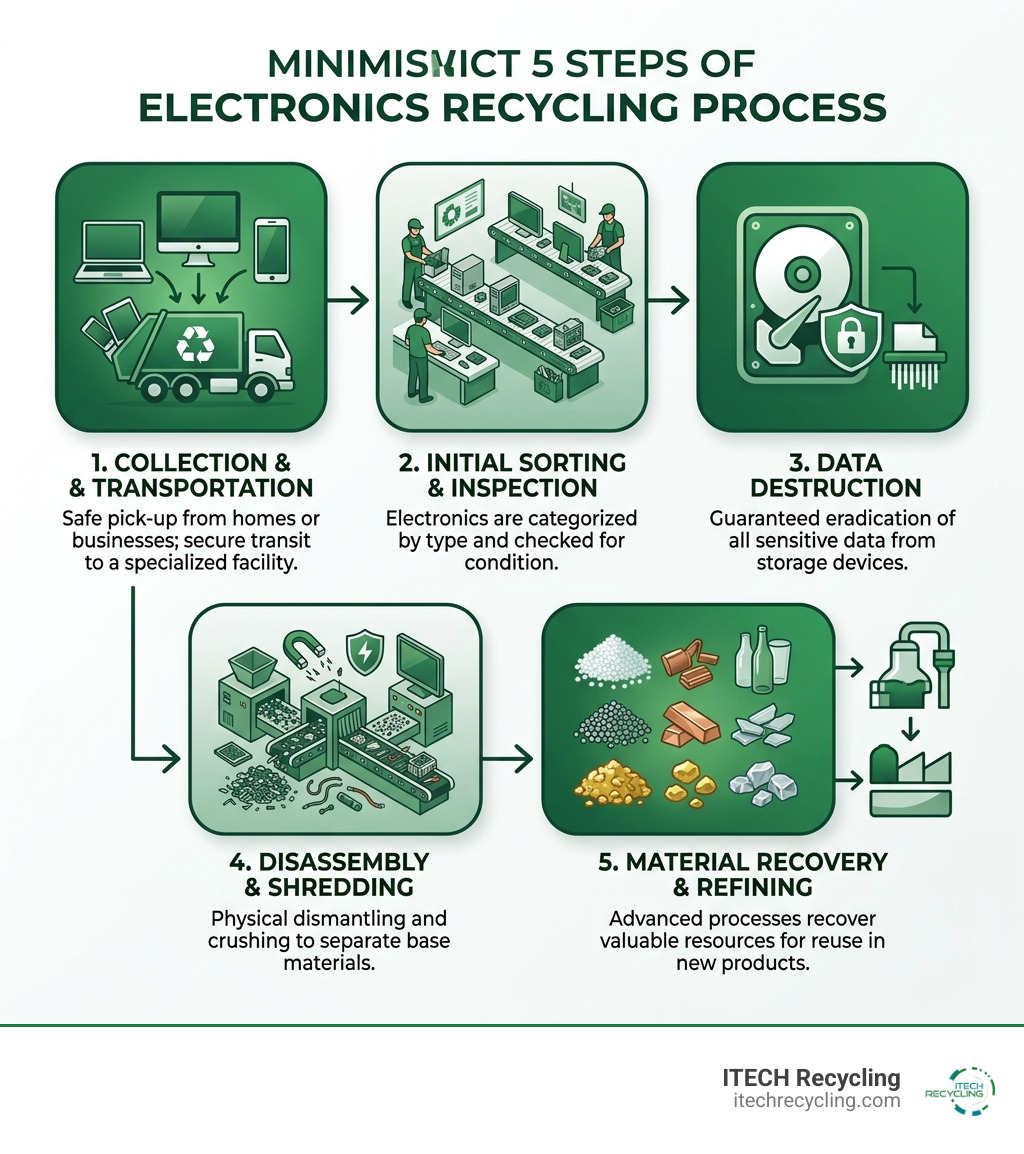
Have you ever wondered what actually happens after you hand over your old laptop? It doesn’t just sit in a room. It goes through a sophisticated, multi-stage industrial journey to ensure every possible resource is reclaimed.
- Collection and Transport: Items are gathered and transported to a specialized facility. At ITECH, we use fuel-efficient routes to keep our own carbon footprint low.
- Manual Disassembly: Before the heavy machinery starts, technicians often pull out high-value or hazardous components by hand. This includes removing batteries, large copper heat sinks, and circuit boards.
- Shredding: The remaining shells are fed into massive shredders. These machines grind everything down into small pieces, usually less than two inches in size. This makes it easier to separate the different materials.
- Dust Extraction: During shredding, a lot of dust is created. Specialized vacuum systems capture this dust to prevent it from escaping into the environment, as it often contains trace amounts of heavy metals.
- Magnetic Separation: The shredded bits move along a conveyor belt under powerful magnets. These magnets pull out “ferrous” metals like steel and iron.
- Water/Air Separation: To separate glass from plastic, we use “tanks” or air sorters. Since plastic and glass have different densities, they can be separated by floating or sinking in water or by being blown into different bins by high-pressure air.
- Rare Earth Extraction: This is the most complex part. The remaining “e-scrap” (mostly circuit boards) is sent to specialized smelters where chemical processes extract gold, silver, and rare earth elements like neodymium.
If you want to see the nitty-gritty details of this fascinating journey, read our full breakdown: What is E-Waste Recycling and How is it Done?.
Frequently Asked Questions About E-Waste Disposal
Can I put electronics in my regular trash or curbside bin?
The short answer is: No.
In Illinois—and 24 other states—it is actually illegal to toss electronics like computers, monitors, and TVs into the trash. This is due to “landfill bans” designed to prevent environmental leaching. Garbage trucks and standard recycling facilities are not equipped to handle the hazardous materials found in e-waste. If you put a laptop in your blue bin, it will likely be pulled out at the sorting center and sent to a landfill anyway, or worse, cause a fire in the truck. For large items, check out How to Recycle Large Electronics – Earth911 for specialized advice.
What certifications should I look for in a recycler?
Not all recyclers are created equal. Some “recyclers” simply ship e-waste overseas to developing nations, where it is burned in open pits to recover copper, releasing toxic fumes. To ensure your tech is handled ethically, look for these certifications:
- R2 (Responsible Recycling): This is the industry standard for operational excellence and environmental safety.
- e-Stewards: This is often considered the “gold standard,” with even stricter rules against exporting waste to non-OECD countries.
Choosing a certified partner ensures that your data is destroyed and your hardware is processed according to the highest global standards. Learn more about R2 and E-Stewards: Navigating the World of Certified Electronics Recycling.
What types of electronics are actually recyclable?
Almost anything with a plug or a battery can be recycled, but some items are easier to process than others. Here is a quick reference table:
| Recyclable Items | Non-Recyclable (Special Handling Required) |
|---|---|
| Computers & Laptops | Smoke Detectors (Radioactive) |
| Smartphones & Tablets | Large Kitchen Appliances (White Goods) |
| Circuit Boards & Motherboards | Light Bulbs (Fluorescent/Incandescent) |
| Monitor & TVs (LCD/LED/CRT) | Thermometers (Mercury) |
| CPUs & RAM | Alkaline Batteries (Regular AA/AAA) |
| Keyboards, Mice, & Cables | Power Tools (with built-in batteries) |
If you are curious about specific components, such as processors, our A Complete Guide to CPU Recycling offers a deep dive into how these tiny chips are reclaimed.
Conclusion
Learning how to recycle electronics is about more than just clearing out your junk drawer or office storage room. It is a vital step toward a sustainable future. By keeping toxic lead and arsenic out of our Illinois soil and reclaiming precious gold and copper, we are protecting both our environment and our economy.
At ITECH Recycling, we are proud to serve the Chicago area—from Elk Grove Village to Bolingbrook and Hawthorn Woods—with responsible, secure, and transparent e-waste solutions. Whether you are a homeowner with one old laptop or a business manager in Vernon Hills with a warehouse full of servers, we have the tools and certifications to handle your disposal needs.
Don’t let your old tech become a toxic legacy. Learn more about our professional electronics recycling services today and join us in making the Chicago area a leader in sustainability. Together, we can ensure that every device has a responsible “end-of-life” and that our valuable resources are never truly wasted.
 Prev
Prev