

Don’t be a Circuit Breaker: How to Recycle Tech in Chicago
Why Recycling Electronics in Chicago Matters More Than You Think
Recycling electronics in Chicago is something every resident and business needs to know how to do — and do right.
Here’s a quick overview of your main options:
| Option | Who It’s For | Cost |
|---|---|---|
| City facility at 1150 N. North Branch St. | Chicago residents only | Free |
| Seasonal city drop-off events (April–January) | Chicago residents only | Free |
| Certified private recyclers (e.g., ITECH Recycling) | Residents and businesses | Free or varies |
| University of Chicago campus drop-off | UChicago affiliates | Free |
Old electronics don’t just take up space. They contain lead, mercury, and cadmium — toxic materials that can leach into soil and water when dumped in a landfill. And in Illinois, throwing electronics in the trash isn’t just a bad idea. It’s illegal.
The state’s Electronics Recycling Act bans landfill disposal of e-waste entirely. Violations can trigger fines starting at $7,000 and climbing into the tens of thousands.
Yet many Chicagoans — and businesses — still aren’t sure where to start.
That’s exactly what this guide fixes. Whether you’re clearing out a home office or managing IT equipment for an organization, you’ll find clear, actionable steps here.
At ITECH Recycling, we have spent years helping Chicago residents and businesses navigate recycling electronics in Chicago through secure, compliant, and sustainable solutions. This guide walks you through everything you need to know — from legal requirements to protecting your personal data before drop-off.
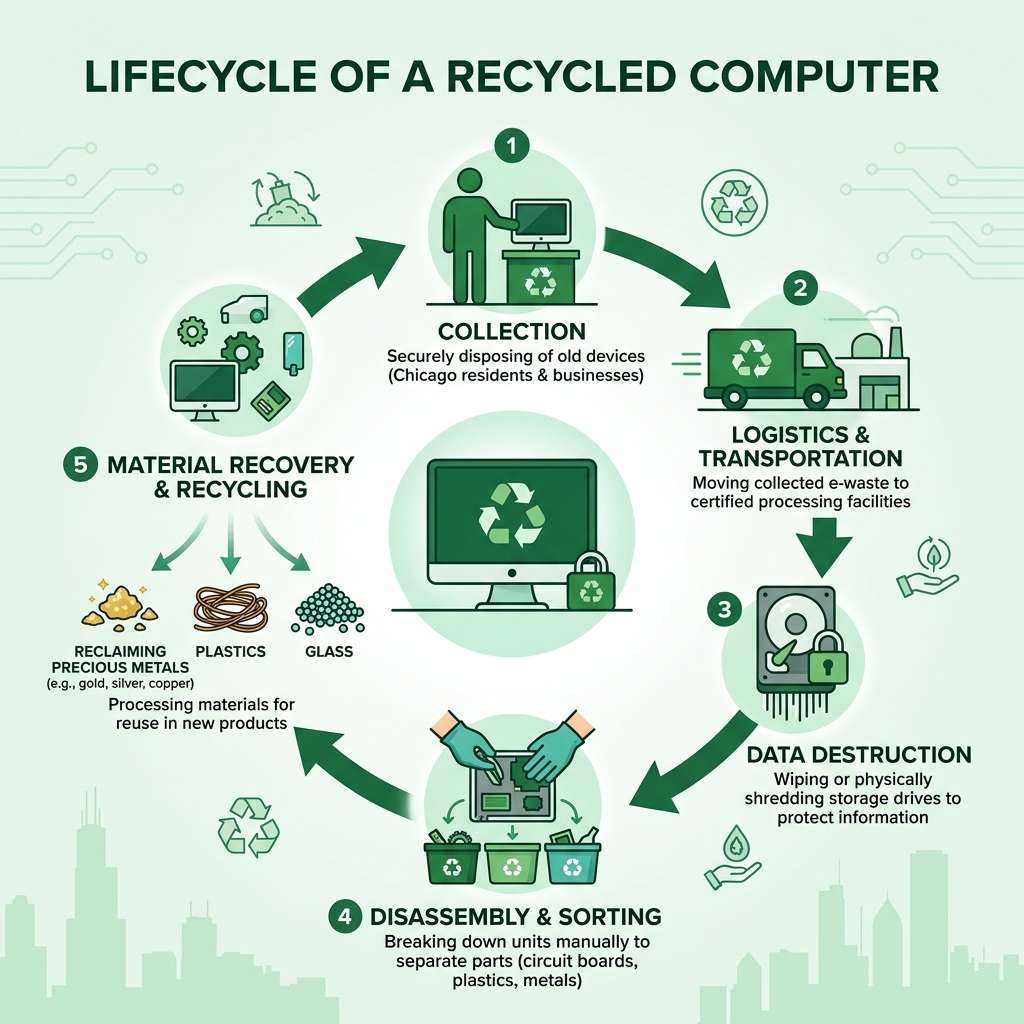
Know your recycling electronics in chicago terms:
Legal Requirements for Recycling Electronics in Chicago
Navigating the legal landscape of recycling electronics in Chicago might feel like trying to program a VCR in 1985, but it is actually quite straightforward once you know the rules. In Illinois, we operate under the Electronics Recycling – Illinois Environmental Protection Agency guidelines, specifically the Illinois Electronics Recycling Act.
This law isn’t just a suggestion; it’s a strict mandate designed to keep hazardous materials out of our communal backyard. Electronics are packed with substances that are great for conducting electricity but terrible for human health. We’re talking about:
- Lead: Found in CRT glass and solder, which can cause neurological damage.
- Mercury: Common in flat-screen backlights and switches, known to harm the nervous system.
- Cadmium: Used in battery contacts and coatings, posing a risk to kidney and bone health.
Because of these risks, Illinois has a total landfill ban on most consumer electronics. This means you cannot simply toss your old laptop into the blue bin or the alley dumpster.
Understanding the Illinois Landfill Ban
The core of the legal framework is section 415 ILCS 150/80 of the Illinois Compiled Statutes. This act specifically prohibits “electronic products” from being disposed of in any landfill in the state. The goal is 100% compliance to prevent toxic chemicals from reaching our groundwater. When electronics sit in a landfill, the outer casings eventually crack, allowing rain to wash those heavy metals into the soil—a process called leaching. By choosing professional recycling electronics in Chicago, you ensure these materials are captured and neutralized.
Penalties for Improper Disposal
If the environmental guilt isn’t enough to sway someone, the financial sting usually is. The state doesn’t take these violations lightly. Fines for improper disposal can range from $7,000 to tens of thousands of dollars per violation. Local ordinances in Chicago often mirror these state-level penalties, making it an expensive mistake to “sneak” a monitor into the trash. For businesses, the stakes are even higher, as regulatory bodies often perform audits to ensure that corporate e-waste is being handled by certified recyclers.
| Rule Category | Residential Disposal | Commercial/Business Disposal |
|---|---|---|
| Primary Goal | Keep household toxins out of landfills. | Ensure data security & regulatory compliance. |
| City Facility Access | Allowed at 1150 N. North Branch St. | Prohibited at city-run residential sites. |
| Documentation | Generally not required for individuals. | Requires Certificates of Destruction/Recycling. |
| Cost | Usually free at city drop-offs. | Varies based on volume and data security needs. |
Where to Go: Chicago’s Permanent and Seasonal Drop-Off Locations
Knowing you must recycle is one thing; knowing where to go is another. For those of us living in the Windy City, we have several reliable avenues. At ITECH Recycling, we provide comprehensive electronics recycling for businesses in Chicago area and residents, focusing on making the process as seamless as possible.
City of Chicago Household Chemicals & Computer Recycling Facility (HCCRF)
The “North Star” for residential recycling in the city is the permanent facility located at 1150 N. North Branch Street. This site is situated two blocks east of the Kennedy Expressway at Division Street. It’s a specialized facility that separates drop-offs into two areas: a “blue” building for household chemicals and a “yellow” building for electronics.
Operational Hours for HCCRF:
- Tuesdays: 7:00 a.m. – 12:00 p.m.
- Thursdays: 2:00 p.m. – 7:00 p.m.
- First Saturday of every month: 8:00 a.m. – 3:00 p.m.
Seasonal Collection Events
If you can’t make it to North Branch Street, the city hosts a Chicago residential electronics recycling program guide that includes seasonal events. These typically run from April 1st through January 31st.
These events are held at various locations like Ravenswood Ave, Wilson Ave, and Vincennes. However, there are a few “pro-tips” to remember:
- Truck Capacity: These events operate on a “first-come, first-served” basis. Once the collection trucks are full, they stop accepting items for the day.
- Stay in Your Car: For safety and efficiency, attendants usually ask you to remain in your vehicle while they unload the items from your trunk.
- No After-Hours Dumping: Leaving electronics outside a facility when it’s closed is considered illegal dumping.
For more details on the rotating schedule, you can check the Official City of Chicago e-waste info.
Accepted Items for Recycling Electronics in Chicago
Not everything with a cord is accepted at city facilities. To avoid a wasted trip, make sure your items fall into these categories:
- Computers & Peripherals: Desktops, laptops, keyboards, mice, and small-scale servers.
- Monitors: Both old-school CRT “bricks” and modern flat screens.
- Entertainment: TV recycling guide materials, including VCRs, DVD players, and video game consoles.
- Communication: Cell phones, fax machines, and portable digital music players.
- Office Tech: Printers, scanners, and digital converter boxes.
Prohibited Items at City Facilities
City-run sites are strictly for residential use. If you show up with a van full of office equipment from your 50-employee startup, you will be turned away. Additionally, these sites generally do not accept:
- Large Appliances: No refrigerators, stoves, or washing machines.
- Business Waste: Any electronics generated by a commercial entity.
- Alkaline Batteries: While some facilities take specialized batteries, standard AA or AAA alkaline batteries are often excluded (though we recommend double-checking current city guidelines via 311).
Protecting Your Privacy: How to Prepare Devices for Disposal
One of the biggest hurdles to recycling electronics in Chicago is the fear of data theft. Dropping off an un-wiped laptop can feel like leaving your diary on a park bench in Millennium Park. We take data security very seriously at ITECH, and you should too.
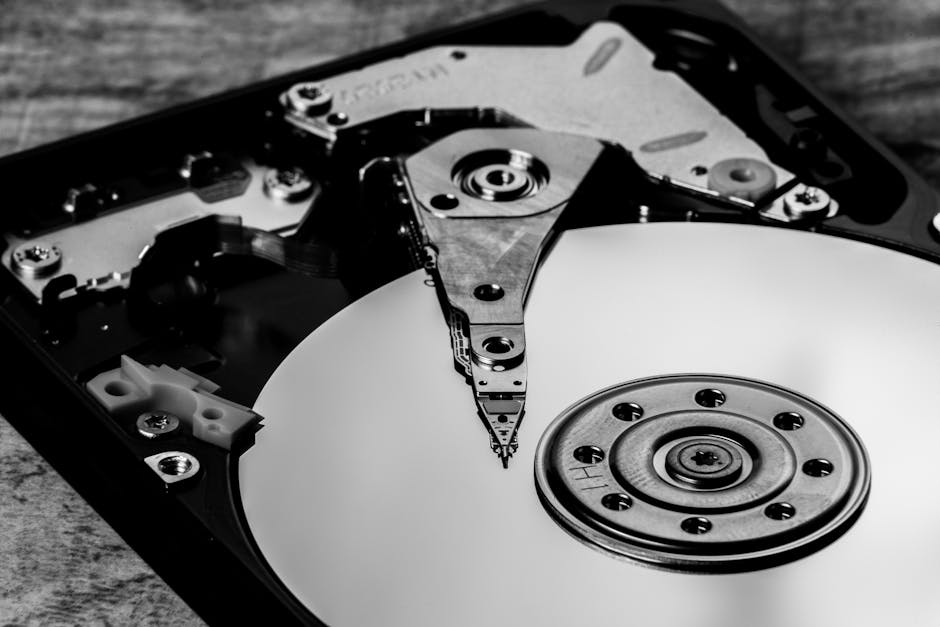
Before you hand over your device, you need to ensure your “digital ghost” isn’t still haunting the hardware.
Steps to Secure Your Digital Footprint
Simply hitting “delete” or dragging files to the trash icon doesn’t actually erase the data; it just tells the computer that the space is available to be written over. To truly protect yourself, follow these steps:
- Back Up Your Data: Move your photos and documents to a cloud service or an external hard drive.
- Sign Out of Everything: De-authorize your computer from accounts like iTunes, Microsoft 365, and Adobe Creative Cloud.
- Perform a Factory Reset: Most modern smartphones and laptops have a “Reset this PC” or “Erase all Content and Settings” option.
- Use Software Wiping: For higher security, use tools that meet NIST 800-88 standards. These programs overwrite your entire drive with random patterns of 1s and 0s, making data recovery virtually impossible.
- Physical Shredding: For non-functional devices where you can’t run software, physical destruction is the only answer. At ITECH, we offer secure data destruction in Chicago, IL to ensure your information is gone for good.
Handling Non-Functional Hardware
What if the computer won’t even turn on? You can’t perform a factory reset on a brick. In these cases, we recommend:
- Removing the Hard Drive: If you’re tech-savvy, unscrew the casing and pull the drive out. You can then have it physically crushed or shredded.
- Hard Drive Punching: This involves driving a steel bolt through the platters of the drive, rendering it unreadable.
- Component Recovery: Even if a device is dead, the circuit boards and precious metals inside are still valuable. Don’t let a “dead” device stop you from recycling; the raw materials are what we are after!
Beyond the Bin: Business Solutions and Environmental Impact
While residential recycling is vital, the volume of e-waste generated by the business sector in Chicago is massive. From the Loop to the suburbs like Wood Dale and Elk Grove Village, companies are constantly upgrading their tech stacks. This is where IT asset disposition in Chicago, IL becomes a critical business operation.
Commercial e-waste requires a different level of care. Businesses must worry about HIPAA compliance, FACTA, and protecting proprietary trade secrets. We provide specialized business recycling services that include serial number tracking and official Certificates of Destruction, which are essential for your annual audits.
The Benefits of Recycling Electronics in Chicago Responsibly
When we talk about the “benefits,” we aren’t just talking about a cleaner garage. We are talking about massive resource recovery.
Consider these staggering statistics:
- Energy Savings: Recycling just one million laptops saves enough energy to power 3,500 American homes for an entire year.
- Precious Metals: Every year, recycling one million mobile phones allows us to recover 800 pounds of silver, 30,000 pounds of copper, 70 pounds of gold, and 30 pounds of palladium.
- Material Recovery: At certified facilities like ours, roughly 99% of electronic material processed gets recycled and turned into brand-new products.
- Zero Landfill Policy: Our commitment to a zero-landfill policy means that nothing—from the plastic casing to the glass in the monitor—ends up in a hole in the ground.
By participating in recycling electronics in Chicago, you are essentially participating in an urban mining operation. Instead of digging new holes in the earth for raw ores, we are reclaiming them from the devices we already have.
Frequently Asked Questions about Chicago E-Waste
Is electronics recycling free for Chicago residents?
Yes! For residents, dropping off household electronics at the 1150 N. North Branch Street facility or at city-sponsored seasonal events is completely free. These programs are funded by the city to encourage proper disposal. However, if you require specialized services like on-site data destruction or business-scale pickups, there may be associated costs.
Where can I recycle specific items like CFL bulbs and batteries?
The Household Chemicals & Computer Recycling Facility (HCCRF) on North Branch Street is your best bet for CFL bulbs (which contain small amounts of mercury) and rechargeable batteries. For standard alkaline batteries, many hardware stores like Home Depot offer collection bins, though the city facility focus is primarily on hazardous types like lead-acid or lithium-ion.
Can businesses use the city’s North Branch facility?
No. The HCCRF is strictly for residential waste. Businesses, schools, and non-profits must partner with a private, certified recycler. This ensures that commercial volumes don’t overwhelm city resources and that businesses receive the proper legal documentation (like a Certificate of Destruction) that the city facility does not provide.
Conclusion
At the end of the day, recycling electronics in Chicago is about more than just following the law—it’s about protecting our community and our future. Whether you are a resident in Lincoln Park or a business owner in the Loop, the choices you make with your old tech have a ripple effect.
By choosing a partner like ITECH Recycling, you ensure that your data is destroyed with military-grade precision, your business stays compliant with Illinois law, and your old “junk” is transformed back into valuable resources. We serve the entire Chicagoland area, including Wood Dale, Bensenville, Franklin Park, and beyond, providing the IT asset disposition Chicago services you need to retire your tech without the stress.
Don’t let your old devices become a “circuit breaker” for the environment. Take a moment to clear out that “junk drawer” and visit a certified facility today. If you want to dive deeper into why this matters, check out our guide on why electronics recycling in Chicago is important. Together, we can keep Chicago green, one motherboard at a time.
 Prev
Prev